
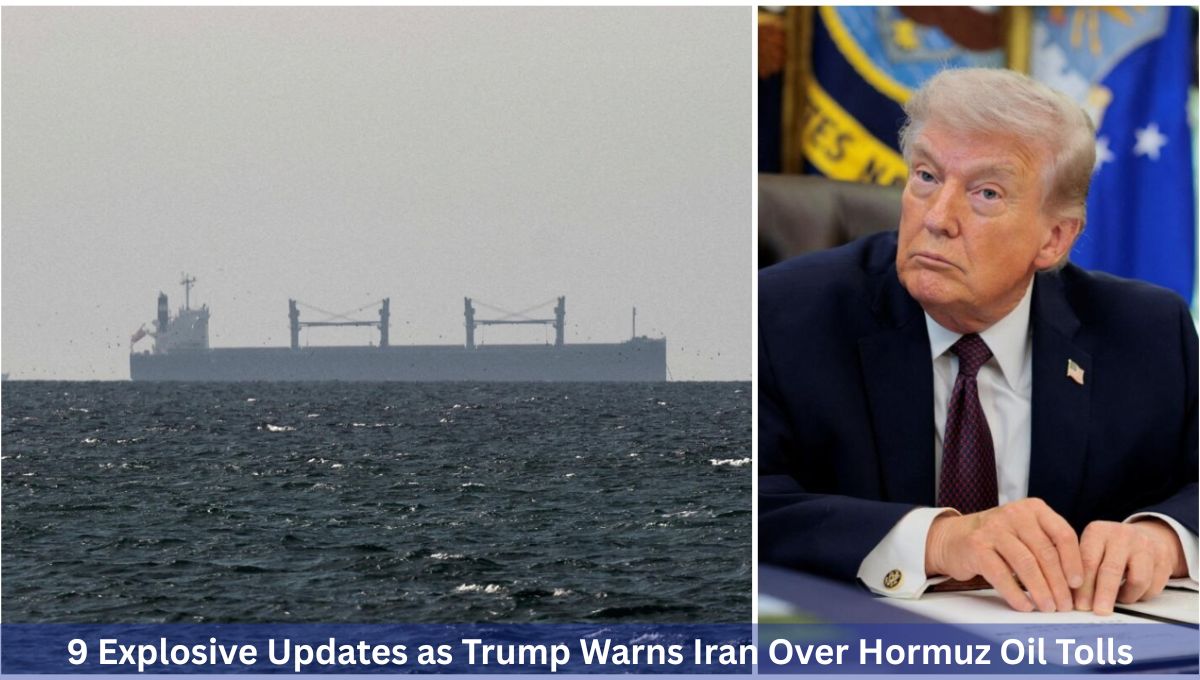
9 Explosive Updates as Trump Warns Iran Over Hormuz Oil Tolls amid a fragile ceasefire. The fragile ceasefire between the United States and Iran is facing renewed pressure after US President Donald Trump issued a sharp warning to Tehran over reports that it may be charging oil tankers for passage through the Strait of Hormuz.
In a series of posts on Truth Social, Trump cautioned that Iran “better stop now” if it is indeed imposing fees on vessels navigating one of the world’s most critical energy chokepoints.
The remarks have added fresh uncertainty to an already volatile geopolitical situation, raising concerns about global oil flows and economic stability.
The Strait of Hormuz, a narrow maritime corridor connecting the Persian Gulf to the Arabian Sea, is responsible for transporting roughly 20% of the world’s oil supply.
Any disruption to traffic through this route has immediate and far-reaching consequences for global markets.
9 Explosive Updates as Trump Warns Iran Over Hormuz Oil Tolls
Trump’s Direct Warning to Iran
Donald Trump’s comments came in response to reports suggesting that Iran is planning to charge transit fees to oil tankers passing through the Strait of Hormuz.
“There are reports that Iran is charging fees to tankers going through the Hormuz Strait — They better not be and, if they are, they better stop now!” Trump wrote.
In subsequent posts, Trump escalated his rhetoric, accusing Iran of mishandling oil transit through the strait and violating the terms of the recently agreed ceasefire.
“Iran is doing a very poor job, dishonorable some would say, of allowing oil to go through the Strait of Hormuz. That is not the agreement we have!” he added.
Trump also asserted that oil would begin flowing “very quickly, with or without the help of Iran,” although he did not provide specifics on how this would be achieved.
The Strait of Hormuz: Why It Matters
The Strait of Hormuz is widely regarded as one of the most strategically important waterways in the world.
- It handles nearly one-fifth of global oil shipments
- It serves as a vital route for liquefied natural gas exports
- It connects major oil-producing nations in the Gulf to global markets
Even minor disruptions in this narrow passage can send shockwaves through energy markets.
Since the outbreak of the current conflict on February 28, vessel traffic through the strait has been severely restricted.
Reports indicate that only a fraction of the usual number of ships are currently able to pass through safely.
Hundreds of tankers remain stranded, with shipping companies reluctant to risk transit amid fears of attack or detention.
Iran’s Reported Plan to Charge Oil Tolls
According to multiple reports, Iran is considering imposing transit fees on ships moving through the Strait of Hormuz.
Key details include:
- A proposed fee of approximately $1 per barrel of oil
- Payments potentially required in cryptocurrency
- Enhanced monitoring of vessels passing through the strait
Iranian officials have indicated that such measures could help the country maintain control over the waterway during the ceasefire period.
They have also suggested that the funds could be used for reconstruction following damage sustained during the conflict.
However, the proposal has sparked strong opposition from Western governments, which argue that international maritime law guarantees free navigation through such critical waterways.
A Fragile Ceasefire Under Pressure
The controversy over tanker tolls comes just days after the United States and Iran agreed to a two-week ceasefire aimed at de-escalating hostilities.
Under the terms of the agreement:
- Both sides committed to halting direct military actions
- Iran was expected to allow the safe reopening of the Strait of Hormuz
- Diplomatic talks were scheduled to begin shortly
However, the situation on the ground suggests that the ceasefire remains highly unstable. Despite official claims that the strait is “open,” actual shipping activity tells a different story.
Vessel traffic remains well below normal levels, indicating that fears and uncertainties continue to deter operators.
Oil Markets React to Rising Uncertainty
Global energy markets have responded sharply to the ongoing tensions.
- Oil prices have surged toward $100 per barrel
- Supply chains remain disrupted
- Market volatility has increased significantly
The uncertainty surrounding Hormuz has made traders particularly sensitive to geopolitical developments. Even small shifts in the situation can trigger large price movements.
Analysts warn that sustained disruption could lead to prolonged energy shortages and higher costs for consumers worldwide.
Trump’s Confidence vs Market Realities
While Trump has expressed confidence that oil flows will resume quickly, analysts remain cautious.
The US president’s assertion that oil will flow “with or without Iran” raises several questions:
- Will alternative shipping routes be used?
- Could military escorts be deployed for tankers?
- Is diplomatic pressure expected to force Iran’s compliance?
Without clear answers, markets remain uncertain.
Experts note that restoring normal shipping levels will require more than political statements—it will depend on tangible improvements in security and trust.
Maritime Security Concerns Intensify
One of the biggest challenges facing the region is ensuring the safety of vessels navigating the Strait of Hormuz.
Shipping companies and crews are currently dealing with:
- Threats of interception or attack
- Unclear navigation guidelines
- Rising insurance costs
Nearly 20,000 mariners are reported to be stranded in the Persian Gulf, unable to safely complete their journeys.
This situation highlights the broader risks associated with the crisis, extending beyond geopolitics to human and operational challenges.
Iran’s Strategic Leverage
Iran’s control over the Strait of Hormuz gives it significant strategic leverage in the current conflict.
By restricting or conditioning access to the waterway, Tehran can:
- Influence global oil prices
- Apply pressure on Western economies
- Strengthen its negotiating position
Iranian leadership has indicated that control over Hormuz will remain a key component of its strategy during ongoing negotiations.
Officials have also framed their actions as a legitimate exercise of sovereignty, despite international criticism.
Global Reactions to the Crisis
The international community has responded with growing concern.
Western leaders have:
- Rejected the idea of paying transit fees
- Called for the immediate reopening of the strait
- Urged restraint from all parties
Energy-importing nations are particularly worried about the potential economic impact.
Prolonged disruption could affect industries, transportation, and household energy costs worldwide.
The Role of Diplomacy
Efforts to resolve the crisis are ongoing, with diplomatic talks expected to play a crucial role.
Upcoming negotiations between the United States and Iran are seen as a key opportunity to:
- Clarify ceasefire terms
- Address disputes over maritime access
- Establish mechanisms for long-term stability
However, the success of these talks will depend on both sides’ willingness to compromise.
Israel and Regional Spillover Risks
The broader regional context further complicates the situation.
Ongoing military actions involving Israel, Iran, and Lebanon have heightened tensions across the Middle East.
These developments increase the risk that the Hormuz crisis could escalate into a wider conflict, with potentially devastating consequences.
Economic Impact Beyond Oil
While oil markets are at the center of the crisis, the economic implications extend much further.
- Shipping delays are affecting global trade
- Insurance premiums for maritime transport have surged
- Supply chains for critical goods are under strain
These factors contribute to a broader economic ripple effect, impacting industries far beyond the energy sector.
What Happens Next?
The coming days will be critical in determining the trajectory of the crisis.
Several scenarios are possible:
1. De-escalation Through Diplomacy
Successful negotiations lead to the reopening of the Strait of Hormuz and stabilization of oil markets
2. Continued Tensions
Partial improvements occur, but uncertainties persist, keeping markets volatile
3. Escalation
Breakdown of the ceasefire results in renewed conflict and severe disruption to global energy supplies
Conclusion: A Critical Moment for Global Stability
Donald Trump’s warning to Iran over potential tanker tolls has added a new layer of tension to an already fragile situation.
At stake is not just a regional dispute, but the stability of global energy markets and the broader international economy.
The Strait of Hormuz remains a vital artery for the world’s oil supply, and any prolonged disruption could have far-reaching consequences.
As diplomatic efforts continue, the world will be watching closely to see whether cooperation or confrontation ultimately prevails.
For now, uncertainty remains the defining feature of the crisis—with global markets, governments, and millions of people awaiting clarity on what comes next.
Also Read: 10 Explosive Updates on Iran Bridge Strike as Trump Warns ‘More to Follow’
Also Read: Trump warns Iran on Hormuz tolls as frozen traffic spurs Japan to release more oil
Related Posts:
- 11 Explosive Warnings as Trump Vows to ‘Knock the…

- 10 Explosive Warnings as Donald Trump Calls Iran…
- 12 Explosive Claims as Donald Trump Says Iran War…
- 10 Explosive Signals Trump Says Iran War Could End…
- Trump's 3 Blunt Warnings to China and Russia Over…
- Trump’s 2025 Gaza Peace Plan Signing and Historic…
