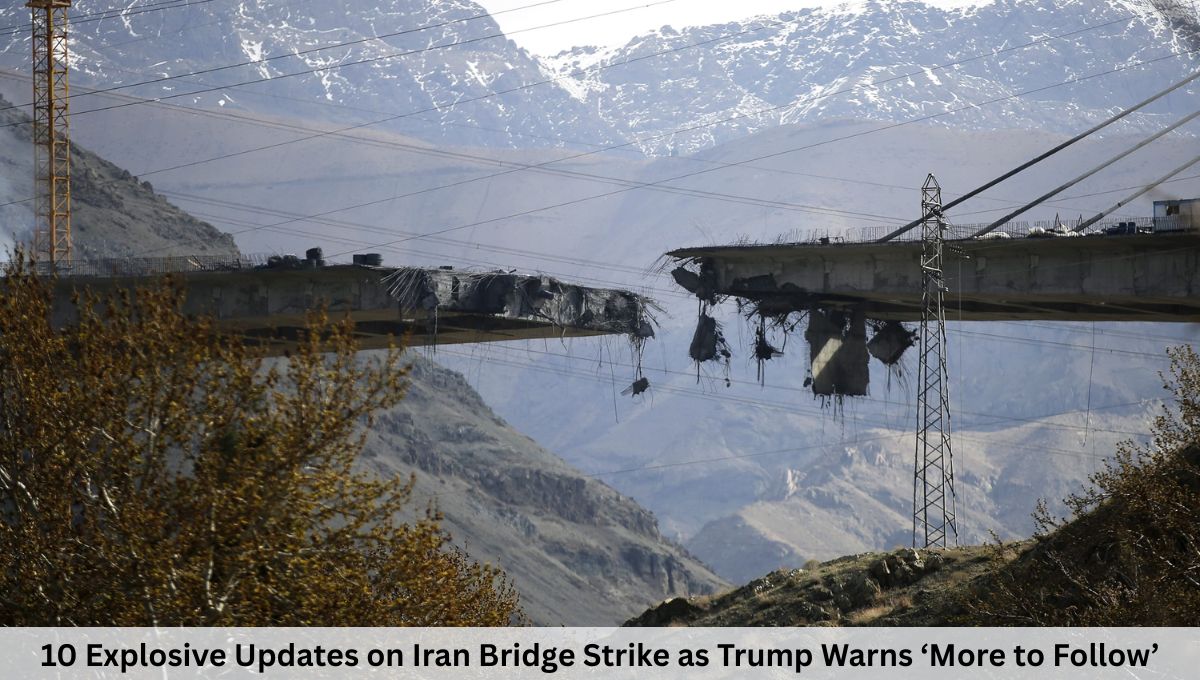
10 Explosive Updates on Iran Bridge Strike as Trump Warns ‘More to Follow’ — tensions escalate across the Middle East. The ongoing Middle East conflict has entered a dangerous new phase following the reported destruction of a major bridge near Iran’s capital.
Thank you for reading this post, don't forget to subscribe!The strike, which allegedly targeted a key infrastructure project linking Tehran to Karaj, has intensified geopolitical tensions and raised fears of a broader regional war.
The incident comes amid increasingly aggressive rhetoric from US President Donald Trump, who warned Iran that “much more” military action could follow unless a deal is reached soon.

10 Explosive Updates on Iran Bridge Strike as Trump Warns ‘More to Follow’
Bridge Collapse: What Happened in Karaj
A massive highway bridge, identified as the B1 bridge in Karaj, was partially destroyed following reported airstrikes.
The structure, still under construction, was considered one of the tallest in the Middle East, standing approximately 136 meters high.
The bridge was designed to connect Tehran with northern and western regions, playing a crucial role in improving trade and transport infrastructure.
Stretching over a kilometer, the project was valued at nearly $400 million and was seen as a symbol of modern engineering progress in Iran.
Eyewitness footage circulating online shows thick smoke rising from the site, followed by sections of the bridge collapsing dramatically.
Casualties and Damage Reports Rise
Initial reports suggested limited casualties, but the toll has since risen significantly.
According to Iranian state media:
- 8 people were killed
- At least 100 people were injured
- Several emergency responders were caught in secondary strikes
Authorities claim that the second wave of attacks occurred while rescue teams were already deployed, compounding the damage and chaos on the ground.
In addition to the bridge, nearby infrastructure and surrounding areas also sustained heavy damage.
Trump’s Warning: ‘More to Follow’
Donald Trump publicly reacted to the strike by sharing footage of the collapsing bridge on social media.
In a strongly worded message, he declared:
“The biggest bridge in Iran comes tumbling down, never to be used again — much more to follow!”
He also issued a direct ultimatum to Tehran, urging Iranian leaders to negotiate before it is “too late.”
In a broader statement, Trump emphasized that the United States would intensify its military operations over the coming weeks if Iran does not comply with demands for a deal.
Conflicting Claims Over Responsibility
Despite Trump’s remarks suggesting US involvement, official confirmation remains unclear:
- No country has formally claimed responsibility for the strike
- Israeli defense officials reportedly denied knowledge of the operation
- Some reports attribute the attack to joint US-Israeli action
This ambiguity has added another layer of complexity to an already volatile situation, making it difficult to verify the exact sequence of events.
Iran’s Response: Defiance and Retaliation
Iranian officials have strongly condemned the attack, calling it a deliberate strike on civilian infrastructure.
Foreign Minister Abbas Araghchi stated that such actions would not force Iran into submission.
Instead, he framed the attack as evidence of “moral collapse” by adversaries and vowed that damaged infrastructure would be rebuilt stronger.
Meanwhile, Iran has escalated its own military actions:
- Missile launches targeting Israel and Gulf states
- Drone attacks on US-linked assets in the region
- Continued threats to strategic maritime routes
Strategic Importance of the Bridge
The B1 bridge was more than just a construction project—it was a key component of Iran’s regional connectivity strategy.
Key Features of the Bridge:
- Height: 136 meters
- Length: Over 1,000 meters
- Location: Karaj, west of Tehran
- Purpose: Enhance trade routes and reduce congestion
Its destruction represents not only a physical setback but also a symbolic blow to Iran’s infrastructure ambitions.
Strikes on Additional Targets
The bridge was not the only reported target.
Iranian authorities claim that multiple sites were hit during the latest wave of strikes, including:
1. Medical Infrastructure
A historic research facility in Tehran, identified as the Pasteur Institute, reportedly suffered significant damage.
2. Industrial Sites
Steel plants and other industrial facilities were also targeted, raising concerns about long-term economic disruption.
3. Military Installations
Earlier strikes reportedly hit missile bases and strategic defense locations.
These coordinated attacks suggest a broader strategy aimed at weakening Iran’s critical infrastructure.
Rising Regional Tensions
The conflict is no longer confined to Iran alone. The broader Middle East is increasingly being drawn into the crisis.
Key Developments:
- Iran launched missiles toward Israel and Gulf nations
- Drone activity reported near US military bases in Iraq and Jordan
- Yemen-linked missile launches toward Israeli territory
The situation has created a multi-front conflict with the potential for rapid escalation.
Impact on Global Energy Markets
One of the most significant global consequences of the conflict has been its effect on energy markets.
Oil Prices Surge
- Prices jumped above $100 per barrel
- Increased volatility due to fears over supply disruptions
Strait of Hormuz Concerns
Iran’s strategic control over the Strait of Hormuz—through which about 20% of global oil passes—has become a major leverage point.
Any disruption to this route could have severe consequences for global economies, particularly energy-dependent nations.
Diplomatic Pressure and Global Reactions
World leaders and international organizations have expressed growing concern over the escalating conflict.
United Nations Warning
UN Secretary-General António Guterres warned that the situation risks spiraling into a wider war with “catastrophic global implications.”
Calls for De-escalation
Several countries have urged immediate ceasefire talks and diplomatic engagement to prevent further escalation.
Western Strategy
The United States appears to be balancing military pressure with diplomatic signaling, pushing Iran toward negotiations while continuing operations.
Trump’s Broader Strategy
Trump’s statements suggest a dual-track approach:
1. Military Pressure
- Intensified strikes targeting infrastructure
- Threats to destroy power plants and energy facilities
2. Negotiation Push
- Repeated calls for Iran to “make a deal”
- Framing military actions as leverage for diplomacy
This strategy aims to force Iran into concessions while maintaining a strong show of force.
Humanitarian Concerns Grow
Beyond geopolitics, the human cost of the conflict continues to rise.
Key Issues:
- Civilian casualties from infrastructure strikes
- Damage to hospitals and research centers
- Displacement and disruption of daily life
Human rights organizations have raised concerns about attacks on civilian infrastructure, which could violate international law.
Information Challenges and Uncertainty
Accurate information remains difficult to obtain due to:
- Internet restrictions within Iran
- Conflicting reports from different sources
- Limited independent verification
This uncertainty complicates global understanding of the situation and increases the risk of misinformation.
What Comes Next?
The situation remains highly volatile, with several possible scenarios:
1. Escalation
Further strikes and retaliation could lead to a broader regional war.
2. Negotiation
Increased pressure may push Iran toward diplomatic talks.
3. Prolonged Conflict
A drawn-out war of attrition with significant global consequences.
Conclusion: A Critical Turning Point
The destruction of the Karaj bridge marks a significant escalation in the Iran conflict.
With rising casualties, intensifying rhetoric, and expanding military actions, the region stands at a critical crossroads.
Trump’s warning that “more is to follow” underscores the seriousness of the situation, while Iran’s defiant response signals that tensions are far from easing.
As global powers watch closely, the coming weeks could determine whether the crisis moves toward resolution—or spirals into a much larger conflict with worldwide repercussions.
Also Read: 7 Explosive Signals as Donald Trump Eyes Iran Oil Seizure and Kharg Island Strike
Also Read: Iran’s Chilling ‘Hit List’: Eight Gulf Bridges Marked as War Escalates
Related Posts:
- 11 Explosive Warnings as Trump Vows to ‘Knock the…

- 10 Explosive Warnings as Donald Trump Calls Iran…
- 12 Explosive Claims as Donald Trump Says Iran War…
- 10 Explosive Signals Trump Says Iran War Could End…
- 10 Explosive Signals: Trump Rates Iran War “15/10”…
- 3 Explosive Conditions Iran Sets to End War with US…