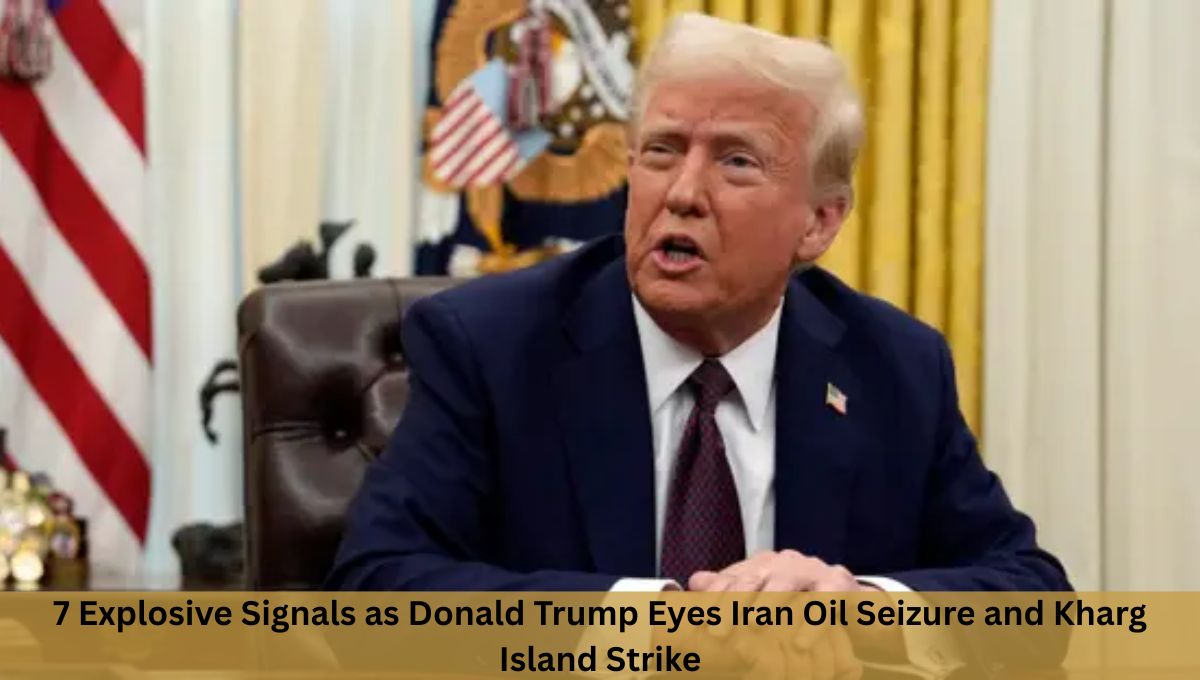
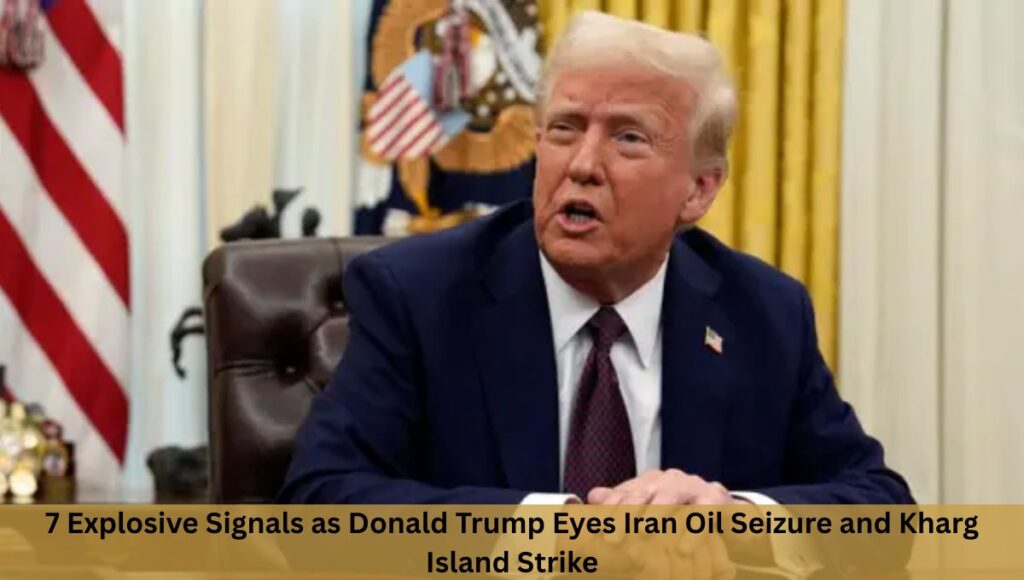
7 Explosive Signals as Donald Trump Eyes Iran Oil Seizure and Kharg Island Strike amid war escalation. The ongoing conflict between the United States and Iran has entered a dangerous new phase, with Donald Trump openly floating the idea of seizing Iran’s oil assets — including the strategically vital Kharg Island.
As the war stretches into its fifth week, Trump’s remarks have triggered alarm among military analysts, energy experts, and global policymakers.
His statements suggest a potential shift from targeted strikes to high-risk ground operations that could reshape not just the Middle East, but the global economic order.
This article breaks down the latest developments, strategic calculations, and the far-reaching implications of what could become one of the most consequential escalations in modern geopolitical history.
7 Explosive Signals as Donald Trump Eyes Iran Oil Seizure and Kharg Island Strike
A Bold and Controversial Proposal
In a striking interview, Trump stated that his “preference” would be to “take the oil in Iran”, a remark that signals a dramatic escalation in US war aims.
He went further, suggesting that the US could seize Kharg Island — Iran’s primary oil export terminal — stating:
“Maybe we take Kharg Island, maybe we don’t. We have a lot of options.”
This marks one of the clearest indications yet that Washington is considering direct control over Iranian economic infrastructure, rather than merely degrading military capabilities.
Why Kharg Island Matters So Much
The Heart of Iran’s Oil Economy
Kharg Island is not just another geographic location — it is the backbone of Iran’s energy exports.
- Handles around 90% of Iran’s crude oil exports
- Located in the northern Persian Gulf
- Serves as a key node connecting pipelines to global shipping routes
Control over Kharg would effectively give the United States leverage over Iran’s economic lifeline.
A Global Energy Chokepoint
The island’s importance is magnified by its proximity to the Strait of Hormuz — a narrow maritime corridor through which:
- Nearly 20% of global oil supply passes
- Major economies depend on uninterrupted flow
Any disruption here sends immediate shockwaves through global markets.
Trump’s “Gift” Claim and Ghalibaf’s Role
Trump also made a controversial claim involving Mohammad Bagher Ghalibaf, suggesting that Iran had allowed more oil tankers to pass through the Strait of Hormuz as a “gesture.”
According to Trump:
- Tanker passage reportedly increased from 10 to 20 vessels
- He described this as a “present” from Iran
- Claimed Ghalibaf personally authorized the move
These assertions remain unverified, but they highlight a complex mix of confrontation and indirect negotiation.
Rising Military Preparations
Troop Build-Up Intensifies
Reports indicate that the US is preparing for potential ground operations:
- 3,500 troops already deployed
- Thousands more from the 82nd Airborne Division en route
- Amphibious assault ships positioned near the Gulf
This scale of mobilization suggests readiness for operations beyond airstrikes.
Strategic Options Under Review
Military planners are reportedly considering:
- Seizure or blockade of Kharg Island
- Special forces raids on critical infrastructure
- Maritime control operations in the Gulf
Each scenario carries significant escalation risks.
Experts Warn: A Dangerous Gamble
Defense analysts have issued stark warnings about the feasibility and consequences of such a move.
High Operational Risks
- Kharg Island is exposed and vulnerable to missile and drone retaliation
- Iran could deploy naval mines, disrupting shipping lanes
- US forces would require sustained air and naval support
Prolonged Conflict Likely
Rather than ending the war quickly, experts believe:
- A ground operation could extend the conflict
- Increase US casualties
- Trigger regional retaliation
Iran’s Likely Response
Tehran has already signaled that any ground incursion would be met with force.
Possible Countermeasures
- Missile strikes on US bases across the Gulf
- Attacks on energy infrastructure in neighboring countries
- Closure or further disruption of the Strait of Hormuz
Iran’s asymmetric warfare capabilities make it a formidable opponent despite recent losses.
The Wider Regional Fallout
The war has already expanded beyond Iran and Israel.
Gulf Nations Under Fire
Recent developments include:
- Missile and drone attacks across Gulf states
- Damage to critical infrastructure, including desalination plants
- Rising civilian and expatriate casualties
Countries hosting US military assets are increasingly becoming targets.
Energy Markets in Turmoil
The mere possibility of disrupting Kharg Island has rattled global energy markets.
Oil Prices Surge
- Brent crude has surged above $100 per barrel
- Markets are pricing in supply disruptions
- Volatility is at multi-year highs
Global Economic Impact
- Higher fuel costs worldwide
- Inflationary pressure on major economies
- Supply chain disruptions
The conflict is rapidly evolving into a full-scale energy crisis.
Diplomatic Signals: War and Negotiation
Despite aggressive rhetoric, Trump has indicated that negotiations are ongoing.
Indirect Talks
- Mediated by Pakistani intermediaries
- Focused on a 15-point peace plan
- Deadline set for April 6
Mixed Messaging
While Trump speaks of deals, he also claims:
- Thousands of targets remain
- Military pressure will continue
This dual-track approach creates uncertainty about US intentions.
Leadership Uncertainty in Iran
Trump also reiterated claims about Mojtaba Khamenei, suggesting he may be dead or severely injured.
Tehran, however, maintains:
- Leadership remains intact
- Absence is due to security concerns
This ambiguity adds another layer of unpredictability to the conflict.
Regime Change Narrative
Trump has gone as far as suggesting that Iran is undergoing a “regime change.”
Following the death of Ali Khamenei, he claimed:
- A “different group” is now in charge
- The new leadership is more “professional”
Whether this reflects reality or strategic messaging remains unclear.
Strategic Objectives Behind Oil Seizure
Analysts believe the focus on oil is part of a broader strategy.
Economic Pressure
Seizing Kharg would:
- Cut off Iran’s primary revenue source
- Force economic collapse or concessions
Geopolitical Leverage
Control over Iranian oil could:
- Influence global supply chains
- Pressure countries dependent on Iranian crude
The China Factor
Iran’s oil exports are closely tied to Asian markets, particularly China.
A US move to control Kharg could:
- Disrupt Chinese energy imports
- Escalate US-China tensions
- Expand the conflict’s global scope
Military Complexity of Kharg Operation
Capturing Kharg Island is far from straightforward.
Operational Challenges
- Amphibious assault under hostile conditions
- Continuous resupply and defense
- Risk of isolation if supply lines are cut
Long-Term Occupation Risks
Holding the island would require:
- Permanent military presence
- Protection against constant attacks
- Massive logistical support
War at a Turning Point
Experts increasingly believe the conflict is:
- Closer to the beginning than the end
- Entering a phase of high-risk escalation
- Shifting toward multi-domain warfare
Global Reactions and Concerns
Allies and Critics
- Some US allies support pressure on Iran
- Others warn of uncontrolled escalation
Domestic Opposition
Protests and political divisions are emerging within the US over:
- War expansion
- Potential ground invasion
What Happens Next?
Several scenarios are possible in the coming days:
1. Limited Strike Strategy
US continues airstrikes without ground invasion.
2. Kharg Island Operation
High-risk move to seize or blockade the island.
3. Negotiated Settlement
Breakthrough via indirect talks before April 6 deadline.
4. Full Regional War
Escalation involving multiple countries and fronts.
Conclusion: A High-Stakes Gamble
The idea of seizing Iran’s oil — once unthinkable — is now openly discussed at the highest levels of US leadership.
While it offers potential strategic advantages, the risks are immense:
- Military escalation
- Economic disruption
- Regional instability
As Donald Trump weighs his options, the world watches closely.
The coming days could determine whether this conflict moves toward resolution — or spirals into a far larger and more dangerous war.
Also Read: 7 Powerful Reasons Behind US Move to Unlock Iranian Oil Amid Global Energy Crisis
Also Read: Trump wants to invade Iran to seize oil, calls US objectors ‘stupid people’
Related Posts:
- 11 Explosive Warnings as Trump Vows to ‘Knock the…

- 10 Explosive Warnings as Donald Trump Calls Iran…
- 3 Explosive Conditions Iran Sets to End War with US…
- 9 Explosive Claims as Trump Says US Winning Iran War

- 10 Powerful Revelations from the Trump–Putin Call on…

- Trump's 3 Blunt Warnings to China and Russia Over…