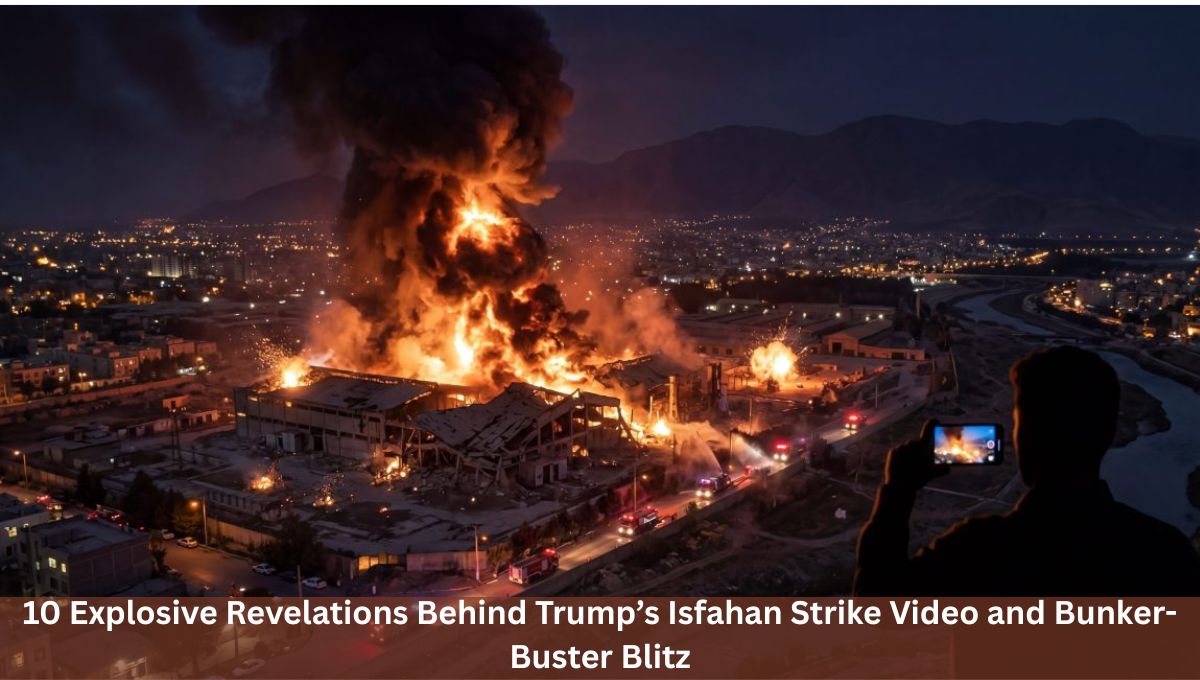
10 Explosive Revelations Behind Trump’s Isfahan Strike Video and Bunker-Buster Blitz on Iran. A dramatic escalation in the ongoing Middle East conflict has captured global attention after US President Donald Trump shared a video showing massive explosions in Iran’s Isfahan. The footage, posted without context, has triggered intense speculation and concern, with multiple reports linking it to a coordinated US-Israeli strike involving powerful bunker-buster bombs.
Thank you for reading this post, don't forget to subscribe!While the authenticity of the video remains unverified, officials and media reports suggest it may depict a major military operation targeting strategic infrastructure deep inside Iran. The incident marks a potentially dangerous turning point in an already volatile conflict.
Here are the key developments, explained in detail.
10 Explosive Revelations Behind Trump’s Isfahan Strike Video and Bunker-Buster Blitz
1. Trump’s Viral Video Sparks Global Alarm
The controversy began when Donald Trump posted a video on his social media platform showing a series of massive explosions lighting up the night sky.
The visuals featured:
- Multiple successive blasts
- Towering fireballs
- Thick plumes of smoke
- Intense orange glow across the skyline
Notably, the video was shared without any caption or explanation. However, analysts and media outlets quickly linked the footage to reported strikes in Isfahan, a major Iranian city.
The lack of official confirmation has only deepened uncertainty, but the timing of the post—coinciding with reports of US-Israeli military activity—has fueled widespread speculation.
2. Why Isfahan Is a Strategic Target
Isfahan is not just another city—it is one of Iran’s most critical military and industrial hubs.
With a population of around 2.3 million, it plays a central role in:
- Military logistics
- Ammunition storage
- Nuclear-related infrastructure
The city is also home to the Badr military airbase and facilities linked to Iran’s nuclear programme. Its strategic importance has made it a recurring target in past operations.
Recent intelligence reports suggest that Iran may have moved a portion of its highly enriched uranium stockpile—estimated at around 540 kilograms—to underground facilities in Isfahan.
If true, this significantly raises the stakes of any military action in the region.
3. Reports Point to US-Israeli Joint Strike
According to multiple media reports citing US officials, the explosions were likely the result of a coordinated strike by the United States and Israel.
The target:
A large ammunition depot believed to contain:
- Stored missiles
- Explosives
- Possibly underground facilities
Officials indicated that the strike involved a “high volume” of penetrator munitions, suggesting the presence of hardened or deeply buried targets.
Such coordination reflects deepening military alignment between Washington and Tel Aviv in their efforts to counter Iran’s strategic capabilities.
4. Bunker-Buster Bombs: The Weapon Used
At the center of the operation are bunker-buster bombs—specialized weapons designed to destroy targets that conventional bombs cannot reach.
What Makes Them Unique?
Unlike standard bombs, bunker busters:
- Have hardened steel casings
- Penetrate deep into soil, rock, or concrete
- Detonate only after reaching a specific depth
This allows them to destroy:
- Underground bunkers
- Reinforced military facilities
- Nuclear infrastructure
Some advanced versions include Bunker-Buster Blitz that detect changes in density, allowing the bomb to explode at the most effective point.
5. The Role of B-2 Stealth Bombers
The strike is believed to have involved B-2 stealth bombers—among the most advanced aircraft in the world.
Key Capabilities:
- Radar-evading “flying wing” design
- Ability to penetrate heavily defended airspace
- Capability to carry massive bunker-buster bombs
These bombers are uniquely suited for high-risk missions targeting fortified installations.
Their stealth technology allows them to operate undetected, making them critical assets in operations like this.
6. Secondary Explosions Amplified the Impact
One of the most striking aspects of the reported attack is the scale of secondary explosions.
When an ammunition depot is hit:
- Stored explosives ignite
- Chain reactions occur
- Fireballs and shockwaves multiply
Witness accounts and visuals suggest that the initial strike triggered a cascade of explosions, significantly increasing the destruction.
This explains the dramatic visuals seen in the video shared by Trump.
7. A Pattern: Previous Strikes on Isfahan
This is not the first time Isfahan has been targeted.
Last year, a US operation reportedly struck nuclear-linked facilities in the city as part of a mission focused on disabling Iran’s nuclear capabilities.
That operation demonstrated:
- The ability to hit deeply buried targets
- The strategic importance of Isfahan
- The growing reliance on precision-guided munitions
The latest strike appears to build on that precedent, suggesting a sustained campaign against Iran’s critical infrastructure.
8. Nuclear Tensions Add to the Stakes
The situation is further complicated by ongoing disputes over Iran’s nuclear ambitions.
The United States and Israel have repeatedly claimed that Iran is close to developing a nuclear weapon.
However:
- International watchdogs have not confirmed this claim
- Iran has denied pursuing nuclear weapons
Despite this, the presence of enriched uranium and nuclear-related facilities in Isfahan makes it a focal point of geopolitical tension.
Any strike on such sites risks triggering broader escalation.
9. Wider Regional Escalation Underway
The Isfahan strike comes amid a rapidly expanding conflict across the Middle East.
Recent developments include:
- Missile and drone attacks targeting Israel
- Strikes on Gulf infrastructure
- An attack on a Kuwaiti oil tanker near Dubai
These incidents indicate that the conflict is no longer contained and could spread across key energy corridors.
The Strait of Hormuz—one of the world’s most critical oil routes—remains under threat, raising concerns about global economic fallout.
10. Trump Signals Both Escalation and Exit Strategy
Interestingly, Trump’s messaging has been mixed.
On one hand, he has:
- Warned of widespread destruction of Iran’s energy infrastructure
- Threatened further strikes if no deal is reached
On the other hand, reports suggest he is considering:
- Scaling down military operations
- Shifting focus to diplomatic pressure
- Avoiding prolonged ground involvement
This dual approach reflects the complexity of the situation—balancing military objectives with political and economic risks.
What Are Bunker Busters? (Detailed Breakdown)
Bunker-buster bombs are not new—they date back to World War II. However, modern versions are far more advanced.
Key Features:
- Reinforced steel casing
- Precision guidance systems (often GPS-based)
- Delayed detonation mechanisms
Types of Targets:
- Underground command centers
- Missile silos
- Nuclear facilities
One of the most powerful variants is the Massive Ordnance Penetrator (MOP), weighing around 30,000 pounds.
While smaller versions were reportedly used in Isfahan, the principle remains the same:
penetrate first, explode later.
Global Implications: Why This Matters
The Isfahan strike is not just a regional issue—it has global consequences.
1. Energy Markets
Disruptions in the Middle East can impact oil prices worldwide.
2. Military Escalation
Increased strikes raise the risk of a full-scale war.
3. Nuclear Concerns
Attacks on nuclear-linked sites could trigger international crises.
4. Diplomatic Fallout
Efforts by countries like Pakistan, Saudi Arabia, Egypt, and Turkey to mediate may become more urgent.
Unanswered Questions
Despite extensive reporting, several key questions remain:
- Was the video shared by Trump authentic?
- What exactly was targeted in Isfahan?
- Did the strike hit nuclear materials?
- Will Iran retaliate further?
- Is a ground invasion being considered?
These uncertainties continue to fuel speculation across global capitals.
Conclusion: A Dangerous Turning Point
The reported strike on Isfahan—and the dramatic video shared by Donald Trump—marks a critical moment in the ongoing conflict.
Whether this represents a decisive military move or a step toward broader escalation remains unclear.
What is certain, however, is that the situation is evolving rapidly, with significant implications for global security, energy stability, and international diplomacy.
As the world watches closely, the coming days will likely determine whether this incident leads to de-escalation—or pushes the region closer to a wider war.
Also Read: 10 Explosive Updates as Israel Strikes Iran Nuclear Sites, War Escalates
Also Read: Iran weapons depot in Isfahan reportedly hit by bunker buster bomb, Trump shares explosion video
Related Posts:
- 9 Explosive Claims as Trump Says US Winning Iran War

- 11 Explosive Warnings as Trump Vows to ‘Knock the…

- Trump's 3 Blunt Warnings to China and Russia Over…
- 11 Explosive Revelations From Ted Cruz’s Leaked…

- Can the EU and NATO Impose Tariffs on India and…

- 3 Explosive Conditions Iran Sets to End War with US…