
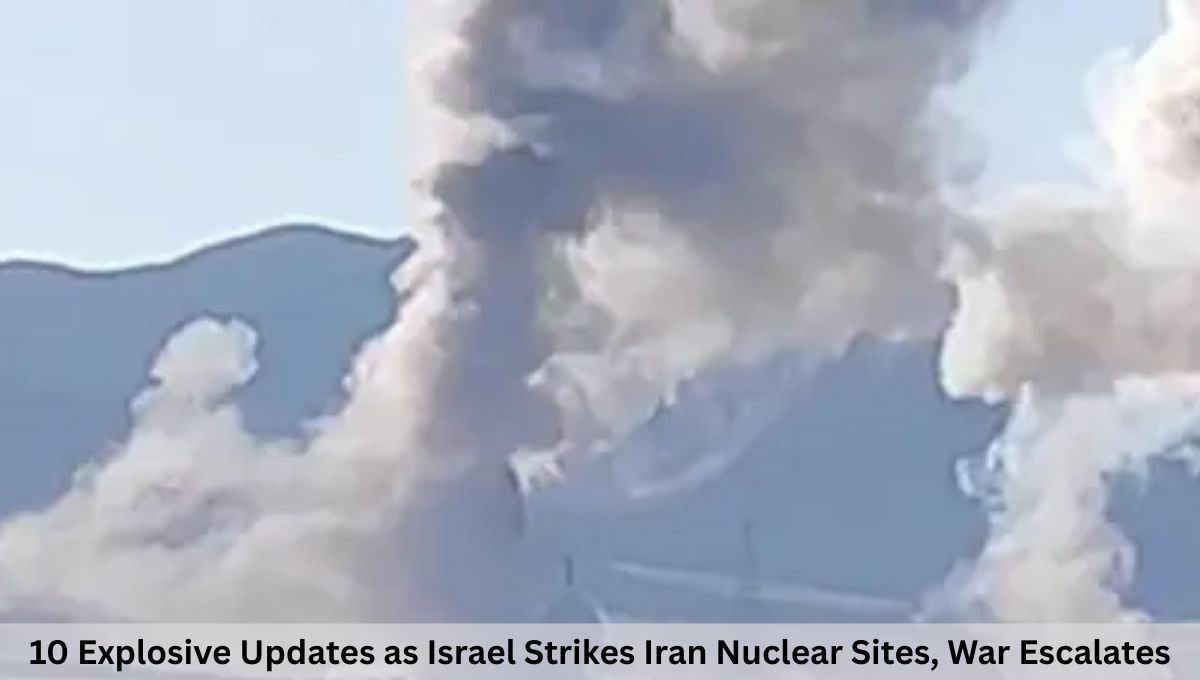
10 Explosive Updates as Israel Strikes Iran Nuclear Sites, War Escalates, tensions rise. The conflict between Israel and Iran has entered a perilous new phase after Israeli airstrikes targeted critical components of Iran’s nuclear infrastructure.
In one of the most significant escalations in recent years, the Israel Defense Forces (IDF) confirmed attacks on two major nuclear-related facilities—the Khondab Heavy Water Complex near Arak and a uranium “yellowcake” production plant in Yazd Province.
These strikes come amid an already volatile regional conflict that now threatens to spiral into a broader war involving multiple countries and global economic consequences.
10 Explosive Updates as Israel Strikes Iran Nuclear Sites, War Escalates
What Happened: Key Nuclear Facilities Targeted
Strike on Arak Heavy Water Reactor
One of the primary targets was the Khondab Heavy Water Complex near Arak, a site long associated with Iran’s nuclear ambitions.
Heavy water reactors are particularly sensitive because:
- They can produce weapons-grade plutonium
- They serve as a key component in certain nuclear weapon designs
- They are difficult to monitor compared to other facilities
The IDF stated that the facility had been under reconstruction following damage sustained in earlier strikes in 2025 and accused Iran of deliberately avoiding international commitments to limit its capabilities.
Iranian authorities confirmed the strike but reported:
- No casualties
- No radiation leaks
- No immediate threat to surrounding populations
Strike on Yazd Yellowcake Production Facility
In a separate but equally significant operation, Israeli forces targeted a uranium processing facility in Ardakan, located in Yazd Province.
This facility is particularly crucial because:
- It is Iran’s only yellowcake production plant
- It processes raw uranium ore into concentrated uranium powder
- It represents the first step in the nuclear fuel cycle
According to the International Atomic Energy Agency (IAEA), it has been informed of the strike and is monitoring the situation closely.
Director General Rafael Grossi called for restraint, warning that continued military activity near nuclear infrastructure increases the risk of a catastrophic accident.
Understanding the Nuclear Targets
What Is Yellowcake?
Yellowcake is a concentrated uranium compound produced after mining and initial processing of uranium ore.
It is:
- A precursor to uranium enrichment
- Essential for both civilian nuclear energy and nuclear weapons
- A critical bottleneck in nuclear development
What Is Heavy Water and Why Does It Matter?
Heavy water is used as a moderator in certain nuclear reactors.
Its significance lies in:
- Enabling the production of plutonium
- Supporting nuclear reactions without enriched uranium
- Potential dual-use in civilian and military nuclear programs
Why Israel Launched the Strikes
The Israel Defense Forces justified the attacks as part of an ongoing campaign to prevent Iran from advancing its nuclear weapons capabilities.
According to Israeli statements:
- Iran has failed to comply with international agreements
- Nuclear facilities were being rebuilt after prior damage
- The program poses an “existential threat” to Israel
The strikes are part of a broader military operation aimed at:
- Disrupting nuclear development
- Targeting missile infrastructure
- Weakening Iran’s military-industrial capabilities
Iran’s Response: Retaliation Promised
Iran reacted swiftly and forcefully to the attacks.
Foreign Minister Abbas Araghchi declared:
- Iran will extract a “heavy price” for the strikes
- The attacks constitute “crimes” against the country
- Retaliatory measures are already underway
Iran’s Islamic Revolutionary Guard Corps (IRGC) also issued warnings targeting:
- Industrial facilities linked to the U.S. or Israel
- Regional companies with Western ties
- Strategic economic assets across the Middle East
Wider Conflict: Industrial and Civilian Targets Hit
Beyond nuclear facilities, the conflict has expanded to include:
Industrial Infrastructure
- Steel plants in Isfahan and Khuzestan
- Cement factories in Firuzabad
- Power generation facilities
Casualties have been reported, including:
- One worker killed in Isfahan
- Multiple injuries across industrial zones
Missile and Airstrike Exchanges
The conflict is no longer limited to strategic infrastructure:
- Iran launched missiles toward Israeli cities, including Tel Aviv
- Air raid sirens sounded across major population centers
- Israeli emergency services responded to multiple impact sites
Regional Spillover: Yemen, Lebanon, and Gulf States
Houthi Involvement from Yemen
The conflict risks widening further with the involvement of the Houthi movement in Yemen.
Recent developments include:
- Missile launches toward Israel
- Threats of direct military intervention
- Potential disruption of Red Sea shipping routes
Lebanon and Hezbollah
Clashes have also intensified in Lebanon:
- Israeli military operations targeting Hezbollah positions
- Civilian casualties reported
- Increased cross-border tensions
Gulf Region Impact
- Saudi Arabia intercepted missiles targeting Riyadh
- Kuwait reported damage to port infrastructure
- U.S. bases in the region faced attacks
Strait of Hormuz Crisis and Global Economic Shock
One of the most critical consequences of the conflict is the disruption of the Strait of Hormuz.
This narrow waterway handles:
- About 20% of global oil shipments
- A significant share of global natural gas
- Key fertilizer trade routes
Economic Fallout
The crisis has triggered:
- A sharp rise in global oil prices
- Stock market declines worldwide
- Supply chain disruptions
Major indices, including the S&P 500 and Nasdaq, have experienced significant losses amid growing uncertainty.
U.S. Role and Diplomatic Efforts
U.S. President Donald Trump has taken a mixed approach:
Military Posturing
- Deployment of additional troops to the Middle East
- Increased naval presence
- Strategic readiness for escalation
Diplomatic Initiatives
- Extension of deadlines for negotiations with Iran
- Proposal of a ceasefire framework
- Use of intermediaries like Pakistan
Despite these efforts, Iran has rejected key proposals, demanding:
- Recognition of sovereignty
- Economic reparations
- Control over regional waterways
Humanitarian Impact: A Growing Crisis
The human cost of the conflict continues to rise:
- Over 1,900 deaths reported in Iran
- More than 1,100 fatalities in Lebanon
- Civilian infrastructure severely damaged
According to global aid agencies:
- Over 180,000 people displaced
- Hospitals and residential areas hit
- Risk of a large-scale refugee crisis
Nuclear Risk: A Global Concern
The involvement of nuclear facilities raises unprecedented risks.
The International Atomic Energy Agency has warned:
- Military action near nuclear sites increases accident risk
- Radiation leaks could have cross-border consequences
- Escalation could undermine global nuclear safety norms
Geopolitical Implications
Shift in Regional Power Dynamics
The conflict is reshaping power balances across:
- The Middle East
- South Asia
- Global alliances
Impact on Global Trade
- Shipping disruptions in key maritime routes
- Increased insurance costs for cargo
- Delays in energy and commodity supply chains
What Happens Next?
The situation remains highly fluid, with several possible scenarios:
1. Full-Scale Regional War
A broader war involving multiple countries and non-state actors.
2. Limited Escalation
Continued strikes without crossing into full-scale conflict.
3. Diplomatic Breakthrough
Ceasefire agreements mediated by global powers.
Conclusion: A Critical Turning Point
The Israeli strikes on Iran’s nuclear facilities represent a defining moment in the ongoing conflict.
By targeting the core of Iran’s nuclear infrastructure, Israel has significantly escalated the stakes.
At the same time, Iran’s vow of retaliation and the involvement of regional actors signal a dangerous trajectory.
As tensions rise, the world watches closely—not just for the next military move, but for whether diplomacy can still prevent a wider catastrophe.
The coming days will be crucial in determining whether this conflict stabilizes—or spirals into a global crisis.
Also Read: Israel Strikes Khorramshahr Missile Sites in Iran as US Joins with Massive Nuclear Facility Bombing
Also Read: Tehran strikes military base in Saudi Arabia after Israel hits Iranian nuclear facilities
Related Posts:
- 3 Explosive Conditions Iran Sets to End War with US…
- 10 Explosive Strikes: Israel Bombs Tehran Oil Depots…

- 10 Explosive Warnings as Donald Trump Calls Iran…
- 10 Explosive Signals: Trump Rates Iran War “15/10”…
- Netanyahu: Iran Regime Collapse “Not a Goal,” But…
- 11 Explosive Warnings as Trump Vows to ‘Knock the…
