In a dramatic escalation in the Middle East, Israel Strikes Khorramshahr Missile Sites in Iran as US Joins with Massive Nuclear Facility Bombing. The Israel Defense Forces (IDF) confirmed that its fighter jets struck Khorramshahr-4 missile storage facilities in Yazd, central Iran, marking the first-ever Israeli strike on this long-range missile system.
Simultaneously, the United States launched a massive air operation targeting three Iranian nuclear facilities Fordow, Natanz, and Isfahan signaling a major shift in the ongoing Iran-Israel conflict.
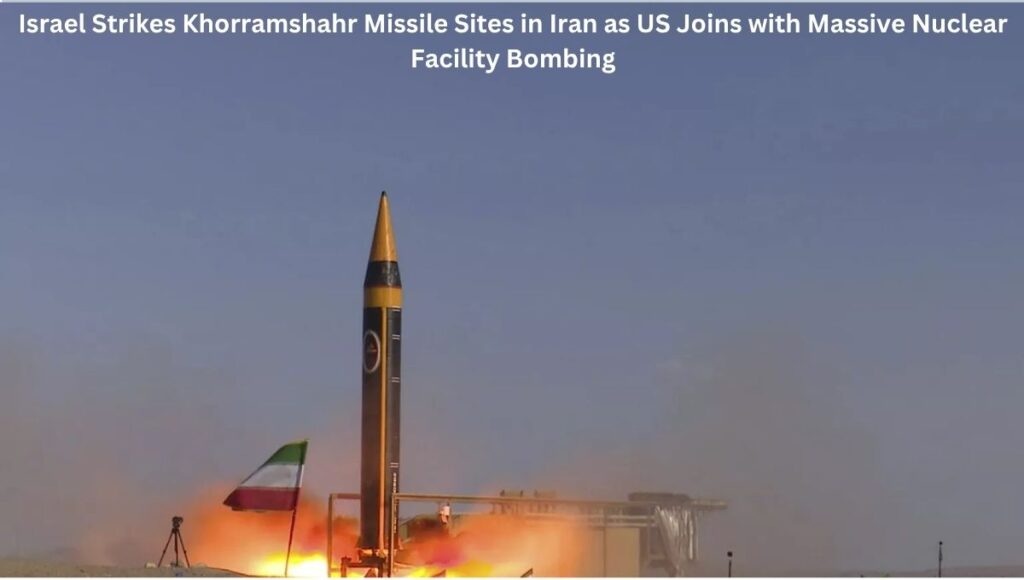
Israel Strikes Khorramshahr Missile Sites in Iran as US Joins with Massive Nuclear Facility Bombing
Khorramshahr-4: Iran’s Powerful Missile System Targeted
The Khorramshahr-4, also known as Kheibar, is among Iran’s most formidable ballistic weapons. Developed by Iran’s Aerospace Industries Organisation (AIO) and unveiled in military parades in 2017 and again in 2019, this missile boasts a 2,000 km range and can carry multiple warheads weighing up to 1,800 kg.
The missile is liquid-fueled, giving it high accuracy and lethality. It has been a central part of Iran’s retaliatory capabilities, including the latest “20th wave” of missile attacks launched on Israeli territory.
The Israeli Air Force (IAF), in a first, hit Khorramshahr missiles at their storage and launch sites in Yazd, just as Iran was reportedly preparing another salvo.
“Furthest Target Ever”: Israel’s Operation Rising Lion Expands
Commanded in real-time by IAF Commander Maj. Gen. Tomer Bar and Brig. Gen. Gilad Keinan, the IDF strike on Yazd was part of Operation Rising Lion, now in its tenth day. The IDF stated:
“In broad daylight, we surprised the ‘Imam Hussein’ missile headquarters in central Iran, the furthest target we’ve struck to date… We destroyed Khorramshahr missiles before they were launched at Israel.”
In total, 30 Israeli fighter jets participated in Sunday’s mission, hitting dozens of military targets across Iran with over 60 precision munitions.
Simultaneous US Strikes: Operation Midnight Hammer Begins
Just hours after Israel’s operation in Yazd, the United States launched its own massive assault, code-named Operation Midnight Hammer, targeting three key Iranian nuclear facilities: Fordow, Natanz, and Isfahan.
The operation involved:
- Seven B-2 Spirit stealth bombers
- More than 125 aircraft
- Over two dozen Tomahawk cruise missiles
- Fourteen 30,000-lb GBU-57 bunker-buster bombs (MOPs)
General Dan Caine, Chairman of the Joint Chiefs, revealed that some B-2s flew decoy routes into the Pacific to confuse Iranian radar.
Meanwhile, the actual strike team penetrated Iranian airspace undetected, dropped their payloads, and returned safely.
“Iran’s fighters did not fly, and it appears that Iran’s surface-to-air missile systems did not see us,” Caine stated at a Pentagon briefing.
Fordow Nuclear Facility Hit with Bunker-Busters
The Fordow site, hidden deep beneath a mountain south of Tehran, was one of the key targets. Known for being impenetrable to conventional weapons, it required the use of Massive Ordnance Penetrators (MOPs) the only weapon capable of reaching such depths.
Each MOP bomb weighs 13,000 kg and can punch through 60 feet of concrete or 200 feet of earth. A total of 14 MOPs were dropped on two nuclear targets.
“All three Iranian nuclear infrastructure targets were hit within a 25-minute window,” said Caine.
Trump: “Sites Obliterated,” Pentagon More Cautious
President Donald Trump declared the mission a “spectacular success,” stating the sites were “obliterated.” However, Pentagon officials and independent analysts offered a more measured view.
Defence Secretary Pete Hegseth emphasized that the operation did not target Iranian troops or civilians, stating: “This mission was not, and has not been, about regime change.”
He acknowledged Israel’s role in coordination, describing the joint effort as a “crucial step to stopping the Iranian regime’s aggression.”
Iran Confirms Strikes, But Denies Major Damage
Iranian authorities confirmed that Fordow, Natanz, and Isfahan were hit, but they downplayed the extent of damage.
Officials claimed that nuclear material and vital equipment had been moved in anticipation of an attack a sign that Tehran may have had prior intelligence on US and Israeli intentions.
Nevertheless, the IAEA (International Atomic Energy Agency) is assessing the facilities and has not reported any radiation leaks.
Missile Launchers, UAV Bases Also Hit
Beyond nuclear facilities, the joint Israeli and US operation targeted:
- Missile launchers in Isfahan, Bushehr, and Ahvaz
- Military production sites for air defense systems
- The ‘Third Brigade’ UAV command center
- A major drone storage facility near the command center
These additional strikes are seen as an effort to degrade Iran’s ability to wage future retaliatory drone and missile warfare.
What Comes Next: Retaliation, Diplomacy, or Further Escalation?
As of now, Iran has not launched a direct counter-strike on US forces, focusing instead on its missile exchanges with Israel.
However, the approval to close the Strait of Hormuz remains pending with Iran’s Supreme National Security Council, a move that could trigger a global oil crisis.
Meanwhile, the UN Security Council has convened an emergency session, with Russia and China calling for an immediate ceasefire and negotiations.
Conclusion: A Dangerous New Phase
With Israel striking Khorramshahr missile facilities for the first time and the US bombing Fordow and other nuclear sites, the Iran-Israel conflict has entered its most volatile and dangerous phase yet.
While both Washington and Tel Aviv insist they are not seeking war or regime change, the scale of military operations, the destruction of strategic assets, and the geopolitical ripple effects make the situation highly combustible.
All eyes now turn to Tehran’s next move and whether the world stands on the brink of a broader regional conflict.
Also Read: Trump Signals Regime Change After Strikes on Iran’s Nuclear Sites
Also Read: ‘Bunker buster’ to ‘Khorramshahr’: Missiles used by US and Iran in the war
Related Posts:
- 10 Explosive Strikes: Israel Bombs Tehran Oil Depots…

- 10 Explosive Updates as Israel Strikes Iran Nuclear…
- Israel Strikes Iranian Airfields, Destroys 15 Jets…
- US B-2 Bombers Strike Iran’s Nuclear Sites: Why…
- 11 Explosive Warnings as Trump Vows to ‘Knock the…

- 10 Explosive Warnings as Donald Trump Calls Iran…