In a significant military escalation, US B-2 Bombers Strike Iran’s Nuclear Sites: Why Fordow, Natanz, and Esfahan Were Targeted. The United States has launched a precision airstrike on three Iranian nuclear facilities Fordow, Natanz, and Esfahan using its elite fleet of B-2 Spirit stealth bombers.
President Donald Trump announced the strikes as a “very successful attack” during a statement on Saturday, June 21, amid ongoing hostilities between Israel and Iran. The move comes after weeks of rising tensions, Israeli warnings, and U.S. military buildup, including the strategic deployment of B-2 bombers to Guam.
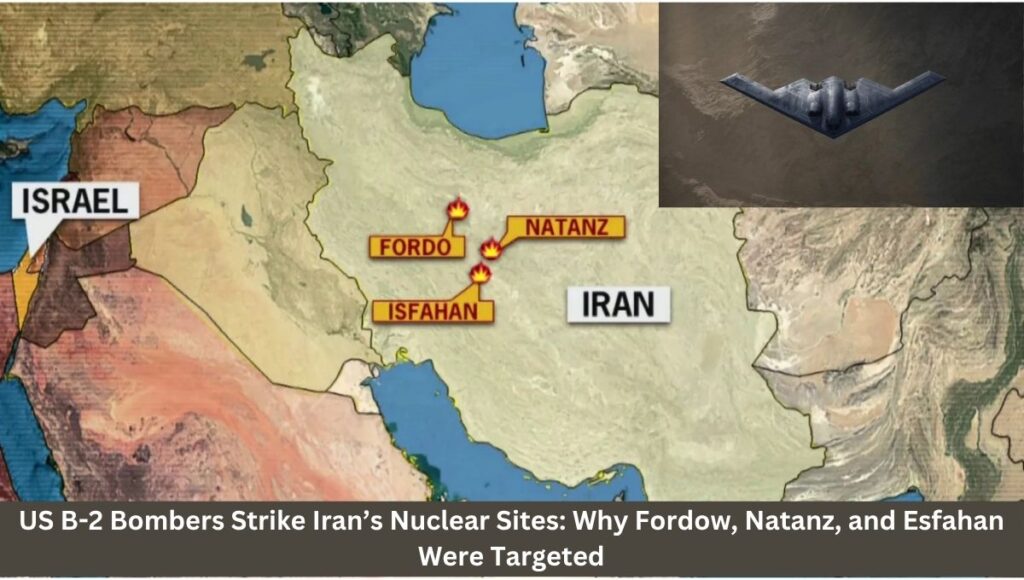
US B-2 Bombers Strike Iran’s Nuclear Sites: Why Fordow, Natanz, and Esfahan Were Targeted
Trump Confirms the Strike: “Fordow is Gone”
Posting on Truth Social, former President Trump stated: “We have completed our very successful attack on the three Nuclear sites in Iran, including Fordow, Natanz, and Esfahan. All planes are now outside of Iranian airspace.
A full payload of bombs was dropped on the primary site, Fordow. All planes are safely on their way home.” Trump also said he would address the nation at 10:00 PM to discuss the operation and the path forward for U.S. policy in the Middle East.
Why Fordow, Natanz, and Esfahan Were Targeted
These three facilities form the core of Iran’s nuclear enrichment infrastructure:
- Fordow is Iran’s most fortified uranium enrichment site, buried under a mountain.
- Natanz is the main uranium enrichment facility, housing thousands of advanced centrifuges.
- Esfahan hosts conversion and heavy water reactor facilities critical to nuclear fuel processing.
Iran claims its nuclear program is peaceful, but Israel and the U.S. insist Iran was moving rapidly toward nuclear weapons capability especially after the collapse of the 2015 nuclear agreement.
The Role of B-2 Bombers in the Iran Airstrikes
The B-2 Spirit stealth bombers were deployed from the U.S. territory of Guam, having been tracked by open-source flight monitoring earlier in the week.
Built by Northrop Grumman, the B-2 is one of the most advanced and expensive aircraft ever made, with each unit costing around $2.1 billion.
Capable of carrying both conventional and nuclear payloads, the B-2’s value in this mission lies in its ability to:
- Evade detection using stealth technology
- Travel intercontinental distances
- Deliver Massive Ordnance Penetrator (MOP) bombs designed for deep underground targets
Key B-2 Specs:
- Range: 6,000+ nautical miles (11,000+ km) without refueling
- Crew: Two
- Payload: 40,000+ pounds
- Stealth: Radar cross-section comparable to a bird
The radar-evading design enabled B-2s to reach their targets deep inside Iranian territory without being intercepted.
Bunker Busters and the Destruction of Fordow
To penetrate Iran’s underground defenses, the B-2 bombers used the GBU-57A/B Massive Ordnance Penetrator (MOP) the largest conventional bomb in the U.S. arsenal. The 30,000-pound bomb is engineered to destroy deeply buried bunkers and fortified structures.
Massive Ordnance Penetrator (MOP):
- Weight: 30,000 lbs
- Length: 20.5 feet
- Penetration: Over 200 feet of reinforced concrete
- Guidance: GPS precision targeting
Reports indicate that six bunker busters were dropped on Fordow alone, effectively crippling the site.
Why the U.S. Used B-2 Bombers for This Mission
Among U.S. air assets, only the B-2 can:
- Carry the MOP while retaining stealth
- Fly missions from continental U.S. or Guam
- Engage heavily defended airspace without fighter escorts
B-52s, while powerful, lack stealth and would require extensive protection. Fighters like the F-22 or F-35 cannot carry MOPs and lack the range for long-haul precision missions.
From Guam, Not Diego Garcia: A Strategic Decision
The B-2 bombers were launched from Guam, surprising many defense analysts who expected the strikes to originate from Diego Garcia, a U.S.-UK base in the Indian Ocean.
Why Guam?
- Political Simplicity: Diego Garcia would require UK government approval, creating diplomatic complications.
- Secrecy: Guam offers better operational cover, especially in an era of satellite and digital surveillance.
- Reach: With aerial refueling, B-2s can hit targets anywhere on Earth, making Guam a viable base.
US Begins Evacuating Americans from Israel
Following the airstrikes and ongoing missile exchanges between Israel and Iran, the U.S. State Department has begun evacuating American citizens from Israel.
Ambassador Mike Huckabee wrote on X: “Our amazing team @usembassyjlm is working around the clock to assist American citizens wishing to depart. I strongly encourage you to fill out the form at the bottom and to take the first option available to you.”
The evacuation reflects growing concern that the conflict could spill further into the region or provoke Iranian retaliation.
Israel Pushed for Action And Trump Responded
In the lead-up to the strike, Israeli officials urged President Trump not to wait two weeks, as he had earlier suggested. According to Reuters, Tel Aviv warned Washington that Israel would act alone if necessary. Israel, despite its military prowess, lacks weapons like the MOP, making U.S. cooperation essential in striking targets like Fordow.
Trump’s Balancing Act Between War and Peace
While Trump has emphasized military strength, he also left the door open for diplomacy.
“I’m giving them a period of time to come to their senses,” he told reporters. “Two weeks would be the maximum.”
With the airstrikes complete, Trump now has a chance to shape the next phase a return to negotiations, or a deeper escalation.
What Happens Next: Escalation or Diplomacy?
Saturday’s airstrikes mark a turning point in the Iran-Israel conflict and U.S. involvement. Iran has not yet responded militarily to the bombings, but experts warn that retaliation is likely—either directly or through proxies in Syria, Iraq, or Lebanon.
The world will also watch Trump’s 10 PM address, where he is expected to outline:
- The objectives and success of the Iran strike
- The conditions for a ceasefire or new nuclear talks
Whether more U.S. military action is planned
Conclusion: The Future of the Iran Conflict Hangs in the Balance
The U.S. B-2 bombers’ strike on Iran’s nuclear infrastructure especially the Fordow facility is a demonstration of unmatched American airpower. But whether this move brings Iran to the negotiating table or provokes further warfare remains to be seen.
As the world waits for Trump’s formal address, one thing is clear: the B-2 Spirit has lived up to its name, silently reshaping the battlefield and the geopolitical stakes.
Also Read: What If the B-2 Stealth Bomber Was Caught? How the US Planned for That Moment
Also Read: Some B-2 bombers went West, real attackers flew East: US decoy plan to bomb Iran