

In a stunning turn of events, Trump Confirms Strikes on Iran’s Nuclear Sites: “Fordow Is Gone.” President Donald Trump has officially confirmed that the United States has conducted airstrikes on three Iranian nuclear facilities Fordow, Natanz, and Esfahan marking a historic escalation in the already volatile Iran-Israel conflict. The announcement came via Trump’s social media platform, Truth Social, where he revealed that B-2 stealth bombers were deployed in a coordinated military operation on June 21.
The direct involvement of the United States signals a major strategic shift in Washington’s Middle East policy, thrusting the U.S. into an expanding war that has already claimed hundreds of lives.
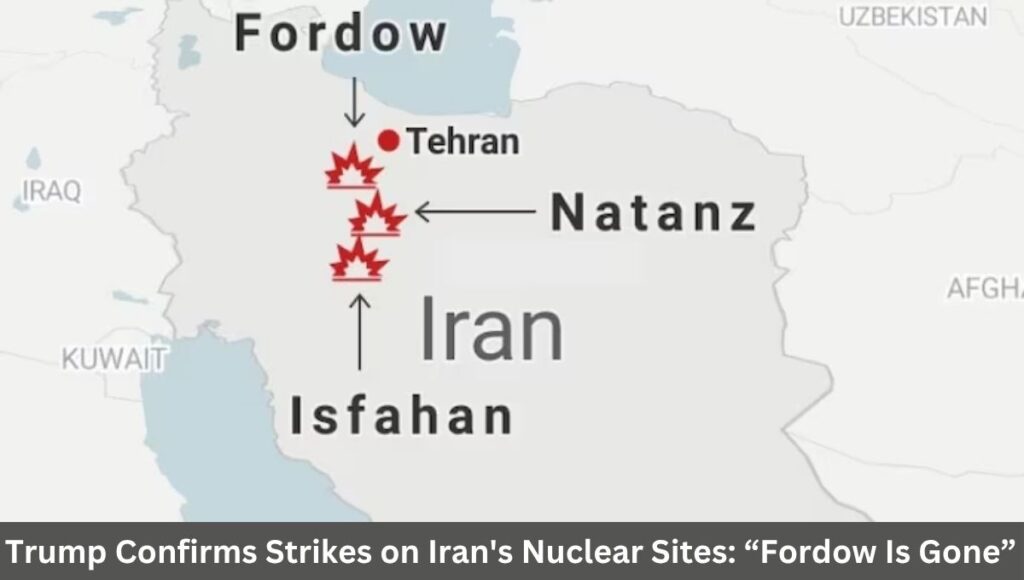
Trump Confirms Strikes on Iran’s Nuclear Sites: “Fordow Is Gone”
“Fordow Is Gone”: A Blow to Iran’s Nuclear Ambitions
In his initial post, President Trump declared,
“We have completed our very successful attack on the three Nuclear sites in Iran, including Fordow, Natanz, and Esfahan. All planes are now outside of Iran air space.”
Trump emphasized that the primary target was the Fordow nuclear facility, a highly fortified underground site suspected of enriching uranium.
“A full payload of BOMBS was dropped on the primary site, Fordow,” he wrote. Moments later, he reshared a report simply stating, “Fordow is gone.”
The site, located deep beneath a mountain near Qom, had been long considered nearly impregnable. Military experts believe only the Massive Ordnance Penetrator (MOP), a 30,000-pound “bunker buster” bomb carried exclusively by the B-2 stealth bomber, could damage it.
US Joins Israel’s “Operation Rising Lion”
The U.S. airstrikes come exactly one week after Israel launched “Operation Rising Lion”, targeting key Iranian military and nuclear infrastructure. Israel had warned that Iran was just weeks away from obtaining a nuclear weapon, prompting preemptive action.
Until now, the U.S. had stopped short of direct military involvement. But as diplomatic efforts faltered and regional threats mounted, Trump authorized what he called a “very successful military operation.”
“Congratulations to our great American Warriors,” Trump said in his second post. “There is not another military in the World that could have done this. NOW IS THE TIME FOR PEACE!”
The Weapons Behind the Strikes: B-2 Bombers and Bunker Busters
According to Pentagon sources and Reuters, the operation employed B-2 Spirit stealth bombers, which flew from Whiteman Air Force Base in Missouri to carry out the attack. These advanced aircraft are designed to penetrate sophisticated air defenses and deliver devastating payloads undetected.
Six GBU-57 bunker buster bombs were reportedly dropped on the Fordow facility alone, while 30 Tomahawk missiles targeted Natanz and Esfahan, according to Fox News.
These weapons are specifically engineered to destroy hardened underground facilities, making them ideal for targeting Iran’s subterranean nuclear program.
Iran Reacts: Tensions at Boiling Point
Iran has acknowledged the attack on Fordow through its state-run IRNA news agency. However, the full extent of the damage remains unclear as Tehran has yet to provide an official casualty count or technical assessment.
Supreme Leader Ayatollah Ali Khamenei, who has reportedly relocated to a deep underground bunker, had earlier warned the U.S. against military action.
“Any American attack on Iranian soil will result in irreparable damage,” Khamenei stated days before the strike. Iran’s foreign ministry also issued a dire warning that U.S. involvement would be a “recipe for all-out war in the region.“
Trump to Address the Nation: “Now Is the Time for Peace”
President Trump is expected to deliver a televised address to the nation at 10 PM ET, where he will expand on the objectives and outcomes of the strike.
In his Truth Social post, Trump described the mission as a “historic moment” for the U.S., Israel, and the world.
“This is an HISTORIC MOMENT FOR THE UNITED STATES OF AMERICA, ISRAEL, AND THE WORLD. IRAN MUST NOW AGREE TO END THIS WAR.”
Trump is reportedly hoping the show of force will push Iran back to the negotiating table, though no additional military operations are currently planned, according to White House insiders.
International Reactions and Humanitarian Concerns
The U.S. strike has stirred mixed reactions across the globe. While allies like Israel praised the move, human rights organizations voiced concerns about escalating civilian casualties.
A Washington-based Iranian rights group estimates that at least 657 people, including 263 civilians, have died in the conflict so far, with more than 2,000 others injured.
The United Nations Security Council has called an emergency meeting to discuss the implications of the strike, and several EU leaders urged both sides to return to diplomatic talks immediately.
Can a U.S. President Bomb Without Congressional Approval?
Legal analysts have reignited debate over the constitutionality of Trump’s action. Under Article I of the U.S. Constitution, Congress has the sole power to declare war. However, presidents have historically used executive powers to carry out short-term military operations without formal declarations.
The 1973 War Powers Act requires the president to notify Congress within 48 hours of deploying armed forces and limits engagements to 60 days without approval. Trump’s previous military actions, including strikes on Yemen’s Houthis, had already sparked legal controversies.
Khamenei’s Succession Plan Revealed Amid Crisis
As the threat to Iranian leadership mounts, Ayatollah Khamenei has reportedly identified three potential successors. According to The New York Times, Khamenei ordered a communications blackout around his bunker to prevent detection and has initiated emergency war protocols.
The news underscores the severity of the crisis and hints at a level of preparedness for further escalations including potential decapitation strikes by Israel or the U.S.
Looking Ahead: What Comes Next?
With Trump’s airstrikes now a reality, the region is bracing for possible Iranian retaliation. The presence of nearly 40,000 U.S. troops in the region has already prompted increased security measures, with American forces now on high alert.
Israeli Prime Minister Benjamin Netanyahu vowed to continue military operations against Iran, stating: “We will proceed for as long as it takes to eliminate existential threats.”
The coming days will likely determine whether this move leads to a new era of negotiations or spirals into a wider regional war.
Conclusion
President Trump’s decision to bomb Iran’s nuclear sites Fordow, Natanz, and Esfahan marks one of the most dramatic and controversial moments of his presidency. The use of B-2 stealth bombers and bunker busters demonstrates America’s unmatched military capabilities, but it also raises profound questions about the future of peace in the Middle East.
While Trump insists the strike was a step toward ending the war, only time will tell whether this bold gamble opens the door to diplomacy or ignites a broader conflict.
Also Read: US B-2 Bombers Strike Iran’s Nuclear Sites: Why Fordow, Natanz, and Esfahan Were Targeted
Also Read: We can’t even see: Iran’s president confirms severe damage to nuclear sites by US
Related Posts:
- US B-2 Bombers Strike Iran’s Nuclear Sites: Why…
- 11 Explosive Warnings as Trump Vows to ‘Knock the…

- 9 Explosive Revelations as Trump Declares His Health…

- 12 Explosive Claims as Donald Trump Says Iran War…
- Trump to Host 2026 G20 Summit at His Florida Golf…

- Trump Ends 33-Year Pause: U.S. to Resume Nuclear…
