

7 Explosive Signals as Hegseth Warns Iran and Trump Readies Military Options amid rising global fears. US Secretary of Defense Pete Hegseth delivered one of the strongest warnings yet to Iran on Thursday, making clear that the United States is prepared to use military force if Tehran pursues nuclear weapons.
Speaking during a Cabinet meeting chaired by President Donald Trump, Hegseth said the Pentagon stood ready to deliver “whatever this president expects” to prevent Iran from crossing the nuclear threshold.
The language was blunt, public and unmistakably deliberate. For global audiences accustomed to calibrated diplomatic phrasing, the message marked a clear escalation in tone as Washington openly signalled that deterrence may soon give way to action.
Hegseth’s remarks come as the United States rapidly builds up naval and air power across the Middle East, including the deployment of an aircraft carrier strike group led by the USS Abraham Lincoln.
Trump himself has described the force as a “massive armada,” underscoring that military pressure is central to his strategy toward Iran.
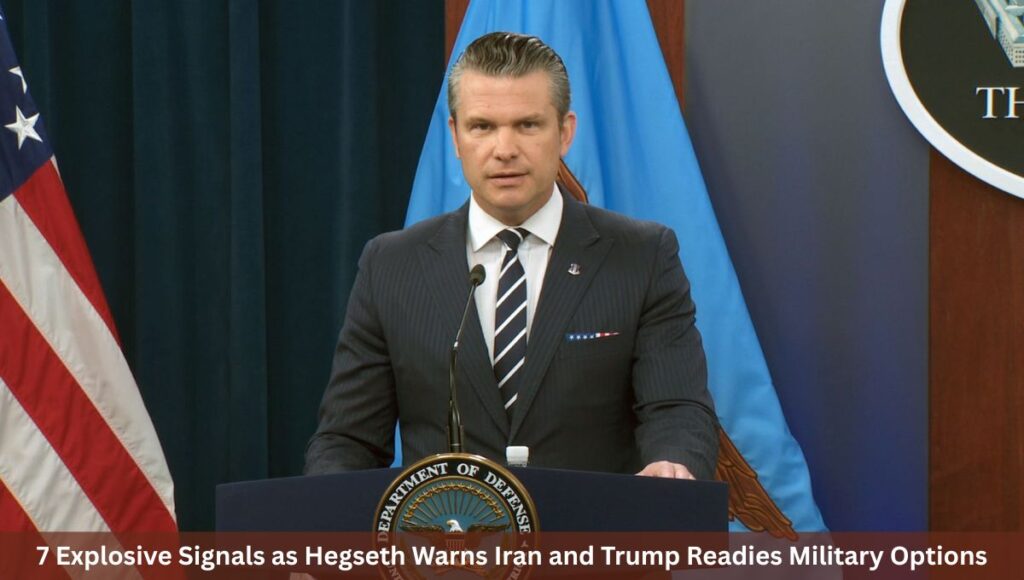
7 Explosive Signals as Hegseth Warns Iran and Trump Readies Military Options
US Military Build-Up Signals Readiness, Not Rhetoric
American officials insist the military deployments are defensive and designed to deter escalation. Yet the scale of the build-up suggests something more consequential.
Warships, destroyers, surveillance aircraft and missile defense systems have been repositioned within striking distance of Iran.
Additional Patriot and THAAD missile batteries are being prepared to protect US forces and allies against potential retaliation.
Hegseth said the posture was meant to send an unmistakable signal:
when President Trump speaks, he expects the US military to be ready to act decisively.
For allies in Europe, Asia and the Middle East, the deployments revive memories of earlier crises in the Gulf, when deterrence and miscalculation existed side by side.
Trump’s Two Red Lines: Nuclear Weapons and Protest Killings
President Trump has framed his approach to Iran around two core demands.
First, Iran must not acquire nuclear weapons. Second, Tehran must halt what Washington describes as mass killings of protesters following weeks of unrest triggered by economic collapse and political repression.
“It would be great if we didn’t have to use” military force, Trump said recently, while noting that powerful US warships were already en route to the region.
The juxtaposition reflects a familiar Trump pattern:
threats of overwhelming force paired with claims of openness to negotiation.
Yet Iranian leaders appear unconvinced that talks would deliver safety rather than further pressure.
Iran Prepares for War as Diplomacy Falters
Iranian officials have responded to US threats with open defiance. Senior figures across the political, military and judicial establishment insist that Iran’s priority is defense, not negotiation.
Foreign Minister Abbas Araghchi has embarked on regional diplomacy, holding talks in Turkiye while signalling that Iran is strengthening ties with neighbours.
But Tehran has made clear that it views Washington’s demands as coercive rather than constructive.
Kazem Gharibabadi, a senior negotiator, said Iran is maintaining “200 percent readiness” to defend the country, even as indirect messages continue to pass through intermediaries.
Military Messaging From Tehran
Iran has amplified its own military messaging in recent days, highlighting new capabilities and exercises conducted since last year’s 12-day war with Israel.
The Iranian army announced the induction of 1,000 new drones, including suicide drones and cyberwarfare-capable platforms able to strike land, sea and air targets.
The Islamic Revolutionary Guard Corps has also reiterated its ability to continue missile attacks even under sustained bombardment.
These statements are intended both for domestic audiences and foreign adversaries, reinforcing the idea that Iran would not be a passive target.
Fear and Defiance Inside Iran
On the streets of Tehran and other cities, public sentiment is divided between defiance and fear.
Some Iranians echo official rhetoric, insisting the United States would face devastating retaliation if it attacked.
Others, particularly younger citizens, express deep anxiety about the human cost of another war so soon after last year’s conflict.
Many fear renewed air strikes, infrastructure damage and communications blackouts, which have already become a feature of recent unrest.
Authorities have begun preparing civilians, delegating emergency powers to provincial governors and announcing long-term plans for underground shelters.
Yet officials acknowledge that meaningful protection would take years to implement.
Protest Crackdown and the Human Cost
The crisis is unfolding against the backdrop of one of the deadliest periods in Iran since the 1979 revolution.
Human rights groups estimate that thousands of protesters have been killed during weeks of unrest sparked by economic collapse and political repression.
Iranian authorities dispute those figures, claiming most deaths involved security forces or bystanders.
The European Union has responded by designating Iran’s Revolutionary Guard Corps as a terrorist organisation and imposing new sanctions.
Trump has repeatedly cited the killings as justification for pressure, saying the US would not stand by if violence continued.
From Venezuela to Iran: Hegseth’s Deterrence Narrative
Hegseth has pointed to recent US military actions as proof of Washington’s resolve, referencing the operation that led to the capture of Venezuela’s former president Nicolás Maduro.
He described it as an unmatched mission that demonstrated both American capability and presidential willingness to act.
The implication was clear:
if the US could execute such an operation elsewhere, Iran should not assume it is beyond reach.
Nuclear Red Lines and the Risk of Escalation
At the heart of the standoff is Iran’s nuclear programme.
Washington is demanding a permanent end to uranium enrichment, restrictions on ballistic missile development and a halt to support for regional proxy groups.
Iran insists its nuclear programme is peaceful and rejects what it calls unilateral diktats.
Analysts warn that military strikes on nuclear facilities could produce unintended consequences, including regional war and accelerated nuclear proliferation.
Iran as a Threshold State
Iran occupies a unique and dangerous position as a nuclear threshold state — possessing the technical capability to produce nuclear weapons without having done so.
Experts argue that attacks on such states may actually incentivise weaponisation, sending a message that restraint offers no protection.
Historical examples from Libya and Ukraine are frequently cited as cautionary tales by Iranian officials and international analysts alike.
Global Nuclear Proliferation Risks
A US strike on Iran could reverberate far beyond the Middle East.
Regional rivals such as Saudi Arabia and Turkey have openly discussed their own nuclear options.
In Asia, allies like Japan and South Korea closely watch whether US security guarantees remain credible.
If Iran concludes that only nuclear weapons can ensure survival, others may follow the same logic, weakening decades of nonproliferation efforts.
Markets, Oil and Economic Fallout
Global markets have already begun reacting. Oil prices have risen on fears that conflict could disrupt supply through the Strait of Hormuz, a critical chokepoint for global energy flows.
Any sustained fighting would likely drive prices higher, worsening inflation and economic pressure worldwide.
For countries far from the Middle East, the consequences would still be felt through energy costs, trade disruption and financial volatility.
Allies Caught in the Middle
Key US allies in the Gulf, including Saudi Arabia and the United Arab Emirates, have reportedly refused to allow their airspace to be used for strikes on Iran.
Their reluctance reflects fears of retaliation and regional instability. Turkey has also voiced concerns about unilateral military action.
These divisions complicate Washington’s strategy and highlight the fragile state of the existing regional security architecture.
Trump’s Calculus: Power and Timing
President Trump is weighing a range of military options, from targeted strikes on nuclear facilities to broader actions aimed at Iranian leadership and security forces.
Officials say he believes US options have expanded with the arrival of additional naval assets. Yet Trump has also expressed a desire for any operation to be decisive and short-lived.
Whether such an outcome is realistic remains deeply contested.
The Risk of a Wider War
Iran has vowed to respond to any attack with force, threatening US assets, Israel and potentially regional capitals.
With multiple armed actors, proxy forces and alliances involved, even a limited strike could escalate rapidly beyond initial intentions.
History suggests that wars launched to send messages often generate dynamics beyond the control of their architects.
Conclusion: A Dangerous Moment for Global Security
Pete Hegseth’s warning to Iran underscores a defining moment in global security.
The United States is signalling readiness to use force, Iran is preparing to defend itself, and diplomacy appears stalled. Between deterrence and disaster lies a narrow margin for miscalculation.
For the world, the stakes extend far beyond Iran or the Middle East. The outcome will shape nuclear norms, alliance credibility and the future of international security for years to come.
As Trump weighs his next move, one reality is clear:
the consequences of this crisis will not be contained by geography or rhetoric alone.
Also Read: 7 Explosive Signals as Trump Sends “Beautiful Armada” Toward Iran
Also Read: Is US Preparing for a Strike on Iran? US Secretary of War Pete Hegseth Says Trump Is ‘Ready’
Related Posts:
- 11 Explosive Warnings as Trump Vows to ‘Knock the…

- 10 Explosive Warnings as Donald Trump Calls Iran…
- 3 Explosive Conditions Iran Sets to End War with US…
- Trump's 3 Blunt Warnings to China and Russia Over…
- 9 Explosive Claims as Trump Says US Winning Iran War

- Trump’s 2025 Gaza Peace Plan Signing and Historic…
