9 Explosive Signals in the Trump–Iran Standoff Shaking the World as the crisis escalates. The standoff between the United States and Iran has entered one of its most dangerous phases in decades.
When US President Donald Trump declared that Iran was “ready to make a deal,” markets, diplomats, and militaries around the world took notice.
Tehran’s response was swift and unequivocal:
negotiations cannot happen under threats.
What might once have been routine brinkmanship now carries the weight of potential war, regime destabilization, and even a global nuclear ripple effect. With American aircraft carriers repositioned, missile defense systems flowing into the Gulf, and backchannel diplomacy struggling to gain traction, the crisis has become a defining test of international order.
This is no longer just about Iran’s nuclear ambitions or US pressure tactics. It is about whether coercion can still deliver diplomatic outcomes—or whether it instead accelerates instability in a world already on edge.
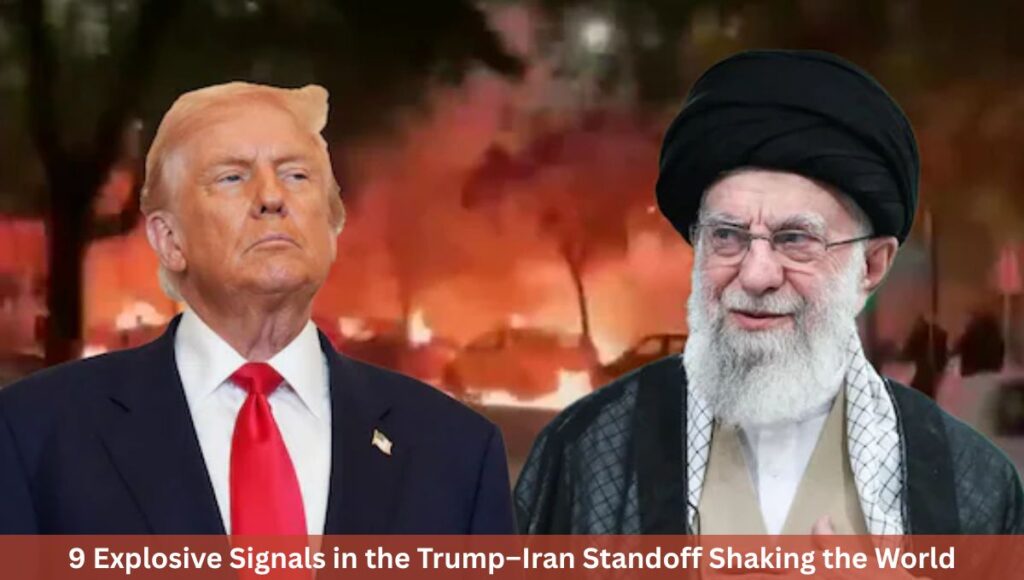
9 Explosive Signals in the Trump–Iran Standoff Shaking the World
Trump’s Message: Deal or Consequences
Speaking at the White House, President Trump projected confidence mixed with menace. “They do want to make a deal,” he said, while confirming he had set a deadline for Iran to enter negotiations—though declining to reveal its timing.
His language was characteristically blunt:
if diplomacy fails, military action remains on the table.
Trump explicitly linked his comments to the growing US naval presence near Iran, including the deployment of a carrier strike group.
The message was unmistakable:
negotiations would take place under the shadow of force.
This dual-track approach—threats paired with overtures—has defined Trump’s foreign policy style, from North Korea to Venezuela.
The question is whether it can work against a country as resilient and strategically entrenched as Iran.
Tehran’s Response: No Talks Under Pressure
Iran’s leadership responded with firmness rather than fear. Foreign Minister Abbas Araghchi stated that Tehran was “ready to begin negotiations if they take place on an equal footing, based on mutual interests and mutual respect.”
But he drew a clear red line:
Iran’s defensive and missile capabilities are not negotiable.
More importantly, Araghchi stressed that no plans were in place to meet US officials under the current climate.
From Tehran’s perspective, entering talks while American warships assemble nearby would signal weakness—and invite further demands.
Iranian officials have consistently argued that Washington’s approach amounts to coercive diplomacy, undermining trust before talks even begin.
For Tehran, the issue is not dialogue itself, but the conditions under which it occurs.
Military Assets Move Into Place
While words dominate headlines, hardware tells its own story. The USS Abraham Lincoln aircraft carrier has arrived in the Indian Ocean, repositioned from the South China Sea alongside destroyers armed with Tomahawk cruise missiles.
Its air wing includes F-35C stealth fighters, F/A-18 jets, and EA-18G Growlers designed to suppress enemy air defenses.
Open-source intelligence analysts have also tracked US transport aircraft delivering advanced air defense systems to Gulf bases, consistent with reports of Patriot and THAAD deployments.
In parallel, around 35 F-15 fighters have been redeployed from RAF Lakenheath in the UK to Jordan’s Muwaffaq Salti airbase.
Initially scheduled to return to the US, the jets are now positioned as additional defensive cover for Israel, Jordan, Iraq, and surrounding areas.
The scale and coordination of these movements suggest preparation not just for deterrence, but for rapid escalation if ordered.
What Would a US Strike Aim to Achieve?
Despite the show of force, fundamental questions remain unanswered. What, exactly, would a US attack on Iran accomplish?
Some analysts argue that limited strikes on military or nuclear facilities would fail to meaningfully degrade Iran’s regime.
Others suggest that the most dramatic option—targeting Supreme Leader Ayatollah Ali Khamenei—has been quietly discussed.
Michael Carpenter, a former US National Security Council official, has described a capture-or-kill operation against Khamenei as the most plausible route to decisive impact, albeit one fraught with risk.
Such an operation would rely on precise intelligence, extensive preparation, and cooperation from insiders—conditions that may not exist in Iran.
Even Israeli officials, despite their past success in targeting Iranian commanders, have acknowledged that Khamenei’s security protocols kept him beyond reach during last year’s conflict.
Assassination or Capture: A Dangerous Precedent
Targeting the leader of a sovereign state with which the US is not formally at war would mark an extraordinary escalation.
While some analysts believe assassination via standoff weapons would be less risky than a capture attempt, the political consequences would be profound.
Iranian President Masoud Pezeshkian has already warned that any attack on Khamenei would amount to a declaration of war.
Such an act would almost certainly unify Iranian factions, trigger immediate retaliation, and close off diplomatic off-ramps.
History suggests that removing a leader does not guarantee policy change. Khamenei has reportedly shortlisted potential successors, and a violent transition could produce internal power struggles that Washington would struggle to influence.
Iran’s Retaliatory Options
Iran’s strongest defense lies not in preventing an attack, but in responding to one. The country is believed to possess around 2,000 high-speed ballistic missiles stored in fortified underground “missile cities.”
One obvious target would be US naval assets, including the Abraham Lincoln. However, analysts note that locating a carrier in the vast Indian Ocean would be challenging with Iran’s available surveillance capabilities.
More likely targets include US military bases in the Gulf, such as al-Udeid airbase in Qatar, headquarters of US Central Command.
Although reinforced by advanced air defenses, past experience shows that even sophisticated systems cannot intercept every incoming missile.
Any such strike would risk dragging Gulf states and their allies into open conflict, transforming a bilateral confrontation into a regional war.
The Strait of Hormuz Wild Card
Another option for Tehran would be to disrupt global energy flows by mining or threatening the Strait of Hormuz. Roughly a fifth of the world’s oil passes through this narrow chokepoint.
While Iran’s submarine fleet is limited and closely monitored by US forces, even partial disruption could send shockwaves through global markets.
Energy prices would spike, shipping insurance costs would soar, and economies far from the Middle East would feel the impact.
This leverage explains why global powers, including China and India, are watching developments with growing concern.
Diplomacy Behind the Scenes
Despite the hardening rhetoric, diplomatic efforts continue. Trump has confirmed direct dialogue with Tehran, even as he weighs military options.
Regional powers including Turkey, Saudi Arabia, Qatar, and Oman are actively attempting to mediate.
Turkish President Recep Tayyip Erdoğan has publicly offered to facilitate talks, emphasizing de-escalation.
Saudi Arabia has reportedly passed messages between Washington and Tehran, wary of a conflict that would destabilize the Gulf.
These efforts underscore a shared regional fear: that a US-Iran war would spiral beyond anyone’s control.
Iran as a Nuclear Threshold State
At the heart of the crisis lies Iran’s status as a nuclear “threshold state”—a country with the technical capacity to build nuclear weapons, but which has stopped short of doing so.
This posture was once seen as strategic restraint, providing leverage without crossing red lines.
But recent US and Israeli strikes on Iranian nuclear facilities, combined with renewed threats, have sent a troubling message: threshold status offers no security.
For Iranian hardliners, the lesson may be that only an actual nuclear deterrent can prevent attack.
The Global Proliferation Risk
The implications extend far beyond Iran. Every country weighing its nuclear options is watching closely.
Libya abandoned its nuclear program in exchange for normalization—only to see its regime collapse under NATO bombs years later. Ukraine gave up its nuclear arsenal for security assurances, yet later faced invasion.
If Iran is attacked despite remaining below the nuclear threshold, the conclusion for other states may be stark: deterrence comes only from possessing the bomb.
Such logic threatens to undermine decades of nonproliferation efforts and weaken institutions like the International Atomic Energy Agency, whose monitoring role is disrupted by military strikes.
A Potential Nuclear Cascade
Saudi Arabia has openly stated it would pursue nuclear weapons if Iran did. Turkey has questioned why it should remain non-nuclear when others are armed.
In East Asia, South Korea and Japan could reassess their reliance on US extended deterrence.
A single conflict in the Middle East could thus accelerate a global nuclear cascade, reshaping security calculations from Riyadh to Tokyo.
Can the Crisis Be Defused?
The Trump administration believes pressure can force concessions. Critics argue it risks entrenching hardliners and closing diplomatic space.
What is clear is that neither side has good options. Iran’s military responses would be costly and destabilizing.
US strikes would carry unpredictable consequences, with no guarantee of regime change or lasting security gains.
The path forward likely lies in difficult, indirect diplomacy—talks mediated by regional actors, confidence-building steps, and a gradual easing of threats.
Conclusion: A Defining Moment for Global Security
The Trump–Iran standoff is more than a bilateral dispute. It is a test of whether coercion or cooperation will shape the next phase of global security.
A deal reached under mutual respect could stabilize a volatile region and reinforce nonproliferation norms. A war, by contrast, risks igniting regional conflict and accelerating the spread of nuclear weapons worldwide.
As warships sail and diplomats scramble, the world waits to see which path will prevail.
Also Read: 9 Explosive Warnings as Hezbollah Backs Iran Against Trump Threats
Also Read: Iran-US Tensions Soar: Diverging Goals Fuel Standoff
Related Posts:
- 11 Explosive Warnings as Trump Vows to ‘Knock the…

- 9 Explosive Claims as Trump Says US Winning Iran War

- Trump's 3 Blunt Warnings to China and Russia Over…
- 10 Explosive Warnings as Donald Trump Calls Iran…
- 3 Explosive Conditions Iran Sets to End War with US…
- 7 Powerful Facts About Ayatollah Ali Khamenei’s…