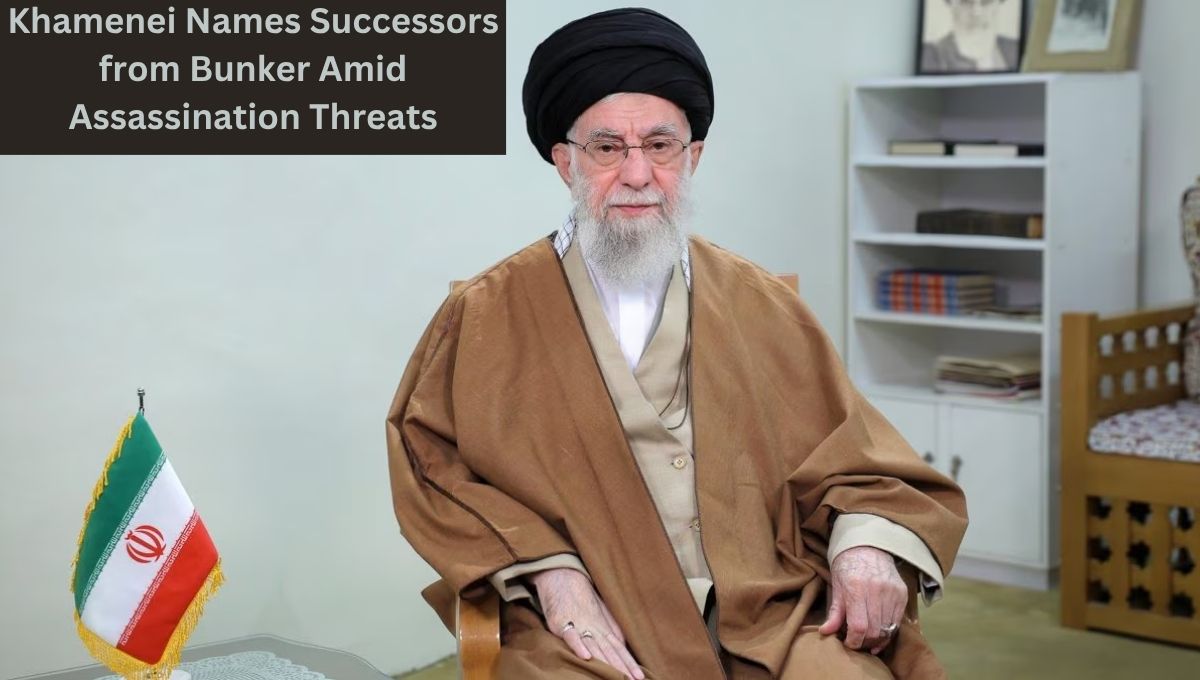
As Israel-Iran tensions escalate into full-blown military confrontation, Khamenei Names Successors from Bunker Amid Assassination Threats. Iran’s Supreme Leader Ayatollah Ali Khamenei has taken an extraordinary step to secure the Islamic Republic’s continuity.
According to The New York Times, Khamenei has named three senior clerics as potential successors in the event of his death, while sheltering in a fortified underground bunker in Tehran. These rare and decisive moves come as Israeli airstrikes kill hundreds, the U.S. moves B-2 bombers closer to Iran, and the Iranian capital remains partially paralyzed by a total internet blackout.
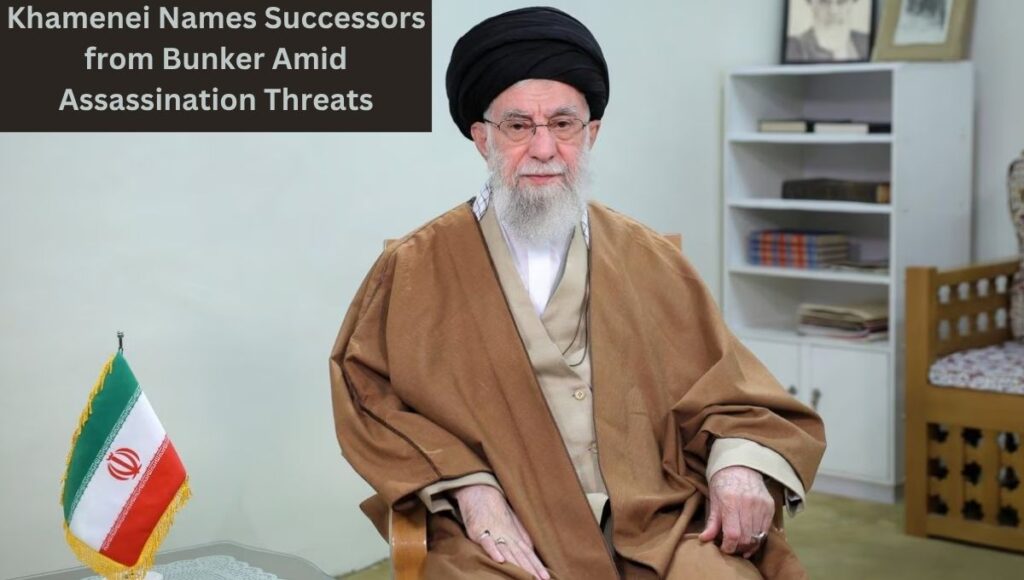
Khamenei Names Successors from Bunker Amid Assassination Threats
No Mojtaba: Son Excluded from Khamenei’s Successor List
One of the most surprising revelations is that Khamenei’s son, Mojtaba Khamenei, long rumored to be groomed for succession, is not among the candidates. Iranian officials told NYT that despite his close ties with the Islamic Revolutionary Guard Corps (IRGC), Mojtaba has been excluded from the shortlist of clerics hand-picked by his father.
This contradicts years of speculation that Mojtaba would inherit leadership, with analysts now seeing his exclusion as a strategic decision to avoid allegations of dynastic politics or internal backlash.
Iran’s Supreme Leader Prepares for the Worst in a Hidden Bunker
Sources indicate that the 86-year-old Khamenei is living in the “beit rahbari” the heavily fortified “leader’s house” bunker in central Tehran. Due to credible assassination threats, he has cut off all electronic communication around him and speaks only through a trusted aide.
This level of isolation is unprecedented, even for a regime that prizes secrecy. Khamenei is believed to be completely off-grid, as Iran’s enemies, including Israel and the U.S., intensify rhetoric and military movement targeting top leadership.
Assembly of Experts Instructed to Act Swiftly
According to the Iranian constitution, the Assembly of Experts, an 88-member clerical council, is tasked with electing the Supreme Leader. Historically, this process has taken weeks or even months of deliberation.
However, the NYT report says Khamenei has issued direct instructions to accelerate the process if he is killed. Iranian officials quoted in the article said that Khamenei wants the Assembly to choose from the three clerics he has personally selected, in order to ensure a swift, controlled transition that protects the state and his ideological legacy.
Khamenei Sees Potential Death as Martyrdom
In internal discussions, Khamenei reportedly views a potential assassination as “martyrdom” and has prepared the Islamic Republic to continue functioning without him. With several of his top military commanders already killed in Israeli strikes, the urgency to solidify leadership plans has never been greater.
Iranian media reports suggest that 430 people have been killed and over 3,500 injured in Israel’s ongoing air campaign, which has targeted military facilities, nuclear infrastructure, and even residential areas across Tehran and Isfahan.
Trump Confirms US Knows Khamenei’s Location
U.S. President Donald Trump, who has thus far resisted immediate military action, hinted that Washington knows Khamenei’s exact location and could eliminate him if desired.
“We know exactly where the so-called ‘Supreme Leader’ is hiding. He is an easy target… but is safe there – We are not going to take him out (kill!), at least not for now,” Trump wrote on Truth Social.
The ambiguous tone underscores the strategic chess game being played, with U.S. stealth bombers already repositioning near Iran.
Israel: “No One Is Immune”
On the Israeli side, Defense Minister Israel Katz and Prime Minister Benjamin Netanyahu have openly suggested that the Iranian leadership, including Khamenei himself, could become direct military targets.
“No one is immune,” Netanyahu said when asked if Israel would consider targeting the Supreme Leader directly.
This aggressive stance came after an Iranian missile reportedly struck a hospital near Tel Aviv, prompting Israeli officials to label Khamenei a war criminal and increase pressure on military assets in Tehran.
U.S. Stealth Bombers Move into Strategic Positions
Amid the crisis, the U.S. Air Force’s B-2 Spirit stealth bombers were spotted crossing the Pacific Ocean on Saturday, with flight data confirming departures from central U.S. bases toward the California coast.
These long-range aircraft are capable of delivering the Massive Ordnance Penetrator (MOP) a 30,000-pound “bunker-buster” bomb designed to penetrate hardened underground structures like Iran’s Fordow nuclear facility.
While Trump has given diplomacy a two-week window, the mobilization of B-2 bombers and aerial refueling jets points to growing U.S. readiness for direct strikes on Iranian nuclear and command facilities.
Internet Shutdown in Iran Raises Fears of State Control
Iran has entered its fifth day of a nationwide internet blackout, with the digital rights group NetBlocks.org confirming that limited connectivity briefly restored Saturday has once again collapsed.
Iranian officials claim the shutdown is a precaution against Israeli cyberattacks, but rights activists call it a tactic of authoritarian information control.
The blackout has cut off millions of Iranians from the outside world, raising fears of unreported casualties and massive disruptions to communication and emergency services.
Iran Restructures Military Command Amid Losses
Alongside political succession planning, Khamenei has reportedly begun selecting replacements for key military commanders, many of whom have been eliminated in targeted Israeli strikes.
This preparation signals the depth of the threat perception within Iran’s leadership. Experts say that the decapitation of Iran’s military chain of command would have been unthinkable weeks ago, but is now a present and growing reality.
European Diplomacy Fails as Geneva Talks Collapse
Talks between European foreign ministers and Iran’s top diplomat in Geneva on Friday failed to produce a breakthrough, with Iranian Foreign Minister Abbas Araghchi saying his government remains open to dialogue but only after Israeli attacks cease.
While European diplomats still hope for de-escalation, Iran has made clear that active military aggression cannot coexist with diplomacy.
Iran-Israel War: Week Two Begins with New Strikes
The second week of the Israel-Iran war began with a renewed Israeli airstrike on a nuclear research facility near Isfahan, according to reports from the Associated Press.
The move follows last week’s U.S.-approved bombing of Fordow, where B-2 bombers reportedly dropped multiple bunker-busting bombs.
Iran retaliated with drone and missile barrages, which triggered air defense systems across Tehran, further inflaming the already volatile situation.
Preservation of the State Above All Else
Experts say Khamenei’s proactive planning reflects a deeply pragmatic side of a leader often characterized as ideological.
Vali Nasr, a noted Iran expert from Johns Hopkins University, told The New York Times: “The top priority is the preservation of the state… It is all calculative and pragmatic.”
This comment reinforces the notion that Khamenei is more focused on ensuring stability than promoting personal loyalties or ideological purity in his potential successors.
Conclusion: A Nation on the Edge of Collapse or Rebirth
Iran’s internal and external crises have converged at a historic crossroads. With a Supreme Leader in hiding, the military command in flux, thousands dead or injured, and global powers circling, the Islamic Republic is under unprecedented pressure.
Khamenei’s naming of successors, exclusion of his own son, and reorganization of Iran’s war command may be enough to preserve regime continuity or may simply signal the end of an era.
As the next days unfold, all eyes will be on Trump’s decision, Israel’s next move, and the ability of Iran’s fragile leadership structure to survive the most serious threat to its existence since 1979.
Also Read: Khamenei Warns of “Irreparable Damage” as Trump Demands Iran’s Surrender
Also Read: Khamenei Hiding In Bunker With Communications Cut Off Amid Assassination Threats: Report
Related Posts:
- Afghanistan Internet Blackout: Taliban Cuts Telecom,…

- 7 Powerful Facts About Ayatollah Ali Khamenei’s…
- 7 Explosive Revelations Behind Iran’s Starlink Kill…
- 7 Explosive Shifts: Mojtaba Khamenei Named Iran’s…
- 3 Explosive Conditions Iran Sets to End War with US…

- 5 Major Takeaways from the US Supreme Court's…