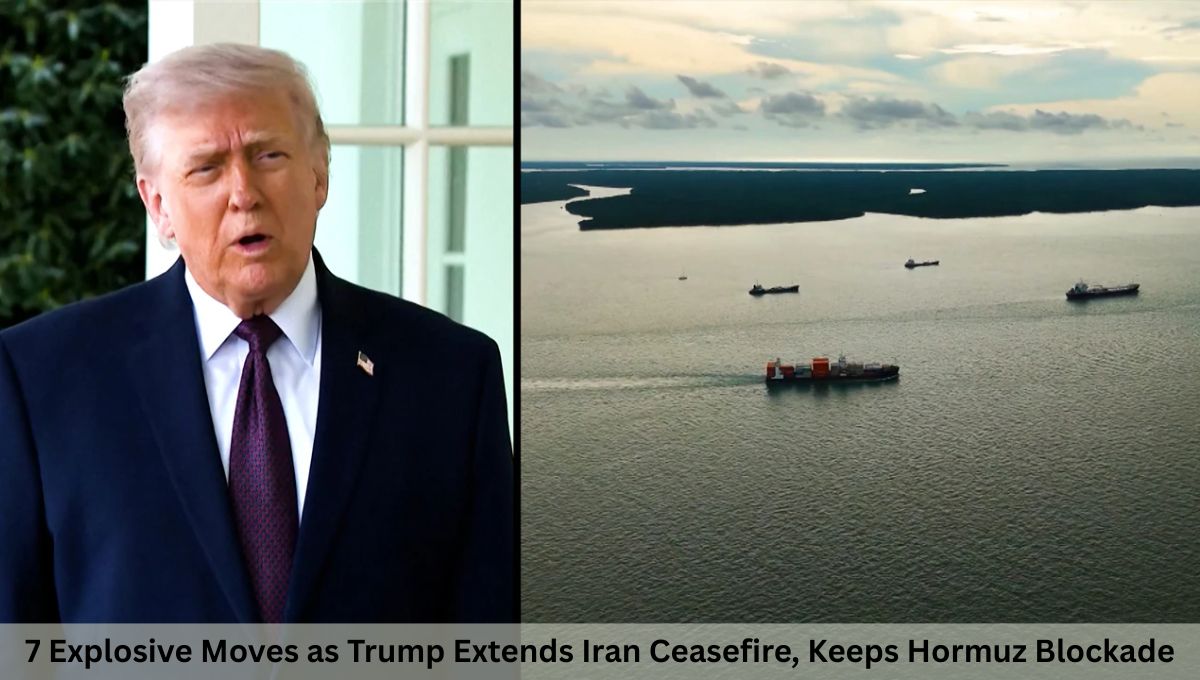
7 Explosive Moves as Trump Extends Iran Ceasefire, Keeps Hormuz Blockade, complicating global peace negotiations. The geopolitical landscape shifted sharply after US President Donald Trump announced an indefinite extension of the ceasefire with Iran, just hours before the truce was set to expire.
The decision, widely seen as a significant U-turn, has added a new layer of complexity to an already volatile conflict that has shaken global markets, disrupted energy supply chains, and heightened fears of a broader regional war.
While the extension signals a temporary pause in direct military confrontation, Trump made it clear that pressure on Tehran would not ease.
The United States will continue its naval blockade of Iranian ports and maintain a strong military posture, keeping the threat of renewed conflict firmly on the table.
7 Explosive Moves as Trump Extends Iran Ceasefire, Keeps Hormuz Blockade
A Last-Minute Reversal That Changed the Equation
In a move that surprised both allies and adversaries, Trump reversed his earlier stance against extending the ceasefire.
Just hours before the deadline, he had indicated that military action could resume, even suggesting that bombing Iran remained a likely outcome.
However, citing diplomatic efforts and internal instability within Iran, Trump opted to delay escalation.
According to his statement, the extension was granted to allow Iran’s leadership time to consolidate and present a unified proposal for peace talks.
He described the Iranian government as “seriously fractured,” suggesting that internal divisions were a key factor behind the decision.
This abrupt shift underscores the fluid nature of the conflict, where military brinkmanship and diplomacy are unfolding simultaneously.
Pakistan’s Crucial Role in De-escalation
A major factor behind the ceasefire extension was the intervention of Pakistan, which has emerged as a key mediator in the crisis.
Pakistani leadership reportedly urged Washington to delay military action to create space for diplomacy. The appeal appears to have played a decisive role in influencing Trump’s decision.
Islamabad had been preparing to host a second round of high-level talks between US and Iranian officials.
However, uncertainty continues to cloud these efforts, with no confirmed timeline and Iran yet to fully commit to participation.
Despite this, Pakistan remains central to ongoing diplomatic efforts, positioning itself as a bridge between two deeply hostile nations.
Ceasefire Extended, But Pressure Intensifies
While the ceasefire extension may suggest de-escalation, the continuation of the US naval blockade tells a different story.
Trump explicitly stated that American forces would remain “ready and able,” signaling that military options remain active.
The blockade, particularly around key Iranian ports and maritime routes, continues to choke Iran’s economic lifelines.
For Tehran, the blockade is more than just an economic measure—it is viewed as an act of war.
Iranian officials have repeatedly warned that they will respond forcefully to any attempt to restrict their maritime activities.
This creates a paradox:
while direct hostilities are paused, underlying tensions are intensifying.
Strait of Hormuz: The Global Flashpoint
At the heart of the crisis lies the Strait of Hormuz, one of the world’s most critical energy chokepoints.
Roughly 20% of global oil and gas supplies pass through this narrow waterway. Any disruption here has immediate and far-reaching consequences for global energy markets.
Iran’s actions to restrict access to the strait, combined with the US blockade, have effectively turned the region into a high-risk zone for international shipping.
Oil prices have already surged significantly since the conflict began, reflecting fears of prolonged disruption.
Countries heavily dependent on Middle Eastern energy supplies are closely monitoring developments, as even a minor escalation could trigger a major economic shock.
Conflicting Signals and Strategic Ambiguity
One of the defining features of this crisis is the conflicting messaging from Washington.
On one hand, Trump has projected confidence, claiming the US is in a strong negotiating position and will ultimately secure a “great deal.”
On the other, his administration has sent mixed signals regarding military action and diplomatic engagement.
The postponement of a planned US delegation visit to Pakistan further adds to the uncertainty.
Initially expected to include senior officials, the trip was delayed indefinitely, raising questions about the seriousness and readiness of negotiations.
This strategic ambiguity may be intentional—designed to keep Iran off balance—but it also risks undermining trust and complicating diplomatic efforts.
Iran’s Response: Defiance and Distrust
Iran’s reaction to the ceasefire extension has been cautious at best and openly hostile at worst.
Officials in Tehran have dismissed the extension as a tactical maneuver by the United States to buy time for a potential surprise attack.
Some have argued that a ceasefire without lifting the blockade holds little value. Iran has also reiterated its readiness to respond militarily if provoked.
Military leaders have issued stark warnings, emphasizing that any aggression would be met with immediate and forceful retaliation.
This hardline stance reflects deeper internal divisions within Iran, where competing factions are debating whether to engage in negotiations or adopt a more confrontational approach.
Internal Divisions Within Iran
Trump’s reference to a “fractured” Iranian government points to a critical dynamic shaping the conflict.
Reports suggest that Iran’s leadership is divided between those favoring continued negotiations and hardliners opposing any concessions under pressure.
Civilian leaders appear more inclined toward diplomacy, recognizing the economic and strategic costs of prolonged conflict.
Meanwhile, elements within the military establishment remain deeply skeptical of US intentions.
These internal tensions have slowed decision-making and contributed to Iran’s noncommittal stance on upcoming talks.
The Risk of Escalation Still Looms
Despite the ceasefire extension, the risk of renewed conflict remains high.
Both sides have accused each other of violating the truce, and incidents at sea—including the interception of vessels—have further inflamed tensions.
Iran has also issued threats against regional oil infrastructure, warning neighboring countries against supporting US military actions.
Such rhetoric raises the possibility of a broader regional conflict involving multiple actors.
Meanwhile, Israel and Hezbollah remain engaged in a separate but related ceasefire, adding another layer of complexity to the situation.
Global Economic Impact
The conflict has already had significant repercussions for the global economy.
Energy markets have been particularly sensitive, with oil prices rising sharply amid fears of supply disruptions.
The uncertainty surrounding the Strait of Hormuz has amplified these concerns.
Beyond energy, the conflict has affected global trade routes, investor confidence, and financial markets.
Even the hint of escalation can trigger volatility, highlighting the interconnected nature of modern geopolitics.
For many countries, especially those reliant on energy imports, the stakes could not be higher.
Life Inside Iran: A Nation Under Strain
While geopolitical strategies dominate headlines, the human impact of the conflict is equally significant.
Reports from within Iran suggest that everyday life has become increasingly difficult, even during the ceasefire.
Economic pressures, combined with uncertainty about the future, have created a sense of despair among many citizens.
The ongoing blockade has exacerbated shortages and driven up prices, placing additional strain on households.
For many Iranians, the ceasefire has not brought relief but rather prolonged uncertainty.
Diplomatic Path Forward: Uncertain and Fragile
The extension of the ceasefire provides a window for diplomacy, but the path forward remains unclear.
Key questions remain unanswered:
- Will Iran present a unified proposal?
- Can trust be rebuilt between the two sides?
- Will the blockade become a deal-breaker?
The success of any negotiations will depend on addressing these core issues.
Pakistan’s role as a mediator will be critical, but achieving a lasting resolution will require significant concessions from both sides.
Strategic Calculations Behind the U-Turn
Trump’s decision to extend the ceasefire can be seen as a calculated move rather than a simple reversal.
By maintaining the blockade while pausing direct attacks, the US retains leverage without escalating into full-scale war.
This approach allows Washington to pressure Tehran economically while keeping diplomatic options open. However, this strategy also carries risks.
Prolonged pressure without progress could push Iran toward more aggressive actions, potentially triggering the very conflict the ceasefire seeks to avoid.
What Comes Next?
The coming days will be crucial in determining the trajectory of the conflict. If Iran submits a proposal and negotiations resume, there is a chance for de-escalation.
However, if talks stall or collapse, the region could quickly slide back into open conflict. The fragile balance between diplomacy and confrontation will define the next phase of this crisis.
Conclusion: A Pause, Not Peace
Trump’s decision to extend the Iran ceasefire marks a critical moment in the conflict, but it is far from a resolution.
The continuation of the blockade, combined with deep mistrust on both sides, means that tensions remain dangerously high.
For now, the world is watching a high-stakes standoff where every move carries global consequences.
The ceasefire may have bought time—but whether that time leads to peace or renewed conflict remains uncertain.
Also Read: 7 Explosive Developments as Netanyahu Pushes Lebanon Talks Amid Fragile Iran Ceasefire
Also Read: Iran ceasefire: Why the US hit pause instead of push
Related Posts:
- 11 Explosive Warnings as Trump Vows to ‘Knock the…

- 12 Explosive Claims as Donald Trump Says Iran War…
- Trump’s 2025 Gaza Peace Plan Signing and Historic…

- 9 Explosive Revelations as Trump Declares His Health…

- 7 Shocking Reasons FIFA’s Peace Prize for Trump…

- 10 Explosive Signals Trump Says Iran War Could End…