Amid Iran-US conflict Iran Eyes Hormuz Closure After US Strikes: What It Means for India. Iran has taken center stage in the global energy conversation after hinting at the closure of the Strait of Hormuz, a crucial oil passage, following US-led airstrikes on its nuclear facilities. If Iran follows through, the implications for the world economy and for major oil importers like India could be seismic.
With nearly 20% of the world’s oil supply flowing through this narrow corridor, any disruption could spike fuel prices, inflame geopolitical tensions, and strain already fragile global supply chains.
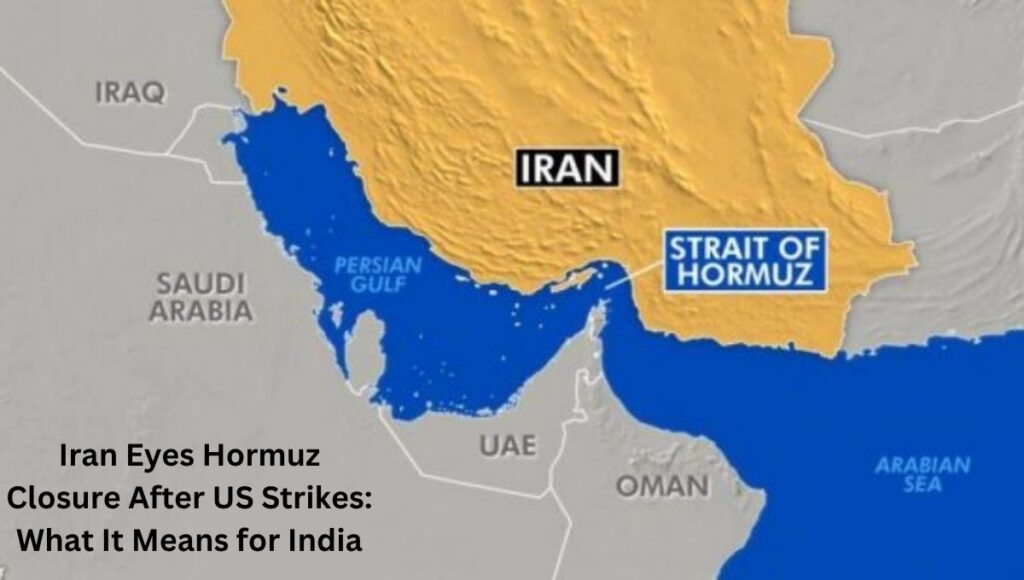
Iran Eyes Hormuz Closure After US Strikes: What It Means for India
What Sparked the Threat? Operation Midnight Hammer
Tensions soared this week as U.S. President Donald Trump confirmed military airstrikes on Iran’s nuclear sites at Fordow, Natanz, and Isfahan.
The operation, codenamed Midnight Hammer, included over 125 aircraft, B-2 stealth bombers, and submarine-launched Tomahawk missiles.
Though Washington claims to have “obliterated” the targets, Iranian officials insist the damage was limited and vowed retaliation.
One of the most serious retaliatory options now on the table is closing the Strait of Hormuz, a move that could trigger economic shockwaves worldwide.
Strait of Hormuz: The World’s Most Strategic Oil Artery
The Strait of Hormuz is a narrow maritime chokepoint situated between Iran and Oman, linking the Persian Gulf with the Arabian Sea and the Indian Ocean.
At its narrowest, it’s just 33 kilometers wide, but the actual navigable shipping lanes are only 3 kilometers wide in either direction.
Every day, approximately 20 million barrels of crude oil pass through Hormuz. That’s one-fifth of global daily oil consumption.
Major oil exporters relying on this route include:
- Saudi Arabia
- Iraq
- UAE
- Kuwait
- Qatar
- Iran itself
Any closure would drastically choke the flow of oil and gas to Asia and beyond.
India’s Reliance on Hormuz: Cause for Concern?
India is one of the world’s top oil importers, bringing in about 5.5 million barrels per day (bpd). Of that, nearly 2 million bpd or 40% passes through the Strait of Hormuz, sourced from:
- Iraq
- Saudi Arabia
- UAE
- Kuwait
A Hormuz shutdown could potentially:
- Disrupt tanker routes and supply timelines.
- Increase freight costs due to rerouting.
- Cause short-term fuel price spikes and domestic inflation.
Energy Minister Reassures Public: India Has Diversified
In response to rising fears, India’s Minister for Petroleum and Natural Gas, Hardeep Singh Puri, issued a public statement on X:
“A large volume of our supplies do not come through the Strait of Hormuz now. Our Oil Marketing Companies have supplies of several weeks and continue to receive energy supplies from several routes.”
India’s Risk Mitigation Strategies:
- Russian Oil: Now a major supplier to India, Russian crude bypasses Hormuz and is shipped via the Suez Canal, Cape of Good Hope, or the Pacific Ocean.
- LNG from Qatar: Despite being geographically close, Qatar’s LNG supply routes do not pass through Hormuz.
- Alternate LNG Suppliers: India also imports gas from Australia, Russia, and the United States, ensuring redundancy in supply lines.
- Strategic Petroleum Reserves: India has multiple weeks’ worth of oil reserves to cushion short-term disruptions.
Market Reactions: Oil Prices Already Climbing
The threat of Hormuz closure has already rattled oil markets. On Monday:
- Brent Crude jumped over 3%, hitting $81.40 per barrel before stabilizing around $77.73.
- West Texas Intermediate (WTI) surged to $78.40, later cooling to $74.55.
Expert Predictions:
- Goldman Sachs estimates Brent could briefly spike to $110, even if Hormuz flow is only halved for a month.
- Longer-term disruption could push prices to $120 per barrel.
- Sugandha Sachdeva, head of SS WealthStreet, believes geopolitical fear alone could push prices to $100.
Global Stakeholders React: Diplomacy in Overdrive
🇺🇸 United States:
US Secretary of State Marco Rubio warned that closure would be “economic suicide” for Iran and urged China to pressure Tehran.
“If they close the Strait, it would hurt others worse than us. I encourage Beijing to call them about that,” he told Fox News.
🇨🇳 China:
China the biggest buyer of Iranian oil, with over 1.8 million bpd has called for restraint and blamed US strikes for escalating the crisis.
🇷🇺 Russia:
Russian President Vladimir Putin is scheduled to meet Iran’s Foreign Minister Abbas Araqchi in Moscow, signaling growing concern from Tehran’s strategic allies.
🇯🇵 Japan & 🇰🇷 South Korea:
Both nations have voiced alarm over energy supply stability, given their heavy dependence on Gulf oil shipped via Hormuz.
Could Iran Actually Afford to Close the Strait?
Despite its threats, many analysts believe a full closure is unlikely or unsustainable for Iran.
🔻 Downsides for Iran:
- Iran’s own oil exports would be cut off, depriving the country of vital revenue.
- Closure would anger China and other friendly trading nations.
- Likely response from US Navy and coalition forces in the Gulf could escalate into open warfare.
- Could isolate Iran diplomatically, even among sympathetic Gulf neighbors like Qatar and UAE.
“Iran has too much to lose and very little to gain by attempting to close the Strait,” said Vandana Hari, energy analyst and CEO of Vanda Insights.
A Calculated Bluff or Prelude to Escalation?
Iranian parliament has reportedly approved a motion to close Hormuz, but the final call rests with the Supreme National Security Council, headed by Ayatollah Khamenei.
Experts believe Tehran may be leveraging the threat to:
- Gain diplomatic leverage in backchannel talks.
- Deter further US-Israel strikes.
- Galvanize domestic support and project strength.
Still, even rhetoric about closure is enough to unsettle oil markets and pressure importers like India to boost preparedness.
Conclusion: No Immediate Crisis, but Vigilance Required
While the Strait of Hormuz faces its gravest threat in years, India appears relatively insulated thanks to energy diversification, diplomatic channels, and reserves.
That said, global markets remain fragile, and oil prices will likely stay volatile in the near future.
For India, the path forward is clear:
- Continue strengthening energy partnerships beyond the Middle East.
- Monitor supply routes and freight costs.
- Engage diplomatically with Gulf allies and global powers to prevent escalation.
In a world still healing from pandemic shocks and supply chain fragility, another energy crisis is the last thing the global economy needs.
Also Read: Israel Strikes Khorramshahr Missile Sites in Iran as US Joins with Massive Nuclear Facility Bombing
Also Read: Why all eyes are on the Strait of Hormuz, a 90-mile strip critical to global oil prices
Related Posts:
- 7 Critical Ways Iran’s Yuan Oil Plan Could Shake the…
- 3 Explosive Conditions Iran Sets to End War with US…

- 7 Shocking Reasons Trump Says Oil Spike Is “Worth…

- 10 Explosive Warnings as Donald Trump Calls Iran…

- 10 Explosive Signals Trump Says Iran War Could End…

- 10 Powerful Revelations from the Trump–Putin Call on…