
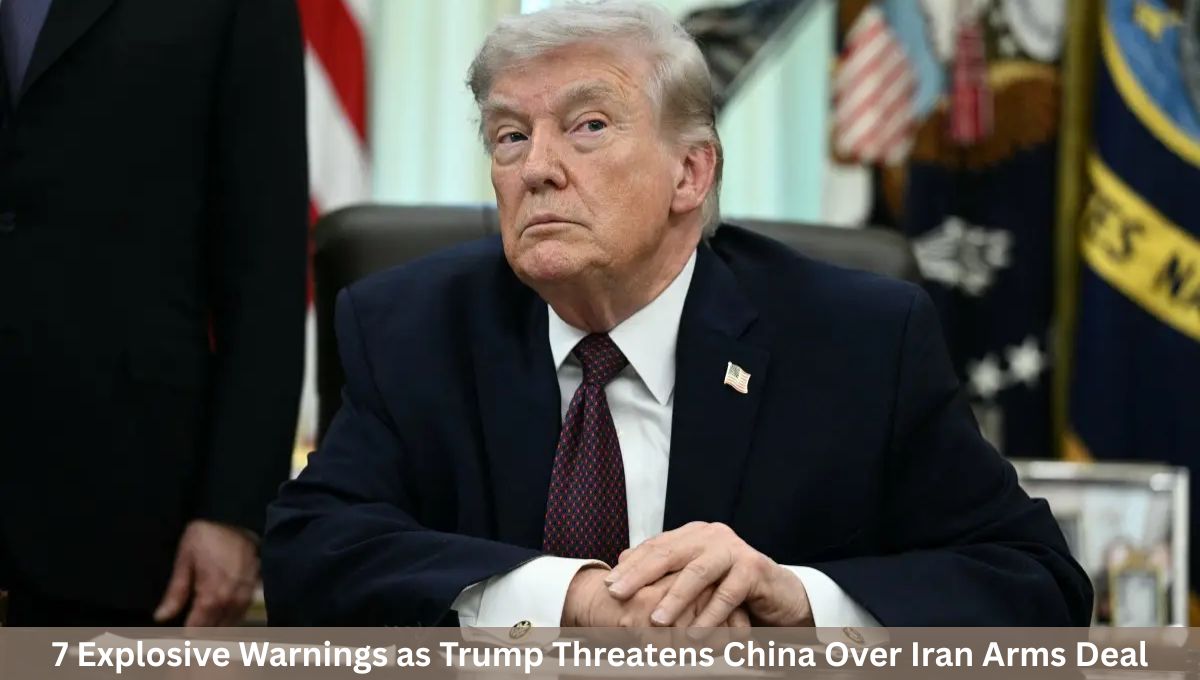
7 Explosive Warnings as Trump Threatens China Over Iran Arms Deal, with 50% tariffs. The fragile geopolitical balance in the Middle East faces renewed uncertainty after US President Donald Trump issued a stark warning to China over alleged plans to supply weapons to Iran.
Thank you for reading this post, don't forget to subscribe!With tensions already high following a six-week conflict and a shaky ceasefire, Trump’s remarks signal a potential escalation that could ripple across global trade, energy markets, and international diplomacy.
At the center of the controversy are intelligence reports suggesting Beijing may be preparing to deliver advanced air defense systems to Tehran—possibly through indirect channels.
While China has categorically denied these allegations, Washington’s response has been swift and forceful, raising concerns of a broader geopolitical confrontation.
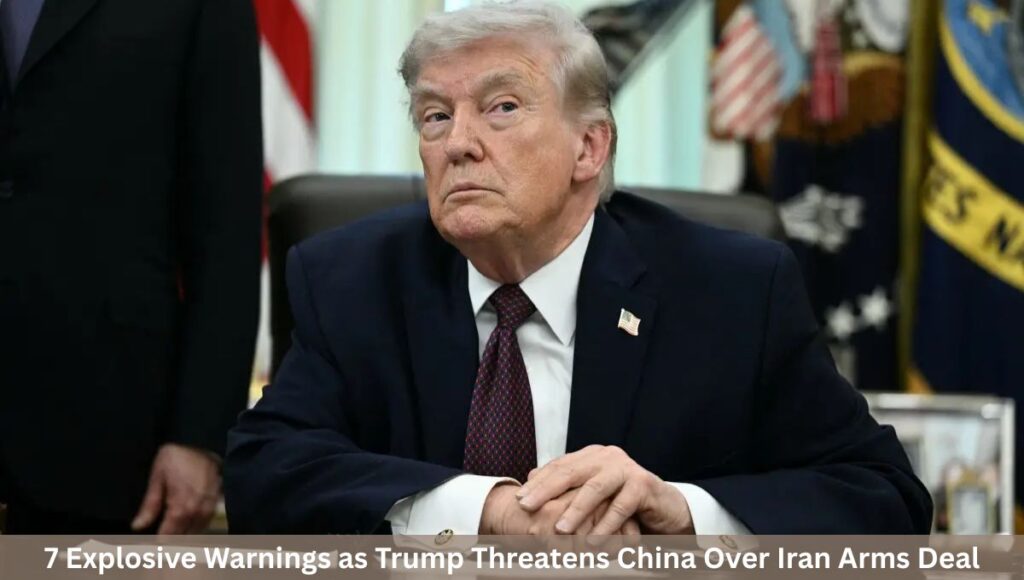
7 Explosive Warnings as Trump Threatens China Over Iran Arms Deal
Rising Tensions After Failed US–Iran Talks
Recent diplomatic efforts aimed at stabilizing the region have faltered.
Marathon negotiations held in Islamabad between US and Iranian officials failed to produce a breakthrough, despite reportedly making progress on several issues.
The talks, mediated by Pakistan, were seen as a critical opportunity to solidify a ceasefire that temporarily paused intense hostilities.
However, deep disagreements—particularly over Iran’s nuclear ambitions—proved insurmountable.
As a result, the ceasefire remains fragile, with both sides maintaining military readiness and signaling that hostilities could resume at any moment.
Trump’s “Big Problem” Warning to China
Amid this volatile backdrop, Trump delivered a blunt warning regarding China’s alleged involvement.
Speaking to reporters and later in a televised interview, he stated:
“If China does that, China is going to have big problems.”
The warning refers to reports that Beijing may provide Iran with military hardware, including shoulder-fired anti-aircraft systems (MANPADS).
Such weapons could significantly enhance Iran’s ability to counter low-flying aircraft, posing a serious challenge to US and allied forces in the region.
Trump’s comments underscore Washington’s zero-tolerance stance toward any external military support for Tehran during the ongoing crisis.
Threat of 50% Tariffs: Economic Warfare Signals
In a further escalation, Trump threatened to impose massive economic penalties on China if it is found aiding Iran militarily.
“If we catch them doing that, they get a 50 percent tariff… that’s a staggering amount.”
This proposed tariff represents more than just a trade measure—it signals a strategic use of economic leverage to influence geopolitical behavior.
Key Implications:
- Trade War Risk: A 50% tariff could severely disrupt US-China trade relations.
- Global Market Shock: Investors may react negatively to escalating tensions between the world’s two largest economies.
- Supply Chain Disruptions: Increased tariffs could impact manufacturing, technology, and energy sectors worldwide.
The move also highlights how economic tools are increasingly being deployed as instruments of foreign policy.
China’s Firm Denial and Strategic Positioning
China has strongly rejected the allegations, calling them baseless and urging restraint.
A spokesperson from China’s defense ministry stated that Beijing has not supplied weapons to any party involved in the conflict and opposes the spread of misinformation.
China’s Strategic Interests:
- Energy Security: Iran remains a key oil supplier to China.
- Diplomatic Balance: Beijing seeks to maintain neutrality while preserving ties with both Iran and global markets.
- Global Image: Positioning itself as a mediator rather than a participant in conflicts.
Despite its denial, analysts note that China has historically provided Iran with dual-use technologies—items that can serve both civilian and military purposes.
Intelligence Reports: What the US Claims
According to intelligence assessments cited in reports, China may be preparing to send:
- Air defense systems
- MANPADS (shoulder-fired missiles)
- Potential dual-use technologies
These shipments could reportedly be routed through third countries to obscure their origin, complicating detection and verification efforts.
If confirmed, such transfers would mark a significant escalation, potentially altering the balance of power in the region.
Strait of Hormuz: A Flashpoint for Global Crisis
Adding to the tension is the strategic importance of the Strait of Hormuz, one of the world’s most critical oil transit chokepoints.
Trump has announced aggressive measures to secure the waterway, including:
- Deployment of minesweepers
- Increased naval presence
- Potential blockade of vessels entering or leaving the strait
Why It Matters:
- 20% of global oil passes through the strait
- Any disruption could trigger a surge in oil prices
- Global supply chains would face immediate stress
Iran, however, has warned that it maintains full control over the waterway and will respond forcefully to any perceived aggression.
Trump’s Dual Strategy: Threats and Incentives
Interestingly, Trump paired his threats with an economic incentive aimed at China.
He suggested that Beijing could purchase oil from the United States instead of Iran—potentially at lower prices.
“We have a lot of overcapacity, and we’ll probably sell for even less money.”
This dual-track approach—combining pressure with incentives—reflects a broader strategy to isolate Iran while drawing China closer to US economic interests.
Military Posturing and Escalation Risks
Trump also made strong statements about US military capabilities, claiming the ability to cripple Iran’s infrastructure rapidly.
“I could take out Iran in one day… their entire energy system.”
Such rhetoric, while likely intended as deterrence, raises concerns about escalation:
- Miscalculation Risk: Strong language can lead to unintended military responses.
- Regional Instability: Neighboring countries may be drawn into conflict.
- Global Security Concerns: Heightened tensions between major powers increase uncertainty.
The Role of Ceasefire and Diplomatic Uncertainty
Despite the aggressive tone, Trump expressed confidence that Iran would eventually return to negotiations.
However, several challenges remain:
- Lack of trust between parties
- Disagreements over nuclear policy
- External influences, including China and regional allies
The ceasefire, while holding for now, appears increasingly fragile as geopolitical pressures mount.
Global Implications: Why This Matters
This unfolding situation has far-reaching consequences beyond the Middle East.
1. Energy Markets
Any disruption in oil supply could lead to price spikes, affecting economies worldwide.
2. Trade Relations
Escalating US-China tensions could impact global trade flows and economic stability.
3. Security Alliances
Countries may be forced to take sides, reshaping international alliances.
4. Military Balance
Potential arms transfers could shift regional power dynamics.
What Comes Next?
Several scenarios could emerge in the coming weeks:
Scenario 1: De-escalation
- China refrains from involvement
- Iran returns to negotiations
- Ceasefire stabilizes
Scenario 2: Economic Conflict
- US imposes tariffs on China
- Trade tensions escalate
- Global markets react negatively
Scenario 3: Military Escalation
- Arms transfers occur
- Conflict resumes
- Strait of Hormuz becomes a battleground
Each scenario carries significant risks, making this one of the most closely watched geopolitical developments.
Conclusion
Trump’s warning to China marks a critical moment in an already volatile geopolitical landscape.
By linking military support for Iran to severe economic consequences, the United States is signaling a willingness to escalate both diplomatically and economically.
With China denying involvement, Iran rebuilding its defenses, and the ceasefire hanging in the balance, the situation remains fluid and unpredictable.
For global audiences, the stakes are clear:
energy security, economic stability, and international peace all hang in the balance as this high-stakes geopolitical drama continues to unfold.
Also Read: 7 Alarming Signs China’s Deep-Sea Mapping Could Transform Submarine Warfare
Also Read: China, Iran Close To Deal For Missiles That Can Sink Aircraft Carriers
Related Posts:
- 7 Crucial Insights Into Trump and Xi’s High-Stakes…
- 11 Explosive Warnings as Trump Vows to ‘Knock the…

- Trump's 3 Blunt Warnings to China and Russia Over…
- 10 Big Takeaways from Trump’s 155% Tariff Warning to China

- Can the EU and NATO Impose Tariffs on India and…

- Trump’s 2025 Gaza Peace Plan Signing and Historic…
