
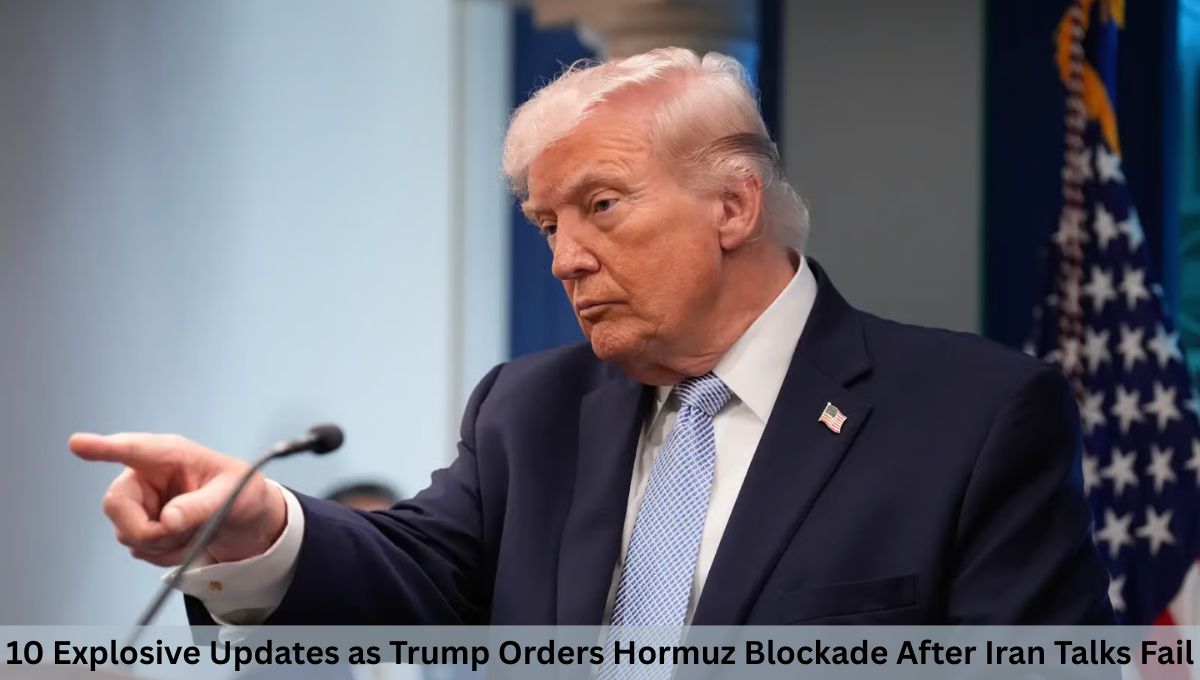
10 Explosive Updates as Trump Orders Hormuz Blockade After Iran Talks Fail, threatening global oil supply. In a dramatic escalation of geopolitical tensions, US President Donald Trump has ordered a naval blockade of the Strait of Hormuz following the collapse of high-stakes peace talks with Iran.
The announcement came just hours after marathon negotiations in Islamabad failed to produce a breakthrough, marking a critical turning point in an already volatile conflict.
The move signals a shift from diplomacy toward coercive maritime enforcement, raising serious concerns about global energy security, regional stability, and the future of a fragile ceasefire.
10 Explosive Updates as Trump Orders Hormuz Blockade After Iran Talks Fail
21-Hour Talks End Without Agreement
The talks between the United States and Iran, mediated by Pakistan, lasted nearly 21 hours and involved multiple rounds of negotiations.
Despite initial optimism and progress on several issues, both sides failed to resolve their core disagreement:
Iran’s nuclear program.
US Vice President JD Vance, who led the American delegation, described the discussions as “substantive” but ultimately inconclusive.
He confirmed that Washington had presented its “final and best offer,” which Tehran declined to accept.
The negotiations marked the highest-level direct engagement between the two nations in more than a decade, but the outcome highlighted the deep mistrust and conflicting strategic priorities that continue to define US–Iran relations.
Trump Announces Immediate Blockade
Following the collapse of talks, Trump took to social media to announce a sweeping military directive.
He declared that the United States Navy would begin the process of blocking all ships attempting to enter or leave the Strait of Hormuz.
The directive also includes intercepting vessels suspected of paying transit fees to Iran and clearing alleged naval mines from the waterway.
The language used in the announcement was forceful, leaving little ambiguity about the seriousness of the move.
Trump framed the blockade as a necessary response to what he described as Iranian “extortion” and failure to keep the vital shipping route open.
Why the Strait of Hormuz Matters
The Strait of Hormuz is one of the most strategically important waterways in the world.
It serves as a critical chokepoint for global oil transportation, with approximately 20% of the world’s crude oil passing through it daily.
Any disruption in this narrow passage can have immediate and far-reaching consequences, including:
- Sharp increases in oil prices
- Disruptions to global supply chains
- Increased shipping and insurance costs
- Economic instability across multiple regions
By ordering a blockade, the United States is effectively placing control over a vital artery of the global economy at the center of its confrontation with Iran.
Nuclear Program: The Breaking Point
Despite progress on other issues, the negotiations ultimately failed over Iran’s nuclear ambitions.
The United States demanded a clear and binding commitment from Iran that it would not develop nuclear weapons or the capabilities required to produce them quickly.
This condition was described as non-negotiable.
Trump emphasized that while “most points were agreed to,” the nuclear issue remained unresolved, calling it the only matter that truly mattered.
Iran, however, maintained its long-standing position that its nuclear program is intended for peaceful purposes and refused to abandon its right to uranium enrichment.
This fundamental disagreement proved impossible to bridge during the talks.
Iran Pushes Back Against US Claims
Iranian officials strongly rejected the US narrative, accusing Washington of imposing unrealistic and excessive demands.
Tehran insisted that it had engaged in negotiations in good faith and proposed constructive solutions.
However, it argued that the US failed to demonstrate the flexibility needed to reach an agreement.
Iran also highlighted a lack of trust as a major obstacle, suggesting that any future deal would require credible assurances from Washington.
Additionally, Iranian authorities denied US claims about naval mines and disputed reports regarding military encounters in the Strait of Hormuz.
Even before the blockade announcement, tensions in the Strait of Hormuz had been escalating.
US warships reportedly entered the region as part of a mine-clearing operation aimed at securing safe passage for commercial vessels.
American officials stated that the operation was necessary to restore confidence in maritime routes.
Iran, however, contested these claims, asserting that it maintains control over the strait and warning that any foreign military presence could provoke a strong response.
Reports from Iranian media suggested that US vessels were monitored closely and warned to retreat, highlighting the risk of direct confrontation.
Crackdown on Shipping and “Illegal Tolls”
A key aspect of Trump’s directive involves targeting vessels that pay transit fees to Iran.
The US administration has characterized these payments as illegal and part of a broader strategy by Tehran to exert control over the waterway.
Under the proposed blockade:
- Ships paying tolls to Iran may be intercepted
- Maritime traffic could be closely monitored
- Enforcement actions could extend into international waters
This approach significantly raises the stakes, as it directly affects commercial shipping and could draw other nations into the conflict.
Fragile Ceasefire Under Threat
The breakdown of talks and the subsequent blockade announcement have placed the existing ceasefire in jeopardy.
The temporary truce, established to facilitate negotiations, was already fragile.
With no agreement in place and tensions escalating, the likelihood of renewed hostilities has increased significantly.
Both sides continue to blame each other for the failure of talks, further complicating efforts to maintain stability.
Regional Conflict Continues
While diplomatic efforts were underway, military activity in the broader region did not fully subside.
Fighting involving Iran-backed groups and US allies has continued, particularly in Lebanon.
This underscores the complexity of the conflict, which extends beyond bilateral tensions between Washington and Tehran.
Iran has called for a broader regional ceasefire as part of any comprehensive agreement, while the United States has focused primarily on nuclear and maritime issues.
This divergence in priorities has made negotiations even more challenging.
Global Economic Fallout
The implications of the Strait of Hormuz crisis extend far beyond the Middle East.
Energy markets are particularly vulnerable, as even the threat of disruption can lead to significant price volatility.
Oil-dependent economies may face increased costs, while global trade could experience delays and uncertainty.
Shipping companies are also likely to reassess routes and risk exposure, potentially leading to higher insurance premiums and logistical challenges.
In short, the crisis has the potential to ripple across the global economy.
Inside the US “Final Offer”
Although full details have not been disclosed, the United States’ final proposal reportedly included:
- Long-term restrictions on Iran’s nuclear program
- Verification mechanisms to ensure compliance
- Measures to guarantee free navigation in the Strait of Hormuz
Despite these provisions, Iran did not accept the offer, leaving the diplomatic process at an impasse.
Pakistan’s Mediation Efforts
Pakistan played a significant role in bringing both sides to the negotiating table.
Its leadership facilitated discussions and urged both parties to maintain the ceasefire.
While the immediate outcome was disappointing, Pakistan’s involvement highlights the importance of third-party mediation in complex conflicts.
There remains a possibility that future negotiations could be hosted under similar arrangements.
What Happens Next?
The situation remains highly fluid, with several possible scenarios:
Renewed Diplomacy
Both sides may return to negotiations, particularly under international pressure.
Prolonged Standoff
A continued deadlock could result in sustained tensions without immediate escalation.
Military Escalation
The blockade could lead to direct confrontations, increasing the risk of wider conflict.
Economic Shockwaves
Disruptions in oil supply and shipping could trigger broader economic instability.
A Defining Moment in Global Geopolitics
The decision to blockade the Strait of Hormuz represents a significant escalation in the US–Iran conflict.
It reflects a broader shift toward assertive measures in response to diplomatic failure and underscores the strategic importance of energy routes in modern geopolitics.
At the same time, it raises critical questions about the balance between military action and diplomacy in resolving complex international disputes.
Conclusion: World Watches as Crisis Deepens
The collapse of the US–Iran talks and the subsequent blockade order have pushed the conflict into a more dangerous phase.
With nuclear tensions unresolved and one of the world’s most vital shipping lanes at the center of the stakes could not be higher.
Whether this moment leads to renewed negotiations or further escalation remains uncertain.
What is clear, however, is that the outcome will have lasting implications for global security, economic stability, and the future of international diplomacy.
Also Read: 7 Explosive Claims: Iran Charging $2M to Ships in Strait of Hormuz Crisis
Also Read: “Enemy To Be Trapped In Deadly Vortex”: Iran After Trump’s Hormuz Blockade
Related Posts:
- 11 Explosive Warnings as Trump Vows to ‘Knock the…

- 7 Alarming Moments: Trump Appears to Doze Off During…

- Trump’s 2025 Gaza Peace Plan Signing and Historic…

- 10 Explosive Warnings as Donald Trump Calls Iran…
- What’s Next for Donald Trump After Court Rules His…

- 9 Explosive Revelations Behind Trump’s ‘Trump-Class’…
