What’s Next for Donald Trump After Court Rules His Global Tariffs Illegal? Supreme Court Battle Looms as Trump vows to fight back. In a dramatic legal blow with far-reaching consequences, a federal appeals court has ruled that President Donald Trump’s global tariffs were illegal, shaking the foundation of one of his most powerful economic tools.
The US Court of Appeals for the Federal Circuit, in a 7–4 decision, concluded that Trump had overstepped presidential authority by imposing sweeping global tariffs under the 1977 International Emergency Economic Powers Act (IEEPA). The ruling sets the stage for a high-stakes Supreme Court battle, with tariffs temporarily left in place until October 14, giving the Trump administration time to appeal.
The decision reverberates far beyond Washington. It affects America’s trade partners from China, Canada, and Mexico to Europe, rattles financial markets, and injects fresh uncertainty into Trump’s 2025 re-election bid.
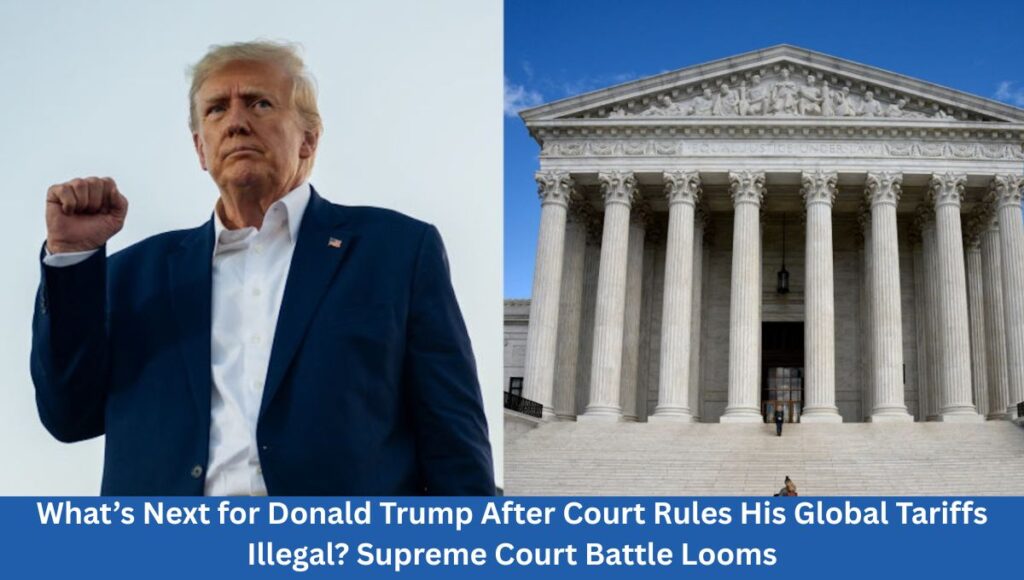
What’s Next for Donald Trump After Court Rules His Global Tariffs Illegal? Supreme Court Battle Looms
The Court’s Ruling: Why Trump’s Tariffs Were Struck Down
At the heart of the appeals court’s decision is a constitutional principle: tariffs and taxes are Congress’s power, not the president’s.
The judges ruled that the IEEPA, the law Trump invoked, was designed to give presidents limited emergency powers to restrict commerce during crises involving “unusual and extraordinary threats.” But, they wrote, the statute makes no mention of tariffs, duties, or taxes.
The majority opinion stated:
“Whenever Congress intends to delegate to the President the authority to impose tariffs, it does so explicitly, either by using unequivocal terms like tariff and duty, or via an overall structure which makes clear that Congress is referring to tariffs.”
In other words, Trump had stretched emergency powers far beyond their intended scope, and the judiciary was unwilling to grant presidents unlimited discretion to tax imports.
This decision upheld a lower ruling from the Court of International Trade, which earlier in May had already concluded that Trump’s “Liberation Day” tariffs were unlawful.
Which Tariffs Are Affected by the Ruling?
The ruling directly impacts Trump’s “Liberation Day” tariffs announced on April 2, which included:
- “Reciprocal” tariffs up to 50% on nations with which the US runs trade deficits.
- A baseline 10% tariff on most other countries.
- Additional punitive tariffs on nations resisting US trade terms (e.g., Laos at 40%, Algeria at 30%).
It also invalidates earlier tariffs on China, Mexico, and Canada, which Trump had justified by declaring cross-border drug trafficking and immigration flows a “national emergency.”
However, tariffs imposed under other laws such as the 25% steel and aluminum tariffs under Section 232 of the Trade Expansion Act (1962) remain unaffected.
This distinction means Trump’s trade arsenal is weakened, but not eliminated.
Trump’s Justification: Declaring a National Emergency on Trade
Trump framed his tariffs as part of a patriotic mission, declaring April 2 as “Liberation Day.”
His argument:
- America’s chronic trade deficits represented a national emergency.
- Tariffs were necessary to restore economic sovereignty.
- Comparisons were drawn to President Richard Nixon’s actions during the 1971 economic crisis, when Nixon severed the dollar’s link to gold.
Trump repeatedly insisted that tariffs were America’s best defense against unfair trade practices and foreign exploitation.
But the courts disagreed. The appeals panel warned that Trump’s interpretation would effectively give the president “unlimited authority” to impose tariffs without congressional approval something the Constitution does not allow.
The Financial Stakes: Billions in Revenue and Refunds
By July, Trump’s tariffs had generated $159 billion in revenue more than double the previous year.
The Trump administration argued that striking down the tariffs could force the US Treasury to refund billions already collected.
In a court filing, the Justice Department warned of potential “financial ruin” if the tariffs were revoked, likening the fallout to the Great Depression.
Critics counter that the tariffs already functioned as a hidden tax, raising prices for businesses and consumers, disrupting supply chains, and straining alliances.
Trump’s Reaction: Fury and Defiance
As expected, Trump responded with fury.
On Truth Social, he blasted the ruling as partisan:
“ALL TARIFFS ARE STILL IN EFFECT! Today a Highly Partisan Appeals Court incorrectly said that our Tariffs should be removed, but they know the United States of America will win in the end.”
He warned that removing tariffs would devastate US industries and workers, insisting:
“If these Tariffs ever went away, it would be a total disaster for the Country. It would make us financially weak, and we have to be strong.”
Tying his message to Labor Day, Trump said tariffs are “the best tool to help our Workers, and support Companies that produce great MADE IN AMERICA products.”
Trump vowed to appeal to the Supreme Court, casting the fight as a battle for America’s economic survival.
What Options Does Trump Have Now?
Even if the Supreme Court rules against him, Trump still has limited tools at his disposal:
- Trade Act of 1974 – Allows tariffs of up to 15% for 150 days on countries with large trade deficits.
- Section 232 of the 1962 Trade Expansion Act – Permits tariffs to protect national security, but only after a Commerce Department investigation.
- Negotiated Trade Deals – Trump could pressure countries into accepting bilateral agreements in exchange for lifting tariffs.
Former Commerce official William Reinsch suggested that Trump’s team has already prepared a “Plan B” to maintain tariffs using alternate statutes.
Global Diplomatic Fallout
The ruling has caused tremors in global diplomacy.
Foreign governments, once wary of Trump’s tariff threats, may now feel emboldened to resist US pressure.
- Deals with the UK, EU, and Japan negotiated under tariff threats could unravel.
- Treasury Secretary Scott Bessent warned of “dangerous diplomatic embarrassment” if tariffs are invalidated.
- Allies may seek to renegotiate trade terms, while rivals like China could exploit the legal setback.
In short, Trump’s leverage on the world stage has been seriously weakened.
Why the Supreme Court Will Be Crucial
The case is now headed to the Supreme Court, where the outcome is uncertain. The Court has a 6–3 conservative majority, including three justices appointed by Trump.
However, recent rulings under the “major questions doctrine” show the Court is skeptical of expansive executive power without explicit congressional authorization.
Cases involving climate regulations and student loan forgiveness have already struck down presidential actions deemed to exceed statutory limits. Trump’s tariff program could face the same fate.
Broader Implications for Trump’s Presidency and the 2025 Election
The ruling’s consequences extend well beyond trade policy:
- Economic Agenda: Losing unilateral tariff powers undermines Trump’s “America First” trade strategy.
- Political Narrative: Trump has campaigned as a defender of US workers. A legal defeat could weaken his populist message.
- Supreme Court Drama: A blockbuster case could dominate headlines, energizing his base but unnerving moderates and businesses.
- Global Trade Stability: The ruling will make allies and rivals reassess how seriously to take Trump’s tariff threats.
As Trump prepares for the 2025 election, this legal fight will become a central part of his campaign rhetoric.
Expert Reactions
Legal and trade experts stress the historic nature of the decision.
- Neal Katyal, attorney for plaintiffs:
“It’s a win for the American Constitution… major decisions on taxation have to be done by Congress, not the president.”
- Ashley Akers, trade lawyer:
“The administration could lose a pillar of its negotiating strategy, which may embolden foreign governments to resist future demands.”
- White House spokesman Kush Desai:
“President Trump lawfully exercised tariff powers to defend our national and economic security. The tariffs remain in effect, and we look forward to ultimate victory.”
India’s Tariffs Likely to Stay
Interestingly, experts note that tariffs on India are unlikely to be rolled back.
After initially imposing IEEPA-based tariffs in April, Trump later used other legal authorities to target India, anticipating judicial challenges.
This “legal layering” makes duties on Indian imports tied to disputes over Russian oil purchases, trade imbalances, and market access more durable than tariffs imposed solely under IEEPA.
As a result, New Delhi is expected to face continued US tariff pressure, regardless of the Supreme Court’s final ruling.
What Happens Next?
For now, all tariffs remain in place until October 14.
If the Supreme Court upholds the appeals court ruling, Trump may be forced to:
- Refund billions in collected duties.
- Scale back his ability to use tariffs as a negotiation weapon.
- Rely on narrower statutes like the 1974 Trade Act or Section 232.
If Trump wins, his use of emergency powers will gain new legitimacy, giving future presidents wider leeway to reshape trade without Congress.
The Bigger Picture: Trade, Politics, and Power
The court ruling strikes at the heart of Trump’s “America First” agenda, raising questions about:
- The limits of presidential power.
- The balance between Congress and the White House in trade policy.
- How global markets adapt when US trade rules swing between courts and campaigns.
For Trump, the legal battle is as much political theater as it is economic strategy. By casting himself as a fighter against elites, foreign powers, and even US courts, he seeks to galvanize supporters heading into 2025.
As Trump declared defiantly:
“Now, with the help of the United States Supreme Court, we will use [tariffs] to the benefit of our Nation, and Make America Rich, Strong, and Powerful Again!”
Conclusion
The appeals court ruling declaring Trump’s global tariffs illegal is more than a legal skirmish it is a defining battle over the scope of presidential authority in trade.
With billions of dollars, global markets, and the 2025 election at stake, the outcome of this case will shape not only Trump’s legacy but also the future of America’s economic policy. For now, Trump refuses to relent.
The world is watching as the fight moves to the Supreme Court, where the ultimate verdict will determine whether tariffs remain Trump’s weapon of choice or become his greatest political setback.
Also Read: Trump Softens Stance on India, China Tariffs After Putin Meeting
Also Read: “Would Make Us Financially Weak”: Trump After US Court Calls Tariffs Illegal