

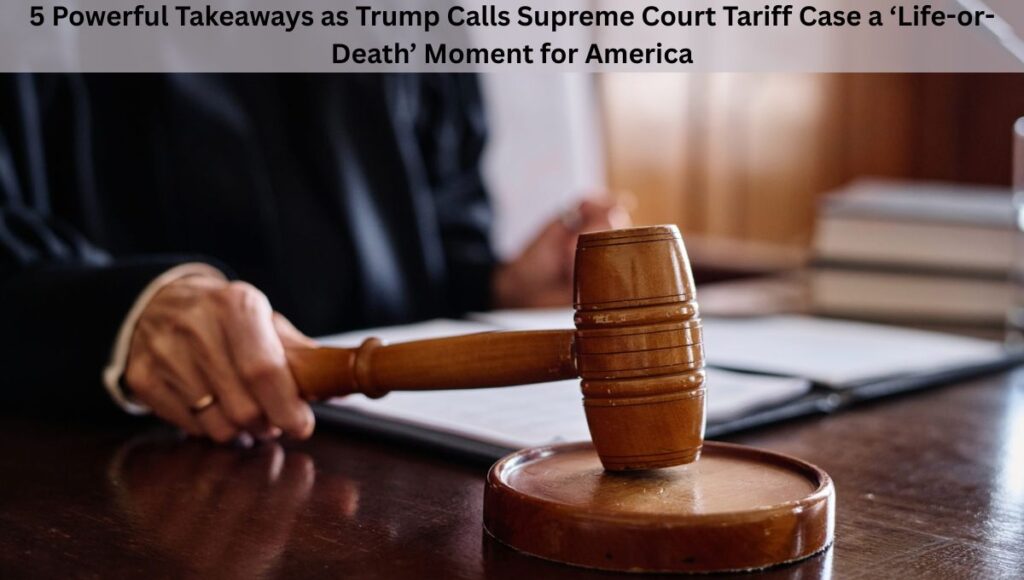
5 Powerful Takeaways as Trump Calls Supreme Court Tariff Case a ‘Life-or-Death’ Moment for America — one of the most consequential legal battles in U.S. history. Calling it “a matter of life or death for our country,” U.S. President Donald Trump on Tuesday framed an upcoming Supreme Court hearing on his tariff powers as one of the most consequential legal battles in American history.
“Tomorrow’s United States Supreme Court case is, literally, LIFE OR DEATH for our Country,” Trump wrote on Truth Social, adding that a favorable ruling would secure “tremendous, but fair, Financial and National Security.” “With a victory, we have tremendous, but fair, Financial and National Security,” Trump continued. “Without it, we are virtually defenseless against other countries who have, for years, taken advantage of us.”
5 Powerful Takeaways as Trump Calls Supreme Court Tariff Case a ‘Life-or-Death’ Moment for America
A Case That Could Redefine Presidential Power
At the heart of the dispute is whether Trump exceeded his authority under the International Emergency Economic Powers Act (IEEPA) of 1977 when he imposed sweeping tariffs on U.S. trading partners.
The nine-judge U.S. Supreme Court will hear oral arguments on Wednesday on an appeal by the Trump administration challenging lower court rulings that found the president overstepped his powers.
The IEEPA, originally designed for national security emergencies, has rarely been used for tariffs. It grants the president authority to regulate imports during “unusual and extraordinary threats” to national security, foreign policy, or the economy.
Trump has also relied on the Trade Expansion Act of 1962 and the Trade Act of 1974 to impose tariffs on sectors he deems strategic — such as autos, copper, semiconductors, pharmaceuticals, robotics, and aircraft. The Supreme Court case, however, focuses solely on tariffs imposed under the IEEPA.
“Our stock market is consistently hitting record highs,” Trump said, crediting his trade policies. “The security created by tariffs has restored fairness to American workers.”
White House Confidence and Backup Plans
Treasury Secretary Scott Bessent said the administration remains confident the Court will uphold the tariffs. Speaking on CNBC’s Squawk Box, he described the case as “a signature policy for the president.”
“Traditionally, SCOTUS has been loath to interfere with these signature policies,” Bessent said. Still, he acknowledged that if the justices rule against Trump, the White House has contingency options.
“There are lots of other authorities that can be used,” he said, referring to Sections 232 and 301 of existing trade laws, which also allow tariff actions for national security or unfair trade reasons. “IEEPA is by far the cleanest, and it gives the U.S. and the president the most negotiating authority.”
A Challenge to Congress’s Authority
Critics argue that Trump’s actions violate the U.S. Constitution, which grants Congress—not the president—the power to impose tariffs and taxes. They claim his use of emergency powers amounts to an unconstitutional overreach.
Earlier this year, both the Court of International Trade and two U.S. appeals courts sided against the administration, writing that “it is far from plain” that the IEEPA authorizes such broad tariff powers.
A ruling against Trump could significantly curb executive power over trade, while a win could expand it dramatically, setting a precedent for future presidents.
Why Tariffs Are Likely to Stay Even If Trump Loses
Even if the Court strikes down Trump’s use of IEEPA, analysts say tariffs will remain a central pillar of U.S. trade policy. The 6–3 conservative-majority Supreme Court, which includes three Trump appointees, will hear challenges from small business groups and several states.
Trump is the first U.S. president to invoke the IEEPA to impose tariffs, a law traditionally used to apply sanctions or freeze assets during crises. The statute allows a president to act against an “unusual and extraordinary threat” to national security.
In 2024, Trump declared the nation’s $1.2-trillion trade deficit a national emergency, even though the U.S. has run trade deficits annually since 1975.
Trump’s Broader Tariff Framework
According to Treasury Secretary Bessent, the administration could easily pivot to other tariff authorities:
- Section 122 of the Trade Act of 1974 allows 15% tariffs for up to 150 days to correct imbalances.
- Section 338 of the Tariff Act of 1930 authorizes up to 50% tariffs on nations that discriminate against U.S. commerce.
- Section 232 of the Trade Expansion Act of 1962 permits tariffs for national security reasons.
- Section 301 of the Trade Act of 1974 allows tariffs to counter unfair trade practices.
“You should assume that they’re here to stay,” Bessent said of Trump’s tariffs. “Those of you who got a good deal should stick with it.”
The ‘Major Questions’ Doctrine Looms Large
The businesses challenging Trump argue that the major questions doctrine—a principle limiting executive power on issues of vast economic significance—should apply here.
Earlier this year, lower courts and a majority of judges on the Federal Circuit Court of Appeals found that IEEPA’s language does not clearly authorize the president to impose tariffs.
Judge James Taranto, appointed by President Barack Obama, dissented, arguing that Congress deliberately gave presidents broad latitude under emergencies. “We do not see IEEPA as anything but an eyes-open congressional choice to confer on the president broad authority,” Taranto wrote.
The Supreme Court has repeatedly invoked the major questions doctrine to block actions by President Joe Biden, such as his student loan forgiveness and COVID-19 vaccine mandates, ruling that Congress never explicitly authorized those measures. Challengers say the same logic applies to Trump.
Addiction to Tariffs and Fiscal Stakes
Critics warn that the government has become “addicted” to tariff revenue. IEEPA tariffs make up a large share of a $118 billion increase in customs receipts for fiscal year 2025, helping offset rising federal spending.
“It’s a significant political economy risk that we get addicted to tariff revenue,” said Ernie Tedeschi, senior fellow at the Yale University Budget Lab. “It makes it harder for any future administration to lower the duties.”
If the Court rules against Trump, the government could be forced to refund more than $100 billion in tariff collections — a potential shock to the Treasury debt market.
A Historic Battle Over the Word “Regulate”
Legal observers say the outcome could hinge on a single word in the IEEPA: “regulate.” The administration argues that regulating imports includes the power to impose tariffs — the most direct way to control trade. The plaintiffs contend the term was intended for sanctions, not duties.
In its briefs, the Justice Department noted that when Congress passed the IEEPA in 1977, lawmakers reused language from the Trading with the Enemy Act, under which President Richard Nixon imposed a 10% tariff in 1971.
A federal appeals court upheld those tariffs at the time. This, the administration argues, shows Congress understood “regulate” to include tariffs. Opponents counter that Congress subsequently enacted clearer tariff limits, meaning it never intended to hand the president an open-ended power.
A Precedent for Executive Power
For Trump, the case represents a defining moment in his second term’s economic nationalism agenda. He has argued that America must be able to respond “instantly” to economic threats, including unfair trade, foreign subsidies, and supply chain manipulation.
“Without tariffs, we are virtually defenseless,” Trump wrote. “Other countries have taken advantage of us for years.” Administration lawyers have described a potential loss as “catastrophic” and “ruinous.”
U.S. Solicitor General D. John Sauer warned the justices that striking down the tariffs could “accelerate the drift toward America’s decline into a vassal state.”
Critics Warn of Executive Overreach
Opposing states and small businesses say such rhetoric overstates the stakes and masks an unconstitutional power grab.
“The question, as in other recent cases of executive overreach, is: ‘Who decides?’” they wrote in a brief. “Congress, not the president, decides whether and how much to tax Americans who import goods from abroad.”
They cite opinions from conservative justices Neil Gorsuch, Samuel Alito, and Clarence Thomas, who emphasized in earlier cases that Congress, not the executive branch, controls major fiscal decisions.
Wilbur Ross: Trump Is ‘Too Committed’ to Turn Back
Former Commerce Secretary Wilbur Ross, who helped design Trump’s first wave of tariffs in 2018, told Fortune that the president is “too invested” to abandon tariffs — regardless of the outcome.
“He’s too committed to the tariff to give it up,” Ross said. “If they lose, I don’t think he’s just going to say, ‘Well, okay, it didn’t work under this law.’ He’s too invested.” Ross said the administration took fewer procedural steps this time than in 2018, which could weaken its case.
“They were in a hurry to get things going,” he said. “That’s taking a bit more risk.” He warned that invalidating all tariffs could create global turmoil and “horrific” uncertainty for markets and companies.
Markets Fear Uncertainty More Than Defeat
Financial markets have grown accustomed to Trump’s tariff-driven trade regime. Economists warn that overturning it could shake investor confidence and roil the Treasury market.
“Markets can adjust to good news or bad news,” Ross said. “What markets have trouble with is uncertainty.”
Even a narrow ruling could force companies to revisit contracts, pricing, and supply chains built around Trump’s tariff structure.
A Broader Battle Over Presidential Power
Beyond trade, the Court’s decision will have far-reaching implications for the balance of powers in Washington. If the justices uphold Trump’s tariffs, future presidents could invoke emergency powers to impose economic measures without congressional consent.
A loss would reaffirm legislative control and restrain executive flexibility in economic crises. Trump’s Justice Department has emphasized the foreign policy dimension, arguing that tariffs serve as leverage in negotiations with countries like China, Canada, Mexico, and Japan.
“A ruling against us would undermine our negotiating strength and endanger national security,” an administration official said privately.
Awaiting the Verdict
Trump has said he considered attending the hearing in person but decided against it. His presence looms large nonetheless.
The Supreme Court’s decision—expected within months—will shape the future of U.S. trade and the scope of presidential authority for years to come. “Tomorrow’s case is life or death,” Trump reiterated. “We will fight for America’s financial and national security with every tool we have.”
Also Read: BRICS Leaders to Hold Virtual Summit on Trump Tariffs and Multilateralism
Also Read: Bessent says U.S. has ‘lots’ of options to use on tariffs if it loses Supreme Court case
Related Posts:
- 10 Big Takeaways from Trump’s 155% Tariff Warning to China

- What’s Next for Donald Trump After Court Rules His…
- 9 Explosive Revelations as Trump Declares His Health…
- Trump to Host 2026 G20 Summit at His Florida Golf…

- Trump’s 2025 Gaza Peace Plan Signing and Historic…

- 7 Shocking Reasons FIFA’s Peace Prize for Trump…
