5 Key Takeaways as Trump–Democrats Standoff Drives Longest U.S. Government Shutdown, crippling vital services nationwide. The U.S. government shutdown has officially entered its 36th day, making it the longest closure in American history. The deadlock, triggered by a dispute between President Donald Trump and Democratic lawmakers over health care subsidies, has left hundreds of thousands of federal employees without pay and millions of Americans struggling to access essential services.
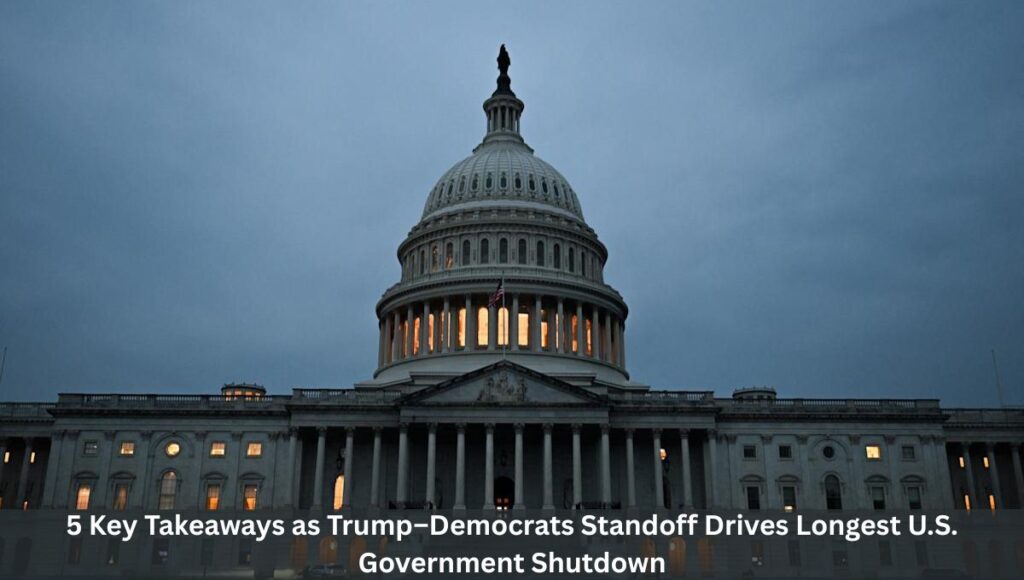
5 Key Takeaways as Trump–Democrats Standoff Drives Longest U.S. Government Shutdown
A Record-Breaking Stalemate
The shutdown, which began on October 1, surpassed the previous record set during Trump’s first term in 2019. It has become a defining test of political will in Washington, exposing the widening divide between Republicans and Democrats.
Congress has voted unsuccessfully 14 times to pass a short-term funding bill that would reopen the government. On Tuesday, the Senate rejected the measure once again — a 54–44 vote, falling short of the 60 votes needed to advance.
Majority Leader John Thune, the Senate’s top Republican, said he believes a resolution may be near but offered no clear timeline.
“I just think, based on my gut of how these things operate, I think we’re getting close to an off-ramp here,” Thune told reporters on Capitol Hill.
The Core of the Dispute
At the heart of the impasse lies a battle over expiring health care tax credits under the Affordable Care Act (ACA). Democrats are demanding that any funding measure include an extension of these subsidies, which they say are vital for low-income families struggling to afford insurance.
Republicans, led by President Trump, have refused to negotiate until Democrats agree to reopen the government first.
“We’re not asking for anything radical,” said Senate Democratic Leader Chuck Schumer. “Lowering people’s healthcare costs is the definition of common sense.”
The White House argues that Democrats are holding government funding hostage over unrelated policy demands. In response, Trump has called for the abolition of the Senate filibuster rule, which requires a 60-vote majority to pass most legislation.
“TERMINATE THE FILIBUSTER NOW, END THE RIDICULOUS SHUTDOWN IMMEDIATELY, AND THEN PASS EVERY WONDERFUL REPUBLICAN POLICY THAT WE HAVE DREAMT OF,” Trump posted on Truth Social.
His message underscored the growing frustration inside the administration, where aides insist that Democrats are to blame for the ongoing stalemate.
Millions of Americans Left Struggling
While Washington debates, ordinary Americans are bearing the brunt of the political impasse. More than 800,000 federal employees have missed paychecks, and many have turned to food banks or temporary jobs to survive.
The impact extends far beyond government workers. The Supplemental Nutrition Assistance Program (SNAP), which serves over 42 million people, has been disrupted due to the shutdown.
Only partial benefits were paid out this month after a federal court ordered the Agriculture Department to use contingency funds.
Transportation Secretary Sean Duffy warned that continued delays could soon cripple the nation’s air travel system.
“If you bring us to a week from today, Democrats, you will see mass chaos,” Duffy told Fox News. “You will see mass flight delays. You’ll see cancellations, and we may close certain parts of the airspace.”
Thousands of air traffic controllers and Transportation Security Administration (TSA) agents have been working without pay for weeks, raising safety and morale concerns nationwide.
Low-Income Families Hit the Hardest
For millions of families, the shutdown has translated into missed food assistance, delayed housing benefits, and rising medical costs.
“It almost feels like we’re being used as pawns on both sides,” said Annemarie King, a SNAP recipient from Maryland. “I understand both sides want to make points, but people like me are the ones suffering.”
Analysts warn that prolonged disruptions to social programs could deepen economic inequality and fuel public anger toward Washington.
Political Fallout Deepens
The shutdown has also dealt a blow to President Trump’s political standing. An NBC News poll found that 52% of Americans blame the President and congressional Republicans for the crisis, while 42% fault Democrats.
Independent voters — a key bloc in upcoming midterm elections — appear to be shifting away from Trump’s camp. Democrats, meanwhile, are framing the standoff as evidence of what they call the administration’s misplaced priorities.
“Donald Trump and Republicans promised to lower costs on Day 1,” said House Minority Leader Hakeem Jeffries. “The American people know that hasn’t happened. Instead, they see prices for groceries, housing, and childcare going up.”
Still, some moderate lawmakers in both parties are signaling openness to compromise. Senators Susan Collins (R-Maine) and Jeanne Shaheen (D-N.H.) are among those quietly working on a bipartisan plan to reopen the government while addressing health care costs.
A Nation Under Strain
With each passing day, the economic toll of the shutdown grows heavier. Delayed paychecks have drained savings accounts, small businesses that rely on federal contracts face closure, and airports across the country report mounting flight delays.
“Enough is enough,” Senate Majority Leader John Thune said Tuesday. “We have to find a way to get the government back open and the American people back on their feet.”
The ripple effects are now touching nearly every corner of American life. Housing assistance programs are on pause, national parks remain closed, and public health agencies are struggling to maintain operations without funding.
Court Intervention and SNAP Showdown
Tensions escalated this week after a U.S. court ordered the administration to resume partial SNAP payments despite lapsed funding. The ruling was seen as a rebuke to the White House’s earlier statement that no funds would be dispersed.
But President Trump appeared to question whether his administration would comply. “[SNAP benefits] will be given only when the Radical Left Democrats open up government, which they can easily do, and not before,” Trump posted on Truth Social.
White House Press Secretary Karoline Leavitt later clarified that the administration “will comply with the court order,” insisting that benefits are being distributed “in line with judicial directives.”
Historical Parallels and Political Stakes
Both of the longest government shutdowns in U.S. history have now occurred under Trump’s leadership — first in 2018–2019, and again in 2025. The earlier standoff stemmed from a dispute over border wall funding; this one, over health care subsidies.
Political analysts say the twin crises underscore Trump’s aggressive governing style and willingness to confront Congress head-on.
“Trump’s strategy is to force Democrats to choose between the trauma of those losing food stamps and those losing health care,” said one Washington policy expert.
The stakes are high for both parties ahead of the 2026 midterm elections. Democrats hope to capitalize on public frustration, while Republicans fear that prolonged economic pain could damage their brand of fiscal competence.
Behind-the-Scenes Negotiations
Despite fiery public statements, quiet negotiations continue behind closed doors. Bipartisan groups in the Senate are exploring a three-bill package that would fund agriculture, military construction, and health care programs through January.
“The pace of talks has increased,” said Senator Gary Peters (D-Mich.), who is involved in the discussions. “We’re trying to build something both sides can support.”
But major differences remain — particularly on how to extend health care subsidies and when to reopen the government.
Some Republican senators, including Mike Rounds (R-S.D.) and Markwayne Mullin (R-Okla.), have expressed optimism that the impasse could end soon. Others, like Elizabeth Warren (D-Mass.), remain skeptical.
“That would be nice,” Warren said. “But so far, Republicans have come to the table to negotiate exactly zero times.”
Public Fatigue and Political Reality
The longer the shutdown drags on, the more it tests the patience of the public — and the resilience of the U.S. economy. Analysts estimate that every week of closure costs the federal government billions in lost productivity and delays critical infrastructure projects.
Even some Republicans privately concede that the political cost may soon outweigh the gains.
“If the Democrats cave on this, it would be a betrayal to millions of working families,” warned Senator Bernie Sanders (I-Vt.). “Anyone who thinks surrendering to Trump now will lead to better outcomes doesn’t understand how power works.”
For now, the nation remains at a standstill — a symbol of gridlock and growing disillusionment.
The Road Ahead
As the shutdown enters uncharted territory, both parties are under immense pressure to reach a deal. Lawmakers are exploring options for a temporary funding measure that could extend into the new year, giving negotiators more time to craft a comprehensive solution.
“All it takes is five of them,” said Sen. Thune, referring to moderate Democrats whose votes could end the stalemate. “We need to get something to send back to the House that would open up the government.”
But with Thanksgiving approaching and millions of families facing financial uncertainty, the political calculus is changing by the hour. Whether Washington can find a compromise — or whether the shutdown will drag further into winter — remains uncertain.
Conclusion: A Crisis of Governance
As the longest U.S. government shutdown in history grinds on, it reflects more than a budget dispute — it exposes a crisis of governance and trust in Washington. Both President Trump and his Democratic opponents appear locked in a struggle not just over policy, but over power itself.
For millions of Americans waiting on food, paychecks, or healthcare, the message from their leaders is painfully clear: Washington is broken, and they are paying the price.
Also Read: Trump, Democrats Face High-Stakes Government Shutdown Showdown Over Healthcare and Power Struggle
Also Read: The government shutdown is now the longest – and likely the most damaging in US history