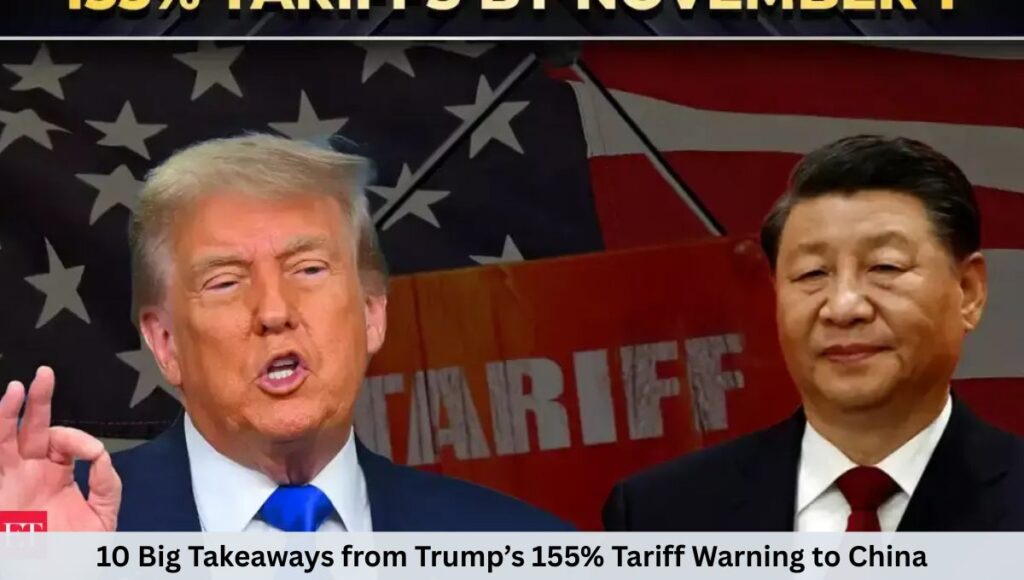
10 Big Takeaways from Trump’s 155% Tariff Warning to China that reignited global trade tensions. In a fresh escalation of trade tensions, U.S. President Donald Trump on Monday issued a stark warning to China, threatening to impose tariffs of up to 155% on Chinese goods unless Beijing signs a “fair deal” with Washington.
Speaking before his bilateral talks with Australian Prime Minister Anthony Albanese at the White House, Trump declared:
“China’s paying 55 percent now, and a potential 155 percent come November 1 unless we make a deal.”
The comment came as Trump and Albanese signed a multi-billion-dollar critical minerals agreement, aimed at strengthening Western supply chains and reducing dependence on China. The threat marks the most dramatic escalation in Trump’s renewed trade war with Beijing since returning to the Oval Office earlier this year.
10 Big Takeaways from Trump’s 155% Tariff Warning to China
1. Trump’s Tariff Warning Came During the Albanese Visit
The White House meeting, intended to celebrate U.S.-Australia cooperation on critical minerals and defense, quickly became a stage for Trump’s broader foreign policy message.
“I think China’s been very respectful of us,” Trump said. “They’re paying tremendous amounts of money to us in the form of tariffs.”
The U.S. president praised recent trade deals with countries that he said had “earlier taken advantage” of America — but warned that China could face “big trouble” unless it agreed to what he called a “very fair trade deal.”
2. 155% Tariffs by November 1 Unless Deal Is Signed
Trump made clear that the deadline is November 1, 2025, suggesting that if Chinese President Xi Jinping refuses to reach an agreement by then, the U.S. will automatically hike tariffs from 55% to 155%.
He told reporters:
“We can lower the tariffs, but they have to do things for us too. It’s no longer a one-way street.”
The potential tariffs would apply across a wide range of imports, from electronics and machinery to rare earth elements, which are vital to the global technology industry.
3. Background: 100% Tariffs Already Announced Earlier
Just days before his 155% remark, Trump had already announced an additional 100% tariff on Chinese goods through a Truth Social post.
“Starting November 1, the United States will impose a Tariff of 100% on China, over and above any tariff they are currently paying,” he wrote.
He also announced export controls on “any and all critical software,” signaling a move toward comprehensive economic decoupling between the two superpowers.
Also Read: Shocking Impacts of Trump’s 100% Tariffs on China
4. U.S.-China Trade Talks Scheduled in Malaysia
Amid the tough rhetoric, there’s still diplomacy at work.
U.S. Treasury Secretary Scott Bessent confirmed that trade officials from both nations would meet in Malaysia later this week.
The talks are expected to focus on tariffs, export controls, and agricultural trade — especially soybean purchases, a politically sensitive issue in the American Midwest.
However, reports suggest Trump had briefly considered canceling his first face-to-face meeting with Xi Jinping since returning to power — an indication of the fragile state of U.S.-China relations.
5. Trump Accuses China of Hurting U.S. Farmers
In his remarks, Trump accused Beijing of halting soybean imports from the U.S. in retaliation for tariff measures.
“We will not allow China to punish our farmers,” he said firmly.
Soybeans — one of the largest U.S. exports to China — have been at the center of past trade wars. After Trump’s announcement, soybean futures rose to their highest level in a month, reflecting renewed optimism among American farmers.
6. “Not a One-Way Street Anymore”: Trump’s Fair Deal Vision
Trump reiterated his long-standing view that America had been taken advantage of by trading partners for decades.
“A lot of countries took advantage of the U.S. and they’re not able to take advantage anymore,” he said.
He emphasized that China was already paying “a tremendous amount of money” in tariffs and hinted at a willingness to compromise — but only if Xi made concrete concessions.
“I expect we’ll work out a very fair trade deal with President Xi,” he added. “It will be very exciting.”
7. Trump and Xi to Meet in South Korea for Asia-Pacific Summit
Trump also confirmed that he will meet President Xi Jinping later this month in South Korea, during an upcoming Asia-Pacific leaders’ summit.
“We have a very good relationship,” Trump said. “I think when we finish our meetings, China and I will have a really fair and really great trade deal together.”
The U.S. leader expressed confidence that the meeting would yield results beneficial to both sides — calling it “fantastic for both countries and for the entire world.”
8. Trump Plans to Visit China Early Next Year
In another surprising announcement, Trump revealed he had received an official invitation from Beijing and would visit China early next year.
“I’ve been invited to go to China, and I’ll be doing that sometime fairly early next year. We have it sort of set,” he told reporters at the White House.
The visit, if confirmed, would mark Trump’s first trip to China since resuming the presidency and could serve as a crucial step toward normalizing ties — provided the tariff dispute doesn’t escalate further.
9. Taiwan Issue Looms Large in the Background
While most of Trump’s comments focused on trade, he also touched on the Taiwan issue, signaling a more conciliatory tone than some expected.
Asked about a Pentagon assessment suggesting China could attempt to seize Taiwan by 2027, Trump responded:
“I think we’ll be just fine with China. China doesn’t want to do that.”
He acknowledged that Taiwan is the “apple of Xi’s eye”, but said he didn’t foresee any immediate conflict.
“We have the best of everything, and nobody’s going to mess with that,” Trump said, hinting that U.S. deterrence remains strong.
Still, he avoided confirming whether he would use military force to defend Taiwan if Beijing acted.
Also Read: Trump downplays Taiwan risk in China talks, expects fair trade deal
10. The Bigger Picture: Trade, Strategy, and Global Power Balance
Trump’s tariff threat isn’t just about trade — it’s about reshaping the global power structure.
The proposed 155% tariff and export controls represent a strategic weapon aimed at forcing China to alter its industrial and currency policies.
Trump’s approach echoes his first administration, when he used economic pressure to push allies and adversaries into renegotiating trade deals.
But this time, the stakes are higher:
- China’s economy is already slowing.
- The U.S. is leading a coalition of democracies on critical mineral independence.
- Taiwan remains a potential flashpoint.
As one analyst put it:
“The tariffs are as much a message to Beijing as they are to Wall Street — that Trump is serious about rewriting the global trade order.”
Trump’s Message to Allies: “No More Free Rides”
Beyond China, Trump’s comments signaled a broader warning to U.S. allies.
“A lot of countries took advantage of us. Not anymore,” he said.
This message aligns with his “America First” agenda, which prioritizes domestic industry, farmer protection, and tariff-driven trade leverage.
Observers noted that the tone of Trump’s statement — though directed at China — also applied to Europe, Canada, and even Japan, which are currently negotiating trade updates with Washington.
Australia’s Role: Minerals, Defense, and the China Factor
Trump’s warning to China came alongside the signing of a critical minerals and defense cooperation deal with Prime Minister Anthony Albanese.
The agreement, worth several billion dollars, aims to secure rare earth elements vital to defense and technology manufacturing — resources that China currently dominates.
“Australia is a key partner in ensuring the free world isn’t dependent on China’s supply chains,” Trump said.
Analysts view the deal as part of a larger Indo-Pacific containment strategy, with the U.S., Australia, and allies like Japan and India working to reduce reliance on Chinese exports.
Bessent: China ‘Pointing a Bazooka’ at Global Supply Chains
U.S. Treasury Secretary Scott Bessent amplified Trump’s tough stance, accusing Beijing of threatening the global economy.
“China is pointing a bazooka at the supply chains and the industrial base of the entire free world,” Bessent said last week.
His remarks underscore Washington’s growing frustration with China’s use of rare earth export curbs as leverage in trade negotiations.
Beijing recently restricted exports of gallium and germanium — two minerals essential for semiconductors — a move seen as retaliation against U.S. chip sanctions.
China’s Response: Strategic Silence So Far
As of now, China’s Ministry of Foreign Affairs has not directly responded to Trump’s 155% tariff threat.
However, Beijing has previously warned Washington against using trade as a “weapon,” saying it would “firmly defend its legitimate interests.”
Chinese state media, including the Global Times, have called Trump’s policy “short-sighted” but acknowledged that Beijing’s export dependence on the U.S. remains a pressure point.
Economic and Political Stakes Ahead
If implemented, the 155% tariff would mark one of the most aggressive trade actions in modern U.S. history — and could significantly impact global markets.
Economists warn that higher tariffs could:
- Increase consumer prices in the U.S.
- Hurt American manufacturers relying on Chinese components.
- Trigger retaliation from Beijing, including export restrictions on rare earths.
Yet politically, Trump’s hardline approach plays well among Midwestern voters, particularly farmers and factory workers who see tariffs as protectionist leverage rather than economic risk.
Trump’s Confidence in Xi Relationship
Despite the fiery rhetoric, Trump repeatedly emphasized his “good relationship” with Xi Jinping.
“I love my relationship with President Xi,” he said. “We’re going to get along very well as it pertains to Taiwan and others.”
This dual tone — aggressive yet optimistic — reflects Trump’s negotiating style: apply maximum pressure publicly while leaving room for compromise privately.
Outlook: A High-Stakes Month for U.S.-China Relations
With the South Korea summit approaching, the coming weeks could determine whether Trump’s tariff threats lead to a new trade deal or another round of economic confrontation.
Analysts believe the U.S.-China rivalry will define not only global markets but also Asia-Pacific security dynamics, especially around Taiwan, technology exports, and resource access.
As one diplomat put it:
“When Trump talks tariffs, he’s really talking power.” The world will be watching closely when Trump and Xi meet — possibly to make or break what could become the defining trade deal of the decade.