
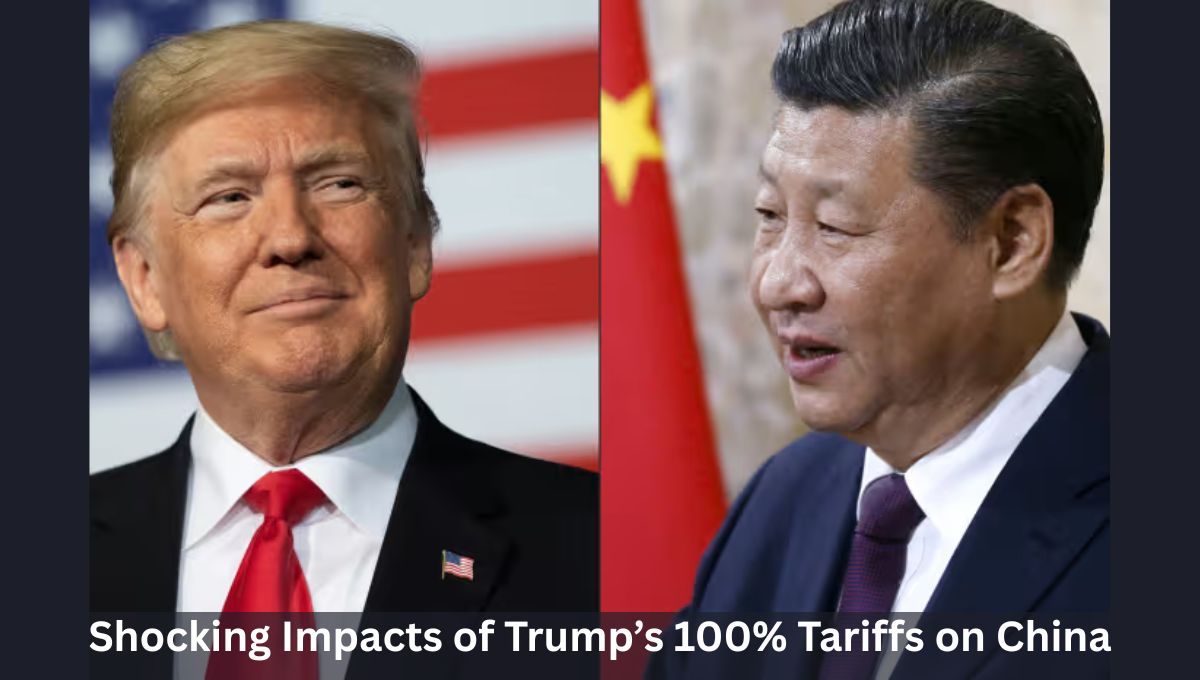
Shocking Impacts of Trump’s 100% Tariffs on China — Global fallout. US President Donald Trump has announced an additional 100% tariff on imports from China, effective November 1, escalating a fragile trade détente between the two largest global economies. The move comes after China tightened export controls on rare earth metals, essential for electronics, electric vehicles, and defence technologies.
Markets reacted sharply, with the S&P 500 dropping 2.7% and global cryptocurrency markets losing billions in a historic sell-off. Beyond economic implications, this development carries significant diplomatic and geopolitical consequences, affecting U.S.–China relations, the Asia-Pacific region, global supply chains, and countries like India that are strategically dependent on rare earths.
Shocking Impacts of Trump’s 100% Tariffs on China
Current Tariff Landscape and Trade Background
Existing U.S.–China Tariffs
Before Trump’s latest announcement, Chinese goods faced a 30% U.S. tariff, while American goods exported to China faced a 10% levy. These tariffs were part of a fragile trade détente established in May 2025 to ease earlier tensions that had nearly frozen bilateral trade.
China had previously imposed strict export controls on rare earth elements, technologies, and materials critical to defence and electronics, citing national security concerns. Trump characterized these moves as an attempt to “hold the world captive” and weaponize China’s dominance in the sector.
China’s Strategic Moves
China’s latest export rules require licenses for 12 out of 17 rare earth metals and restrict technology used in mining and processing. This not only targets U.S. companies but also overseas defence manufacturers, heightening strategic stakes.
Simultaneously, China announced port fees on U.S.-linked ships, mirroring previous U.S. tariffs on Chinese shipping. Experts note that these retaliatory measures demonstrate China’s readiness to escalate if Washington follows through with new tariffs.
Also Read: Trump ratchets up US-China trade war, promising new tariffs
Geopolitical Implications
U.S.–China Power Balance
The escalation has implications for global power dynamics. Rare earth metals, dominated by China, are critical to both economic and military technology. The U.S., reliant on these imports, faces a strategic vulnerability.
According to Gracelin Baskaran, director of the Critical Minerals Security Program, targeting the U.S. defence sector is particularly significant:
“Nothing makes America move like targeting our defence industry… we need to build our industrial defence base.”
Trump’s additional tariffs and export controls signal a hardline approach, demonstrating U.S. willingness to counter China’s leverage, but also risking a deepening confrontation that could destabilize global markets.
Global Reactions
Global markets reacted immediately. The S&P 500 fell 2.7%, Nasdaq dropped 3.6%, and cryptocurrencies experienced the largest liquidation event in history, wiping out over $19 billion in positions in under 24 hours.
Economists warn this may trigger a new global supply chain shock, particularly in sectors heavily dependent on Chinese rare earths, semiconductors, and electronics. Countries with strong trade ties to either superpower must navigate a volatile economic landscape, balancing risk and opportunity.
Xi–Trump Tensions
The announcement also casts doubt on the upcoming Asia-Pacific Economic Cooperation (APEC) summit. Initially scheduled for late October in South Korea, the summit was expected to host a Trump–Xi meeting, which now appears uncertain.
Trump has alternately suggested the meeting might proceed but expressed skepticism in social media posts, calling China’s trade hostility a “real surprise” despite recent six-monthly cooperation.
China, for its part, described U.S. threats as a disproportionate response, emphasizing its national security justification. Analysts suggest that both leaders are using tariffs and export controls as leverage for negotiating future economic and technological terms.
Economic and Market Impacts
Stock and Crypto Market Volatility
Trump’s tariff threat sent shockwaves through global markets:
- S&P 500: Down 2.7%
- Nasdaq: Down 3.6%
- Dow Jones: Down 1.9%
- Cryptocurrency markets: Lost $19–30 billion in liquidation
Major cryptocurrencies like Bitcoin and Ethereum saw declines of 8.05% and 12.71%, respectively. Experts warn this represents a “black swan” event, highlighting vulnerabilities in leveraged positions and institutional exposure to market volatility.
Supply Chain Disruptions
The escalation is expected to deepen global supply chain challenges:
- Electronics and EV industries rely heavily on rare earth metals.
- U.S. manufacturers may face shortages and rising costs, potentially prompting a reshoring of production.
- Chinese companies might adjust export policies to retain strategic control over critical materials.
India’s Strategic Angle
India is a critical player in the rare earths and electronics supply chain. The country imports rare earth-based components for electronics, defence, and renewable energy. A prolonged U.S.–China trade conflict could:
- Increase the cost of imports for Indian manufacturers.
- Present opportunities for India to expand rare earth mining and processing.
- Force India to balance diplomatic ties with both the U.S. and China, especially given regional security considerations.
Analysts suggest that India could leverage this period to enhance domestic production of rare earths and attract foreign investment seeking alternatives to China.
Diplomatic Consequences
U.S.–China Relations
The escalation represents a major setback in U.S.–China diplomacy. The fragile truce achieved earlier this year, which involved tariff reductions and trade negotiations on semiconductors, rare earths, and agricultural products, is now at risk.
China sees tariffs as a tool to assert economic sovereignty, while the U.S. frames them as necessary to counter unfair trade practices. This divergence could prolong tensions well beyond the immediate economic impact.
Asia-Pacific Security Dynamics
With the U.S. and China asserting their strategic and economic influence, regional players such as Japan, South Korea, and Australia are closely watching the fallout. The APEC summit, originally expected to foster dialogue, now faces uncertainty, increasing the risk of miscommunication or heightened geopolitical friction.
Global Diplomatic Reactions
Countries outside the U.S.–China axis are cautiously monitoring developments:
- European Union: Concerned about trade disruptions and global market volatility.
- Southeast Asia: Evaluating supply chain risks and potential investment shifts.
- Middle East: Monitoring rare earths export implications for defence and technology sectors.
Strategic Considerations
Rare Earths: The Global Bottleneck
Rare earths are central to modern technology:
- Used in smartphones, electric vehicles, wind turbines, and military systems.
- China controls 70% of global mining and 90% of magnet production.
This makes rare earths a critical geopolitical lever. By tightening export controls, China signals its readiness to use economic tools for strategic advantage, while the U.S. counters with tariffs and export controls.
Potential Outcomes
Analysts suggest several scenarios:
- Negotiated Settlement: Trump and Xi resume talks to stabilize trade, potentially at a delayed APEC meeting.
- Prolonged Trade War: Continuous escalation disrupts global supply chains and markets.
- Market Shock: Rapid, unpredictable moves in commodities, equities, and crypto markets.
The balance of power in global technology, defence, and trade will likely be influenced by which side can withstand economic pressures longer.
Conclusion
Trump’s announcement of a 100% tariff on Chinese goods, combined with export controls on critical software, marks a significant escalation in U.S.–China trade tensions. The move has triggered immediate market volatility, deepened diplomatic uncertainty, and raised strategic questions about rare earth supply chains and global trade balances.
For India, this development presents both risks and opportunities: potential supply chain disruptions, rising costs, and an opening to expand domestic rare earth production. Globally, policymakers and investors must navigate a complex geopolitical environment, balancing trade, technology, and security imperatives.
As the APEC summit looms, all eyes will be on whether Trump and Xi can stabilize relations or whether the world faces a prolonged era of economic uncertainty and strategic rivalry.
Related Posts:
- China’s Rare Earth Export Curbs: Bold New Move

- Can the EU and NATO Impose Tariffs on India and…

- U.S. Sanctions: China Rejects Measures, Vows to…

- 7 Big Takeaways: Macron’s High-Stakes China Visit…

- U.S.–China Trade War 2025: 500% Tariff Threat Sparks…

- 10 Big Takeaways from Trump’s 155% Tariff Warning to China
