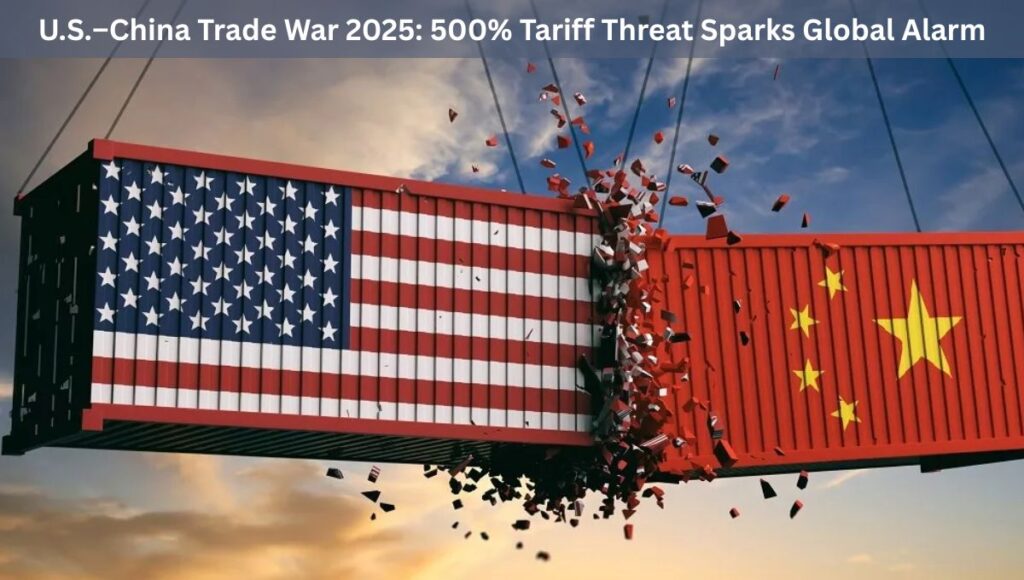
U.S.–China Trade War 2025: 500% Tariff Threat Sparks Global Alarm and economic retaliation.Washington and Beijing brace for new economic escalation as Trump eyes massive sanctions over Russian oil. U.S. Treasury Secretary Scott Bessent announced Wednesday (October 15) that 85 U.S. senators are prepared to grant President Donald Trump the authority to impose tariffs of up to 500% on Chinese imports.
The move targets China’s ongoing purchases of Russian oil, which Washington says help fund Moscow’s war in Ukraine. “Eighty-five U.S. senators are willing to give President Trump the authority to put up to 500% tariffs on China for the purchase of Russian oil,” Bessent told reporters in Washington.
If implemented, such tariffs would mark an unprecedented escalation in U.S.-China trade relations, threatening to shake global markets, intensify energy price volatility, and destabilize international supply chains already under strain.
U.S.–China Trade War 2025: 500% Tariff Threat Sparks Global Alarm
A New Flashpoint in U.S.-China Trade Relations
The proposed measures come as Washington steps up pressure on Beijing for maintaining trade and energy ties with Moscow.
According to Bessent, China buys 60% of Russia’s energy exports and 90% of Iranian oil, directly fueling what he called “the Russian war machine.” “It is the purchase of Russian oil by China that fuels the Russian war machines,” he said.
The U.S. Treasury chief stressed that Washington is not acting alone. “We have already been in touch with the allies,” Bessent said, noting that coordination is underway with European, Indian, and Asian democracies to ensure a unified response.
The proposed tariff authority, if endorsed by Congress, would significantly strengthen Trump’s trade powers and mark the most dramatic expansion of U.S. tariff authority in decades.
Senate Support and Political Backdrop
Bessent’s remarks suggest bipartisan support in the Senate for taking a tougher stance on China’s trade practices and oil purchases. Earlier this year, the Senate voted 49-49 to reject a motion aimed at blocking Trump’s existing tariffs, reflecting a narrow but steady consolidation of legislative support for his trade agenda.
Although the resolution was largely symbolic, it signaled that Congress remains divided but increasingly willing to empower the executive branch in managing trade enforcement. Republican lawmakers argue that China’s economic policies and alliance with Russia have made a stronger response unavoidable.
A Plan to Fund Ukraine’s Defense
Amid heightened global tensions, Bessent confirmed that President Trump has instructed his economic team to explore a “Ukraine Victory Fund”, financed by revenue from the new China tariffs.
According to reports in The Telegraph, the proposed fund would redirect proceeds from Chinese tariff payments to supply weapons and aid to Ukraine. Bessent said Washington is ready to proceed “if European partners will join us.”
“Whether you would call it a Russian oil tariff on China or a Ukrainian victory tariff, our Ukrainian and European allies have to be willing to follow,” he said.
The initiative underscores the administration’s strategy to link economic measures with geopolitical goals, using trade penalties as leverage to influence the outcome of the war in Ukraine.
Beijing’s Firm Response: ‘If Our Rights Are Harmed, We Will Counter’
China swiftly rejected Washington’s warning over its Russian oil purchases, calling the move an act of “unilateral bullying” and “economic coercion.” At a media briefing, Foreign Ministry spokesperson Lin Jian defended China’s trade with Russia as “legitimate and lawful.”
“China’s normal trade and energy cooperation with countries around the world, including Russia, is legitimate and lawful,” Lin said. “We firmly oppose the U.S.’s action of directing the issue at China and imposing illegal unilateral sanctions and long-arm jurisdiction.”
Lin further warned that Beijing would take “firm countermeasures” if Washington harmed China’s interests, stressing that such steps violate international trade rules and endanger global supply chain stability.
India’s Balancing Act on Russian Energy
Trump also referenced his conversation with Indian Prime Minister Narendra Modi, claiming Modi had assured him that India would stop buying oil from Russia.
However, India’s Foreign Ministry pushed back, saying its energy policy is guided by national interest and global market stability.
“Ensuring stable energy prices and secured supplies have been the twin goals of our energy policy,” Indian spokesperson Randhir Jaiswal said. “Our import policies are guided by the interests of Indian consumers and the realities of the global market.”
India remains the second-largest buyer of Russian fossil fuels after China, according to the Centre for Research on Energy and Clean Air (CREA).
Rare Earth Dispute: Another Front in the Trade War
Beyond oil, the U.S. and China are increasingly clashing over rare earth minerals — critical elements used in electronics, defense systems, renewable energy, and electric vehicles.
China produces roughly 70% of the world’s rare earth minerals and controls nearly 90% of their processing, giving it an outsized influence over global supply.
Beijing recently introduced new export controls requiring foreign firms to obtain government approval before exporting products containing even trace amounts of these materials. Washington views the move as an attempt to “weaponize supply chains” against global competitors.
“This is China versus the world,” Bessent declared. “They’ve pointed a bazooka at the supply chains and industrial base of the entire free world.”
Also Read: Huge Surge in US & China Port Fees Ignites Maritime Trade Turmoil
‘Unreliable Partner’: Bessent’s Sharp Criticism
Bessent characterized Beijing as an “unreliable partner to the world”, accusing Chinese officials of using trade policy as leverage over other nations. He vowed that Washington and its allies would resist any attempt by Beijing to dominate critical materials or dictate industrial policy.
“Make no mistake, bureaucrats in China cannot manage the supply chain or the manufacturing process for the rest of the world,” he said. “We’re going to have a fulsome group response with our allies — Europeans, Indians, Australians, and Asian democracies alike.”
These remarks reflect growing Western unease about China’s export restrictions, which could affect key industries from semiconductors to green technology.
Pause Possible on Tariffs Amid Rare Earth Talks
Despite the tough rhetoric, Bessent hinted at the possibility of delaying U.S. tariffs on Chinese goods if Beijing postpones or softens its rare earth export restrictions.
“Is it possible that we could go to a longer roll in return? Perhaps. But all that’s going to be negotiated in the coming weeks,” he said.
The two countries have already agreed to multiple 90-day truces on tariff hikes, currently capped at 145%, with the next deadline due in November.
Analysts believe the temporary pauses have allowed both economies to avoid a deeper recession while maintaining diplomatic contact.
Diplomacy Amid Tensions: Trump-Xi Talks Still On
Despite rising tensions, both sides appear committed to dialogue. Bessent said that “daily communication” continues between U.S. and Chinese officials and that both President Trump and Xi Jinping maintain what he described as an “excellent relationship.”
“The trade conflict between the two countries has not escalated further due to trust between Trump and Xi,” Bessent said. The U.S. president is expected to arrive in South Korea on October 29 for the Asia-Pacific Economic Cooperation (APEC) summit, where Xi is also slated to attend.
Although Trump earlier threatened to cancel the meeting in protest of China’s export curbs, Bessent confirmed that plans remain unchanged. “As the president said, ‘We want to help China, not hurt it,’” Bessent added, signaling that Washington prefers negotiation over confrontation.
Allies Divided Over Tariff Strategy
While Washington hopes for global coordination, European nations remain cautious.
Diplomatic sources told The Telegraph that some European governments are wary of the potential fallout from such extreme tariffs, fearing retaliation from Beijing and economic disruption across industries.
The European Union is already working to diversify its rare earth supply chains, investing in alternative sources in Africa and Australia. But the bloc has not yet endorsed Washington’s 500% tariff proposal, reflecting divisions among U.S. allies on how far to go in confronting China economically.
Also Read: Trump says ‘We’re in one now’ about a trade war with China
Economic Implications and Global Risks
If enacted, a 500% tariff on Chinese imports would have far-reaching effects.
Economists warn it could trigger massive price surges in consumer goods, electronics, and manufacturing materials, potentially slowing global growth.
China, in turn, could retaliate with its own tariffs or export bans, deepening the trade conflict and disrupting industries from automobiles to clean energy.
Financial markets have already shown sensitivity to these developments.
Oil prices rose slightly after Bessent’s remarks, while global indices reflected investor caution amid uncertainty over supply chain stability.
Military and Strategic Dimensions
The trade dispute has increasingly taken on a strategic and military dimension. Bessent revealed that the U.S. has obtained Ukrainian-supplied photographs showing Chinese components inside Russian drones operating in Ukraine — evidence Washington says strengthens the case for sanctions.
Meanwhile, Defense Secretary Pete Hegseth emphasized that the U.S. remains ready to deliver the “firepower needed for Ukraine to achieve peace through strength.”
“You achieve peace not with words or gestures but with strong and real capabilities that adversaries respect,” Hegseth said. “If this war does not end soon, the U.S. and its allies will impose costs on Russia in ways only America can.”
This alignment between trade and defense policy illustrates how economic tools are now part of a broader geopolitical strategy aimed at pressuring both Moscow and Beijing.
Avoiding a Full-Blown Trade War
Despite the harsh tone, U.S. officials continue to insist they do not seek full-scale confrontation.
Bessent said Washington remains open to a “comprehensive deal” with China, contingent on Beijing’s willingness to curb its support for Russia and ease rare earth restrictions.
“We’re not looking to escalate,” Bessent said. “We’re looking to protect our industries and uphold fair competition.”
Chinese Commerce Ministry spokesperson He Yongqian echoed a similar note, saying Beijing remains “open to resolving trade issues with Washington through dialogue.”
“China has always maintained an open attitude toward equal consultations based on mutual respect,” he said.
Outlook: Uncertain but Still Open
As Trump prepares for his Asia tour — with stops expected in Malaysia, Japan, South Korea, and possibly a meeting with Vice Premier He Lifeng — both governments face a delicate balance.
The U.S.-China economic relationship, worth over $750 billion annually, remains too large and interdependent for either side to sever entirely.
However, the political will for confrontation is growing in both capitals, fueled by domestic pressures and strategic competition.
For now, the 500% tariff threat remains a negotiating weapon — one that could either lead to a breakthrough in talks or plunge global trade into a new era of division.
Conclusion: The High Stakes of Economic Power Politics
The proposed 500% tariff underscores the shift from cooperation to confrontation in global trade diplomacy. With U.S. lawmakers backing stronger measures and China asserting its sovereignty, both sides appear locked in a high-stakes test of economic power.
While diplomacy remains alive, the path ahead is uncertain.
Whether the world witnesses a new trade war or a negotiated truce may depend on how Washington and Beijing navigate the next few weeks — and how far both are willing to go to defend their national interests.
Related Posts:
- Can the EU and NATO Impose Tariffs on India and…

- “Don’t Want Them To Buy Russian Oil”: Trump Urges…
- 10 Big Takeaways from Trump’s 155% Tariff Warning to China

- 7 Crucial Insights Into Trump and Xi’s High-Stakes…
- 7 Powerful Measures: Trump Sanctions Russian Oil…

- Trump Spares India, Targets China: 100% Tariff…