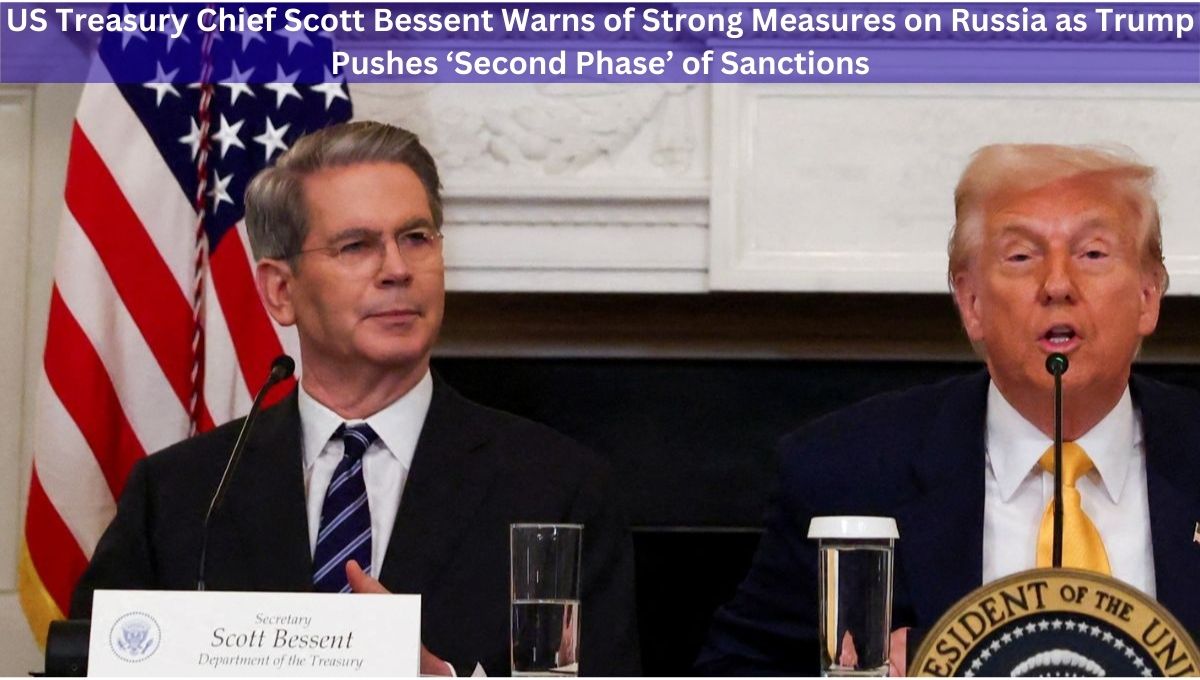
US Treasury Chief Scott Bessent Warns of Strong Measures on Russia as Trump Pushes ‘Second Phase’ of Sanctions, urges full EU cooperation. The United States has signaled a significant escalation in its approach to Russia’s war in Ukraine. Treasury Secretary Scott Bessent, a close aide to President Donald Trump, said Washington is prepared to take “strong measures” against Russia if European allies fully align with U.S. strategy.
The comments come as U.S. and European Union officials meet in Washington to coordinate a new wave of sanctions targeting Moscow, even as Russia unleashed its largest aerial assault on Ukraine since the war began.
US Treasury Chief Scott Bessent Warns of Strong Measures on Russia as Trump Pushes ‘Second Phase’ of Sanctions
US-EU Sanctions Talks Intensify
According to an EU official, two days of high-level meetings were held in Washington on Monday and Tuesday, focusing on strengthening sanctions and preventing Russia from evading existing restrictions.
The talks brought together officials from the Treasury Department, White House, State Department, and the U.S. Trade Representative’s office, alongside the EU delegation led by sanctions envoy David O’Sullivan.
O’Sullivan has spearheaded Europe’s global outreach on preventing Moscow from sidestepping sanctions through third countries.
An EU source told AFP that Monday’s meeting lasted less than two hours but covered key topics, including potential economic sanctions, tariff actions, and secondary measures targeting Russia’s trading partners.
Also Read: Tariffs on Russian Oil Buyers Could Trigger Economic Collapse, Says US Treasury Chief
Bessent: “Business as Usual Has Not Worked”
Following his discussions with O’Sullivan, Treasury Secretary Scott Bessent issued a sharp warning:
“Business as usual has not worked. We are willing to take strong measures against Russia, but our European partners must fully join us in this to be successful.”
Writing on X, Bessent added that “all options remain on the table” under Trump’s strategy to pressure Moscow into peace negotiations with Kyiv. He emphasized that Washington and Brussels remain “aligned on the importance of ending the war in Ukraine.”
Bessent was joined in the meetings by John Hurley, Treasury Undersecretary for terrorism and financial intelligence, signaling Washington’s focus on tightening financial pressure on the Kremlin.
Trump Threatens “Second Phase” of Sanctions
President Donald Trump himself raised the stakes over the weekend. Speaking after Russia launched its largest-ever aerial attack on Ukraine—killing at least four people and damaging a government building in Kyiv—Trump said he was prepared to move to a “second phase” of sanctions.
When asked whether the United States was considering new measures against Russia or countries buying Russian oil, Trump responded tersely: “Yeah, I am.”
The Trump administration has already imposed penalties on India, one of Russia’s biggest oil customers, slapping 25 percent punitive tariffs on Indian exports that raised the overall import duty to 50 percent. Trump has repeatedly accused New Delhi of “fueling the Russian war machine.”
Despite tensions, Trump and Indian Prime Minister Narendra Modi recently exchanged positive remarks online, hinting at an attempt to prevent a deeper rift in bilateral relations.
EU Prepares 19th Sanctions Package
While Washington signals a more aggressive line, the European Union is finalizing its 19th package of sanctions against Russia since the 2022 invasion.
Diplomats confirmed that Germany and France are pushing to target Russian oil giant Lukoil, a move that would tighten restrictions on Moscow’s energy sector.
The EU’s new measures are expected to include additional secondary sanctions targeting countries and companies that help Moscow evade punishment, particularly in Asia, the Middle East, and Africa.
The European Commission has said the package will be unveiled by September 12, aligning its rollout with U.S. efforts to synchronize sanctions policy.
US Pushes Europe for Unity
Secretary Bessent has stressed that Washington cannot act alone. In interviews and public remarks, he has urged the EU to fully commit to stepping up penalties on Moscow.
Speaking to NBC’s Meet the Press on Monday, Bessent said:
“We are prepared to increase pressure on Russia, but we need our European partners to follow us.”
This reflects the administration’s view that without full transatlantic cooperation, sanctions will fall short of their intended effect. Russia has weathered four years of Western restrictions, partly by finding alternative markets for its energy exports.
Russia Downplays Sanctions
The Kremlin, however, dismissed the new threats from Washington and Brussels. Dmitry Peskov, Kremlin spokesman, said Monday that no sanctions could force Russia to change its stance on Ukraine.
“The unprecedented number of sanctions imposed on Russia over the past four years has had no effect,” Peskov told reporters.
Moscow argues that sanctions have only pushed it closer to non-Western trading partners, particularly China, India, and the BRICS bloc, which continue to purchase Russian oil and gas.
Trump’s Oil Buyer Crackdown
President Trump has repeatedly vowed to go after countries that buy Russian oil, viewing energy revenue as Moscow’s financial lifeline.
He has already hit India with steep tariffs, calling them “secondary sanctions.” Officials in Washington say additional countries could face penalties in what Trump describes as a “second phase” of enforcement.
Treasury Secretary Bessent reinforced this point, telling NBC that only by collapsing Russia’s economy could the U.S. and EU force President Vladimir Putin to negotiate a peace settlement.
Ukraine Pushes for Tougher Action
In Kyiv, Ukrainian President Volodymyr Zelenskyy has welcomed the possibility of tougher U.S. and EU sanctions.
After Russia’s latest aerial attack involving 810 drones and missiles—the largest since the invasion began—Zelenskyy said he was prepared to meet Putin for direct negotiations, but only if Moscow shows readiness for a genuine peace agreement.
He urged President Trump and Western allies to “put punishing sanctions on Russia” to compel the Kremlin to end its aggression.
India’s Energy Dilemma
India remains at the center of U.S. concerns. New Delhi continues to justify its purchases of Russian crude on grounds of national energy security, even as Western nations cut back on imports.
Indian officials argue that U.S. tariffs are unfair, particularly as Europe itself has taken years to wind down its dependence on Russian energy. However, Washington views India’s imports as a critical lifeline keeping Moscow’s war machine afloat.
The 25 percent punitive tariff on Indian exports last month has strained ties, though both sides insist they want to avoid a major rupture.
BRICS Aligns on Ukraine
Meanwhile, the BRICS bloc of emerging economies—Brazil, Russia, India, China, and South Africa—held an online summit Monday, where members agreed to continue working together on the Ukraine issue.
The group reaffirmed support for the “Friends of Peace” initiative, which seeks alternative diplomatic solutions outside the U.S.-EU framework.
This alignment underscores the geopolitical challenges Washington and Brussels face in rallying global support for sanctions.
The Road Ahead
With Trump threatening a new round of sanctions, Bessent pushing for strong measures, and the EU finalizing its 19th sanctions package, the pressure on Russia is set to intensify in the coming weeks.
But the effectiveness of these steps will depend heavily on whether the U.S. and EU can act in unison—and whether major oil buyers like India can be persuaded, or coerced, into reducing their purchases from Moscow.
For now, both Washington and Brussels appear determined to escalate the economic war on Russia, even as Moscow insists it will not change course in Ukraine.
Conclusion
The United States and European Union are entering a decisive phase in their sanctions strategy against Russia. Treasury Secretary Scott Bessent’s call for “strong measures” and Trump’s warning of a “second phase” of sanctions underscore Washington’s growing frustration with Moscow’s resilience.
Whether these measures succeed in forcing President Vladimir Putin to the negotiating table—or deepen global economic tensions with countries like India—remains an open question. What is clear is that as the Russia-Ukraine war escalates, the sanctions battle is moving into uncharted territory.
Related Posts:
- 7 Alarming Facts About Super Typhoon Fung-wong

- Putin’s Shocking Risks Ahead of Trump–Hungary Summit 2025

- US Strike on Venezuelan Boat Kills 6 in Fifth…

- Trump’s 20-Point Gaza Peace Plan Gains Urgent Global…

- 10 Explosive Facts About Donald Trump’s $1 Billion…

- China Hosts SCO Summit 2025 and Military Parade as…