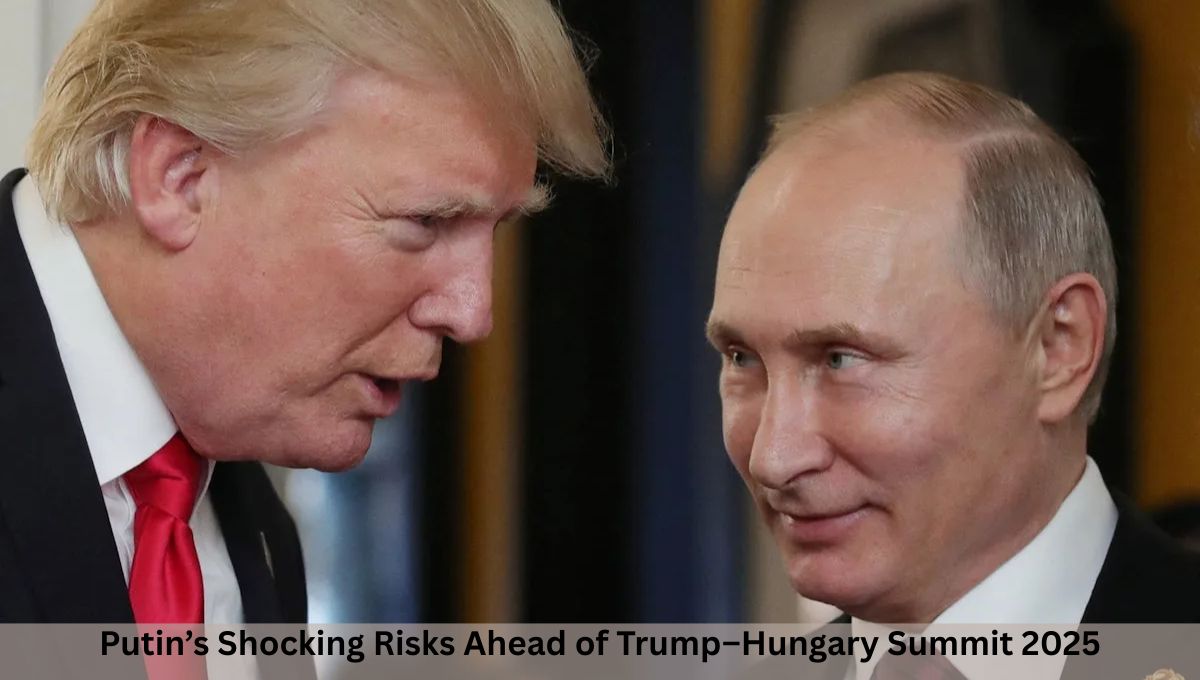
Amid ICC arrest warrant, Putin’s Shocking Risks Ahead of Trump–Hungary Summit 2025. After the failed Alaska summit, US President Donald Trump and Russian President Vladimir Putin have agreed to hold a second face-to-face meeting — this time in Budapest, Hungary — to discuss a possible end to the Ukraine war.
But the choice of venue has stirred controversy across Europe. On paper, Hungary is still a signatory to the International Criminal Court (ICC), which in 2023 issued an arrest warrant for Putin for alleged war crimes linked to the deportation of Ukrainian children. In theory, this means Putin should be arrested the moment he lands on Hungarian soil or enters its airspace. In reality, though, the situation is far more complex — and politically explosive.
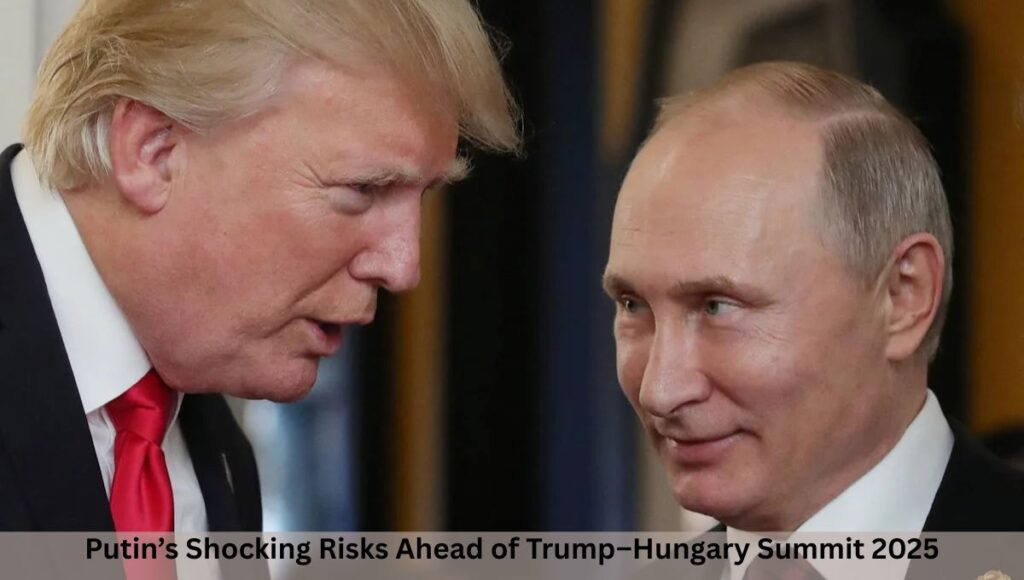
Putin’s Shocking Risks Ahead of Trump–Hungary Summit 2025
Putin Faces ICC Arrest Warrant
The International Criminal Court (ICC) in The Hague issued an arrest warrant for Vladimir Putin in March 2023, accusing him of being personally responsible for war crimes and the illegal deportation of Ukrainian children to Russia during the ongoing conflict.
However, the ICC has no police force or enforcement mechanism. It relies entirely on member states to execute arrests. Under international law, any ICC member — including Hungary and its EU neighbors — is obliged to detain Putin if his aircraft enters their airspace.
Germany has already stated unequivocally that Hungary must arrest Putin if he lands there. But the Hungarian government has different priorities.
Prime Minister Viktor Orban, a close ally of both Trump and Putin, has vowed to guarantee Putin’s safety, effectively turning Budapest into one of the few European capitals where the Russian leader can safely meet a Western head of state.
Hungary’s ICC Dilemma: Still a Member, But Not for Long
While Hungary has begun the process of withdrawing from the 1998 Rome Statute, the international treaty that established the ICC, the exit is not yet legally complete.
Orban’s government initiated the withdrawal proceedings in April 2025, during the visit of Israeli Prime Minister Benjamin Netanyahu — another leader facing ICC accusations over alleged Gaza war crimes.
By law, a country’s withdrawal from the ICC takes one year from the date the UN Secretary-General is formally notified. That means Hungary remains legally bound by ICC obligations until at least April 2026.
Yet, Orban’s administration has made it clear that Budapest will not comply with any order to arrest Putin. Foreign Minister Peter Szijjarto confirmed on Friday:
“We will ensure President Putin can enter Hungary, hold successful talks here, and return home safely.”
Will Hungary Arrest Putin?
The answer appears to be a resounding no. Hungary’s Prime Minister Viktor Orban has positioned himself as Europe’s outlier, defying both Brussels and NATO on multiple issues — from migration to sanctions against Russia.
He has described Budapest as “essentially the only place in Europe where such a meeting can be held.” Hosting the Trump–Putin summit gives Orban international visibility at a time when his government faces domestic discontent over inflation, food prices, and a sluggish economy.
European diplomats say the meeting is designed to boost Orban’s political profile, distract from economic woes, and signal Hungary’s independence from EU foreign policy.
Risk #1: The ICC Arrest Warrant Still Applies
While Orban may welcome Putin with open arms, Hungary’s legal status remains unchanged until April 2026. That makes any visit by Putin a legal grey zone. If Hungarian authorities refuse to enforce the ICC warrant, other EU members could raise objections, accusing Budapest of violating international obligations.
Already, Germany, the Netherlands, and Poland have warned that failure to act on the ICC mandate would “undermine the rule of law in Europe.” For now, Orban appears undeterred.
A senior EU diplomat told Politico Europe:
“Hungary has already made its political choice. No one seriously expects Orban to arrest Putin. But this will deepen the EU’s divide.”
Risk #2: How Will Putin Travel to Hungary Safely?
The logistics of Putin’s journey to Budapest are equally daunting.
Since the ICC warrant was issued, Putin has dramatically reduced his international travel, confining visits to friendly or non-ICC countries such as China, Mongolia, and Tajikistan.
Flying to Alaska for the first Trump–Putin summit was relatively easy — a direct polar route from eastern Russia over the Bering Strait avoided any hostile airspace.
But reaching Budapest is far more complex.
EU sanctions currently ban all Russian aircraft from flying over or landing in EU airspace, including Hungary’s. The “Flying Kremlin”, Putin’s heavily modified Ilyushin Il-96 presidential jet, would therefore require special exemptions.
Possible Flight Routes for Putin
- Shortest Route (Risky): Moscow → Belarus → Ukraine → Hungary
- The most direct, but impossible. Ukrainian airspace is an active war zone and entirely closed to Russian flights.
- Via Belarus and Poland
- Slightly longer but politically hazardous. Poland is a NATO member and one of Kyiv’s staunchest supporters. Warsaw has already warned Moscow not to test its air defenses.
- Via Turkey and the Balkans (Most Likely)
- A more feasible southern route could take Putin over Turkey, then Greece, Montenegro, Serbia, and finally Hungary.
- Turkey is not an ICC member and maintains good relations with Moscow, making it a reliable corridor.
According to aviation analysts, this 8-hour detour would be the safest — albeit symbolically awkward — route for a leader wanted by an international court.
Risk #3: EU’s Catch-22 Situation
The European Union faces a diplomatic dilemma over the summit. Blocking Putin’s access to Budapest could be interpreted as obstructing potential peace talks on Ukraine. But allowing him safe passage might weaken the EU’s moral stance on accountability and justice.
A spokesperson for the European Commission, Anitta Hipper, told reporters:
“Member states can grant individual exemptions for humanitarian or diplomatic reasons, but these must be decided case by case.”
In other words, Hungary and neighboring countries could allow Putin’s plane to cross their airspace — but doing so would require political consent from Brussels or national authorities. The EU has frozen Putin’s assets and banned his travel since 2022, but no blanket flight ban exists for the individual — only for Russian aircraft in general.
So, while technically possible, Putin’s trip to Hungary would still require extraordinary coordination between EU, NATO, and Russian officials.
Risk #4: Security Threats En Route
Even if Putin’s flight is approved, security risks remain high. The Ukrainian air defense network, stretching across the western frontier, is on high alert. Rogue factions or cyber sabotage could target Russian aircraft passing nearby.
Poland and the Baltics have previously intercepted Russian drones and warned Moscow that “any breach of NATO airspace” would provoke a swift response. Additionally, Turkey and Greece are embroiled in their own airspace disputes, complicating any overflight arrangements.
According to former Russian pilot Roman Svitan, “Every NATO radar will be watching Putin’s flight. The risk of interception or provocation is low but not zero.”
Putin’s plane, known as the Flying Kremlin, is equipped with electronic countermeasures, missile defenses, and radar jammers, but these systems can only mitigate, not eliminate, threats.
Risk #5: Political Fallout — and the Optics
The optics of the meeting are arguably the most explosive risk of all. By hosting Putin, Hungary would become the first EU country to welcome the Russian president since the Ukraine war began nearly four years ago.
Orban’s defiance will likely anger European allies and embolden Russia’s narrative that Western unity on Ukraine is fracturing. For Trump, the Budapest summit could either be framed as a peace mission — or as a political miscalculation that drags him closer to the Kremlin’s orbit.
As one senior EU diplomat told Reuters:
“Trump may see himself as a peacemaker. But to much of Europe, this summit looks like appeasement.”
Orban’s Strategic Gamble
For Hungary’s Prime Minister Viktor Orban, this summit is more than diplomacy — it’s political theatre. Facing domestic discontent over high inflation, energy prices, and corruption allegations, Orban hopes the Trump–Putin summit will divert attention and reassert his influence on the world stage.
He told Hungarian radio on Friday:
“Since the EU is pro-war, it’s logical that it will be left out of this peace process.”
Orban’s ruling Fidesz party has governed Hungary for 15 consecutive years, but polls suggest declining support ahead of elections next spring. Hosting both Trump and Putin in Budapest — against the wishes of Brussels — could help rally nationalist voters and reinforce Hungary’s sovereignist identity.
Trump–Putin Call: The Deal Behind the Summit
The Budapest summit was reportedly agreed upon during a two-and-a-half-hour phone call between Trump and Putin — their eighth conversation this year.
According to Kremlin aide Yuri Ushakov, the call was initiated by Moscow and covered Ukraine, sanctions, and US weapons deliveries.
Ushakov said:
“President Putin reiterated that US-supplied Tomahawk missiles would not change the situation on the battlefield, but would cause significant damage to relations between our countries.”
Trump, who met Ukrainian President Volodymyr Zelensky earlier this week, reportedly told Putin he would “take into account” Russia’s concerns before deciding on new arms transfers.
The Kremlin said the “strategic initiative” along the Ukraine front line “remains with Russian forces.”
Will Putin Ever Be Arrested?
Despite the ICC warrant, the odds of Putin being detained remain extremely slim.
In modern history, only a handful of sitting or former leaders have ever faced trial in The Hague:
- Slobodan Milosevic, extradited from Serbia in 2001 after his ouster.
- Charles Taylor, convicted in 2012 for war crimes in Sierra Leone.
- Rodrigo Duterte, who surrendered voluntarily earlier this year to face crimes against humanity charges.
Analysts say a similar fate for Putin is almost unimaginable without a complete power shift inside Russia.
As one European legal expert told Deutsche Welle:
“Only a post-Putin Russia could extradite him. Until then, the ICC warrant is largely symbolic — a political statement rather than an enforceable order.”
The Optics of Peace: Trump’s Gamble
Trump, meanwhile, sees the Budapest summit as a chance to cement his legacy as a global dealmaker — building on his recent ceasefire success in Gaza.
In remarks at the White House, he said:
“We’re bringing peace where others failed. I like stopping people from being killed. I’ve saved millions of lives already.”
However, critics argue that Trump’s open admiration for Putin risks undermining US credibility and alienating European allies. “Every time Trump engages with Putin, he elevates him,” said former US diplomat Victoria Nuland. “This summit is no exception.”
Final Hurdles: Can the ‘Flying Kremlin’ Reach Budapest?
Putin’s presidential aircraft, the Ilyushin Il-96-300PU, nicknamed the “Flying Kremlin”, is one of the most heavily guarded planes in the world. It features anti-missile systems, encrypted communication channels, and a mini command center that allows Putin to run the country midair.
But flying over EU or NATO airspace remains a bureaucratic and diplomatic nightmare. Each EU member state must grant individual exemptions for any Russian aircraft to transit, even temporarily.
The European Commission says such exemptions can be made “in the interest of peace.” Yet no country has publicly confirmed it would permit Putin’s passage. Still, with Trump involved, analysts believe NATO allies may acquiesce quietly to avoid sabotaging potential peace talks.
Also Read: Can Putin’s ‘Flying Kremlin’ travel through EU airspace to Budapest?
Conclusion: The Summit That Could Rewrite Europe’s Map
As preparations for the Trump–Putin Budapest summit accelerate, the world is watching closely.
For Trump, it’s a test of his diplomatic showmanship. For Putin, it’s a calculated gamble — to project strength, defy Western isolation, and prove he can still walk onto European soil without handcuffs.
For Hungary, it’s a moment of global spotlight, but one that could deepen its rift with the EU.
Whether the summit leads to peace or paralysis, one thing is clear:
The question “Will Putin be arrested in Hungary?” may define the geopolitical tone of 2025 — balancing between diplomacy, defiance, and the limits of international justice.
Related Posts:
- Trump-Putin Alaska Summit: High-Stakes Talks on…

- ICC Issues Arrest Warrants for Taliban Leaders Over…

- US Expanded Sanctions on ICC Judges Over Netanyahu’s…

- Putin–Zelensky Summit: Where Could Peace Talks Happen?
- Impacts of the Trump-Putin Call on Ukraine’s 2025 Strategy
- Putin’s Viral Alaska Summit Moment with Trump:…