

In a landmark and unprecedented move, ICC Issues Arrest Warrants for Taliban Leaders Over Crimes Against Women. The International Criminal Court (ICC) has issued arrest warrants for Taliban Supreme Leader Haibatullah Akhundzada and Chief Justice Abdul Hakim Haqqani, accusing them of crimes against humanity particularly the systematic persecution of Afghan women and girls since the Taliban’s return to power in August 2021.
The Hague-based tribunal stated that both men are suspected of being criminally responsible for gender-based persecution a grave violation under Article 7 of the Rome Statute, which defines crimes against humanity. The court’s actions mark a crucial turning point in the effort to hold the Taliban accountable for widespread human rights violations and gender apartheid in Afghanistan.
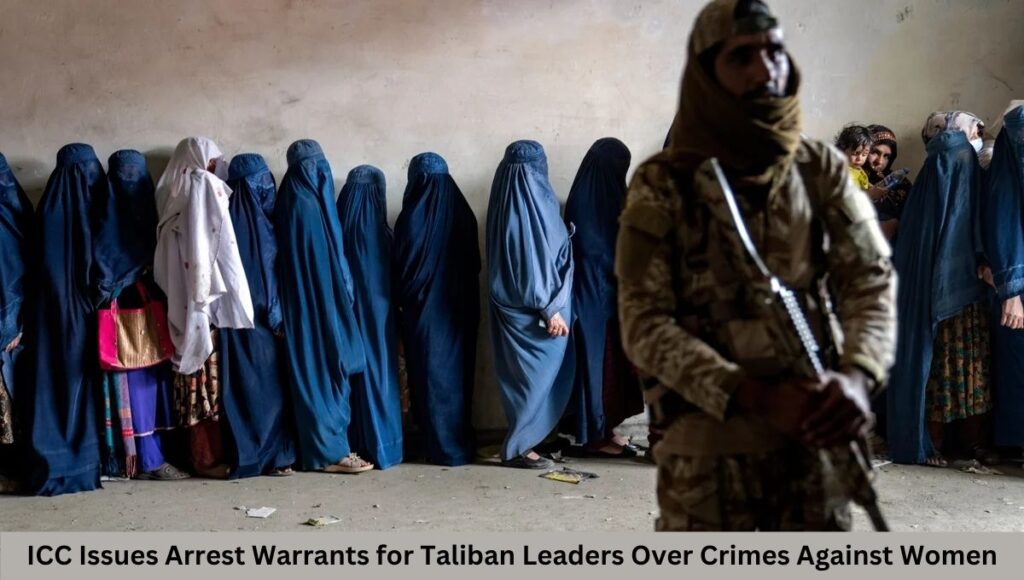
ICC Issues Arrest Warrants for Taliban Leaders Over Crimes Against Women
ICC Accuses Taliban of Systemic Gender Persecution
The ICC’s Pre-Trial Chamber II determined there are “reasonable grounds to believe” that Akhundzada and Haqqani ordered, induced, or solicited crimes targeting women, girls, LGBTQI+ individuals, and anyone perceived as an ally to gender equality.
The court cited Taliban edicts that deprived women and girls of their rights to:
- Education
- Employment
- Privacy and family life
- Freedom of movement, expression, thought, conscience, and religion
This persecution, the court said, occurred from August 15, 2021, when the Taliban seized Kabul, through at least January 20, 2025 and continues today.
“While the Taliban have imposed certain rules and prohibitions on the population as a whole, they have specifically targeted girls and women by reason of their gender,” the ICC said in a public statement.
Taliban’s Crackdown on Women: A Timeline of Repression
Since retaking power after the withdrawal of U.S. forces, the Taliban’s ultra-conservative regime has erased Afghan women and girls from public life, enforcing a harsh version of Islamic Sharia law.
Key restrictions include:
- Banning girls over age 12 from attending school
- Prohibiting women from attending universities
- Shuttering beauty salons, gyms, and public parks
- Restricting travel without a male guardian
- Enforcing full-body veils and face coverings
- Banning women from singing or reciting poetry in public
- Silencing women’s voices and visibility in society
In addition, a “vice and virtue” law mandates that women remain veiled and unheard in public — a policy the United Nations and rights groups have condemned as “gender apartheid.”
Taliban Rejects ICC’s Authority and Calls Charges “Baseless”
In response to the announcement, Taliban spokesperson Zabihullah Mujahid dismissed the ICC’s arrest warrants as “nonsense” and accused the court of religious hostility.
“The leadership and officials of the Islamic Emirate have established unparalleled justice in Afghanistan based on the sacred laws of Islamic Sharia,” Mujahid said.
He further stated that Afghanistan does not recognize the ICC, which complicates potential enforcement.
The Taliban has consistently claimed that its policies reflect Afghan culture and Islamic values, though critics argue these policies represent some of the world’s most severe human rights violations against women and minorities.
ICC Prosecutor: This Is Systemic, Institutionalized Persecution
Karim Khan, the ICC’s Chief Prosecutor, first requested the arrest warrants in January 2025 after gathering extensive evidence of systemic gender persecution by the Taliban.
“This case is not only about denial of education or jobs,” Khan said. “It’s about institutionalized persecution that strips entire populations of their basic dignity and rights.”
The ICC emphasized that gender-based persecution involves not only physical violence, but also policy-driven and institutional forms of harm, including bans, social exclusion, and restrictions that eliminate women’s participation in society.
Historic Recognition of LGBTQI+ Victims
In a groundbreaking element of the case, the ICC has also recognized that individuals with non-conforming gender identities or sexual orientations were victims of crimes against humanity under Taliban rule.
Lisa Davis, ICC Special Adviser on Gender and Discriminatory Crimes, declared:
“This is the first time in history that LGBTQ people have been confirmed as victims of crimes against humanity, namely gender persecution.”
This sets an important precedent in international criminal law and expands the ICC’s recognition of LGBTQI+ rights within the broader framework of gender justice.
International Human Rights Community Welcomes the Move
Major rights organizations hailed the ICC’s action as a critical breakthrough in global accountability.
Amnesty International Secretary General Agnes Callamard said:
“This is a crucial step to hold accountable all those allegedly responsible for the gender-based deprivation of fundamental rights to education, to free movement and expression, to private and family life, and to physical integrity and autonomy.”
Liz Evenson, International Justice Director at Human Rights Watch (HRW), added:
“The arrest warrants could provide victims and their families with an essential pathway to justice. When justice is supported, victims can have their day in court.”
HRW further called on the international community to enforce the warrants and to expand ICC accountability to include perpetrators from other groups such as ISIS-K, former Afghan security forces, and U.S. personnel, where appropriate.
Enforcement Remains a Challenge
Despite the significance of the ICC’s action, practical enforcement is limited. The ICC does not have a police force and relies on member states to arrest and transfer suspects. Afghanistan is not a party to the Rome Statute, and the Taliban rejects the court’s authority.
While the warrants bar the accused from traveling safely to ICC member states, past cases demonstrate that enforcement is not guaranteed.
For example, in 2024, the ICC issued arrest warrants for Israeli Prime Minister Benjamin Netanyahu and former Defense Minister Yoav Gallant over alleged war crimes in Gaza.
Some European countries like Hungary and Poland refused to enforce those warrants and even welcomed Netanyahu during official visits.
The United States, which is also not a party to the ICC, previously imposed sanctions on ICC officials investigating American and Israeli military conduct.
The Broader Impact on Global Gender Justice
Even if Haibatullah Akhundzada and Abdul Hakim Haqqani are not immediately arrested, the ICC’s decision holds profound symbolic and legal value. It elevates the issue of gender-based repression to the level of international criminal accountability.
The public disclosure of the warrants is also designed to deter further crimes, signal to victims that the world is watching, and show that no leader is above the law.
The ICC statement notes: “This provision reflects the Statute’s broader aim to protect civilian populations from serious and systemic violations of fundamental rights, particularly those targeting vulnerable groups.”
A Beacon of Hope for Afghan Women and Girls
This decision by the ICC offers a rare moment of international recognition and validation for Afghan women, girls, and LGBTQI+ individuals whose lives have been devastated by Taliban rule.
The move came one day after the UN General Assembly passed a resolution expressing “serious concern about the grave, worsening, widespread and systematic oppression of all women and girls in Afghanistan,” urging the Taliban to “swiftly reverse these policies.”
For many activists and survivors, this legal milestone may serve as the beginning of a broader push for justice, reparations, and renewed international pressure on the Taliban.
Conclusion: A Landmark for International Justice
The ICC arrest warrants for Taliban leaders Haibatullah Akhundzada and Abdul Hakim Haqqani mark a historic first: the global criminal justice system is taking direct aim at a regime accused of codifying gender apartheid into national policy. While enforcement remains a major obstacle, the symbolic and legal importance of these warrants cannot be understated.
They affirm the rights of Afghan women and LGBTQI+ individuals, recognize systemic repression as a crime against humanity, and send a message that impunity has limits. As the international community watches and waits, the ICC’s move stands as a powerful call for justice, a beacon of hope, and a crucial precedent in the long fight for gender equality and human rights in Afghanistan and beyond.
Also Read: Gaza Ceasefire Talks Stall in Doha as Trump Hosts Netanyahu at White House
Also read: ICC issues arrest warrants for Taliban leaders in Afghanistan over gender crimes
Related Posts:
- 5 Major Takeaways from the US Supreme Court's…

- US Expanded Sanctions on ICC Judges Over Netanyahu’s…

- Pakistan–Afghanistan Border Conflict 2025: Ceasefire…

- Afghan Women Left to Die After Earthquake as…

- Afghanistan–Pakistan Border Clashes 2025: Key Facts…

- Pakistan’s Bold Airstrikes in Kabul: Af-Pak Crisis…
