In a bold and controversial move, Trump Targets Sri Lanka, BRICS with Sweeping Tariffs. U.S. President Donald Trump has significantly expanded his global trade offensive by announcing sweeping new tariffs on Sri Lanka, BRICS nations, and several other countries. The tariffs, which range from 20% to 50%, are set to take effect on August 1, 2025, and form part of a broader strategy that Trump says is aimed at protecting American interests and correcting what he calls “unfair trade relationships.”
This latest tariff directive represents a new chapter in Trump’s hardline “America First” trade policy, drawing sharp global attention and raising concerns about escalating economic and diplomatic tensions.
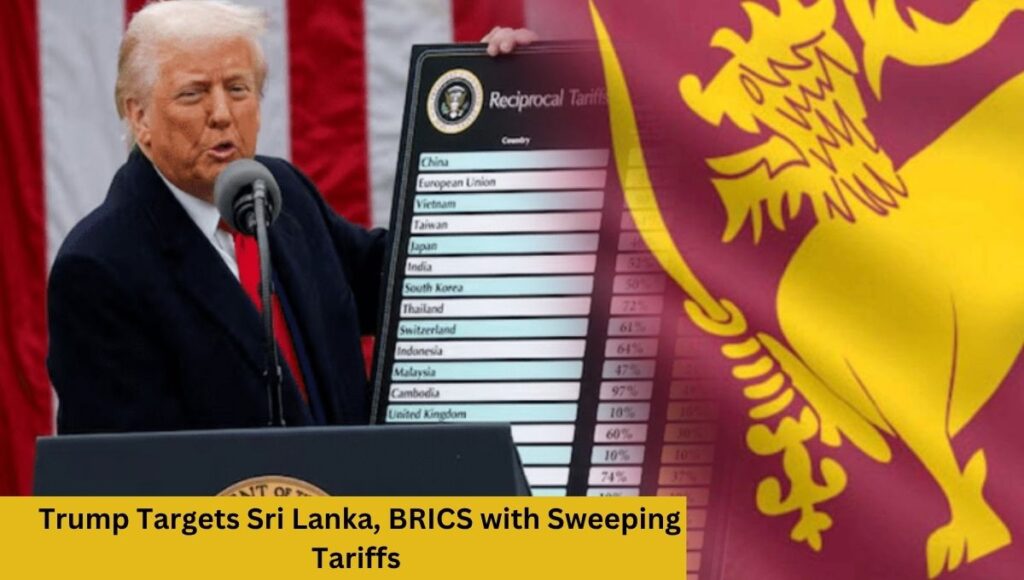
Trump Targets Sri Lanka, BRICS with Sweeping Tariffs
30% Tariff on Sri Lanka and Others: Realigning Trade with Emerging Economies
At the center of the announcement is a 30% import tariff on Sri Lanka, Iraq, Libya, and Algeria. While these numbers are lower than earlier threats Sri Lanka’s proposed April tariff was 44% they still reflect a significant step in Trump’s effort to restructure trade ties with emerging economies.
Sri Lanka, a growing exporter of textiles, machinery, and IT services to the United States, has increasingly become a target for Trump’s trade team.
The administration argues that Sri Lanka’s trade surplus with the U.S. has grown unsustainably, warranting intervention.
“These countries have been taking advantage of us for too long,” Trump said during a cabinet meeting. “We’re going to fix this once and for all.”
This recalibration is part of a wider move to tighten U.S. control over trade imbalances, especially with nations that Trump believes are exploiting the U.S. market without offering reciprocal opportunities for American businesses.
Brazil Hit with 50% Tariff Amid Political Tensions
While Sri Lanka faces stiff penalties, Brazil has been dealt the harshest blow, with Trump increasing its tariff from 10% to 50%.
The move appears to be politically charged, tied closely to Brazil’s internal affairs specifically, the ongoing trial of former Brazilian President Jair Bolsonaro.
In a strongly worded letter to Brazilian President Luiz Inacio Lula da Silva, Trump condemned what he called a politically motivated “Witch Hunt” against Bolsonaro, a close ally of the former U.S. president.
He also criticized Brazil’s restrictions on American tech firms and alleged censorship practices, prompting him to direct the U.S. Trade Representative to launch a Section 301 investigation.
Trump’s new tariff is being seen not only as a punishment for perceived political wrongs but also as a tool to reset economic relations with one of the U.S.’s largest trading partners.
With two-way trade reaching $92 billion in 2024, Brazil is a critical economic ally. However, this sudden and steep tariff threatens to ignite a trade war that could disrupt supply chains in sectors like energy, agriculture, and technology.
Trump Announces 10% Tariff on All BRICS Nations
Perhaps the most sweeping element of Trump’s trade escalation is his announcement of a 10% blanket tariff on all BRICS nations Brazil, Russia, India, China, and South Africa.
“If they’re a member of BRICS, they are going to have to pay a 10% tariff,” Trump declared. “Just for that one thing and they won’t be a member long.”
Trump accused the BRICS bloc of trying to undermine the U.S. dollar and warned that their efforts to create an alternative reserve currency represent a major threat to America’s global economic dominance.
India, which has been negotiating a mini trade deal with the U.S., now finds itself caught in the crossfire.
Although strategic and defense ties between Washington and New Delhi have strengthened in recent years, the new BRICS tariff on India could strain those relations.
This policy marks the first time a multilateral organization has been targeted as a whole in Trump’s trade war, raising legal questions and geopolitical alarm bells around the globe.
Tariffs as Diplomacy: “You Fight, We Don’t Trade”
Trump has made it clear that trade is not just an economic tool but also a diplomatic weapon.
“You guys are going to fight, we’re not going to trade,” he said during a White House meeting with African leaders, referencing ongoing tensions between India and Pakistan, and Kosovo and Serbia.
This approach was evident in the 35% tariff slapped on Serbia earlier this week, which Trump framed as a direct response to Serbia’s perceived unwillingness to resolve disputes diplomatically.
Critics argue that such tactics undermine international norms and may push other countries to retaliate in kind. Supporters, however, see it as a way to use economic pressure to enforce political discipline.
Sector-Specific Tariffs Expand Scope: Copper and Pharma in the Crosshairs
Beyond country-specific tariffs, Trump also announced sector-specific tariffs, including duties on copper and pharmaceuticals. These come in addition to earlier levies on steel, aluminum, and automobiles.
The 50% copper tariff, justified under Section 232 on national security grounds, is especially significant. Copper is vital to industries such as semiconductors, electric vehicles, renewable energy, and defense manufacturing.
The administration argues that overreliance on foreign copper could leave the U.S. vulnerable in times of crisis. “We will rebuild America’s DOMINANT copper industry,” Trump stated.
Businesses have responded by rushing to import copper before the tariff takes effect, but economists warn that such measures could ultimately lead to higher production costs and inflationary pressures in downstream sectors.
Trump’s Final Warning: No More Deadline Extensions
Originally set for July 9, the tariff deadline has now been extended to August 1. Trump, however, emphasized that no further extensions will be granted.
“All money will be due and payable starting August 1 no extensions will be granted,” he posted on Truth Social.
Commerce Secretary Howard Lutnick confirmed that up to 20 countries may receive tariff letters this week.
With formal notices already sent to Japan, South Korea, South Africa, and others, the scope of the trade war continues to widen.
Market Reaction and Economic Outlook
Despite the dramatic scope of the new tariffs, global markets have remained surprisingly calm. Analysts point to the incremental rollout strategy dubbed “TACO” (Trump Always Chickens Out) as one reason why markets aren’t panicking.
Many investors believe Trump may ultimately soften the measures or strike last-minute deals.
However, Treasury Secretary Scott Bessent has cautioned that 18 countries accounting for 95% of the U.S. trade deficit are still under review. His belief that a stronger dollar would offset tariff-driven inflation has not materialized.
The dollar has declined 10% in 2025, raising questions about how sustainable this trade strategy really is.
Global Trade Realignment: A World Without the U.S.?
As the U.S. builds what some call a “tariff wall”, other countries are strengthening trade ties independent of Washington.
New trade agreements like the UK-India and EU-Canada deals highlight a global trend toward economic diversification and resilience.
China’s exports to the U.S. have fallen 9.7% in 2025, while its exports to Africa are up 18.9%, and to the UK up 7.4%.
This shift suggests that Trump’s trade war is driving a realignment of global trade patterns, one in which the U.S. may not be the center of gravity.
EU Negotiations Hang in the Balance
The European Union remains in delicate negotiations with the Trump administration. EU Commission President Ursula von der Leyen confirmed that talks are continuing in “good faith,” but Trump has signaled he will soon issue a formal tariff letter to the EU.
The U.S. and EU are reportedly working on a framework deal to avoid additional tariffs, particularly those affecting automobiles and digital services. However, tensions remain high, especially in light of the EU’s legal actions against U.S. tech firms.
The Legal Backbone: Section 232 and Section 301
At the legal heart of Trump’s trade arsenal are Section 232 and Section 301.
- Section 232 permits tariffs based on national security concerns, which Trump has used to justify tariffs on steel, aluminum, and now copper.
- Section 301 targets unfair trade practices, especially in digital trade, and is being invoked in Trump’s case against Brazil.
Critics argue these provisions are being used too broadly, while supporters say they give the U.S. the leverage needed to reset unfair global trade dynamics.
Final Thoughts: High Stakes, Uncertain Outcomes
With the August 1 tariff deadline fast approaching, countries like Sri Lanka, Brazil, and India now face a stark choice: negotiate a deal or absorb significant economic blows. Trump insists his aggressive tariff policy is about securing fair and balanced trade, but critics warn it could destabilize the global economy and erode America’s leadership role.
As this bold new 2025 tariff regime unfolds, businesses, investors, and governments around the world are bracing for impact. Whether this strategy will lead to stronger American industry or unintended global fallout remains to be seen. For now, one thing is clear: Trump is using tariffs as both a shield and a sword, reshaping America’s place in the global economic order one trade deal at a time.
Also Read: Trump Targets BRICS With 10% Tariffs: A Dollar Defense or Global Disruption?
Also Read: Trump’s 50% Levy on Brazil Shows World Nothing Is Off Limits