

Destroying the BRICS effort to “destroy” the US dollar Trump Targets BRICS With 10% Tariffs: A Dollar Defense or Global Disruption? As the BRICS bloc expands its footprint and builds momentum behind dedollarization, President Donald Trump has responded with a sweeping tariff threat.
During a recent Cabinet meeting and through multiple Truth Social posts, Trump announced a 10% tariff on all nations associated with BRICS, accusing the group of pursuing “anti-American policies” and attempting to dethrone the US dollar as the world’s reserve currency.
The measure, which is expected to take effect on August 1, 2025, has sent shockwaves through international markets and diplomatic circles, escalating tensions between Washington and the emerging BRICS alliance, which now includes Brazil, Russia, India, China, South Africa, and newer members like Iran, Indonesia, and the UAE.
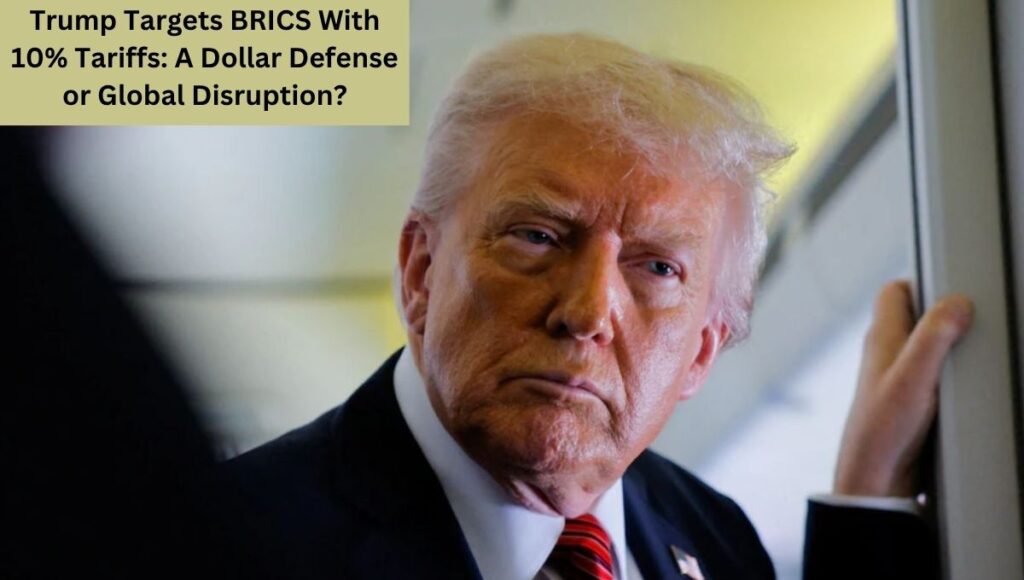
Trump Targets BRICS With 10% Tariffs: A Dollar Defense or Global Disruption?
Trump’s Warning: BRICS Nations to Face a 10% Charge
Trump made his intentions clear: all BRICS nations would be subject to the 10% tariff unless they abandon efforts to replace or bypass the dollar in international trade.
“They’re gonna have to pay a 10% tariff,” Trump said. “BRICS was set up to hurt us, to degenerate our dollar, to take it off as a standard.”
This economic penalty, Trump argued, is necessary to defend America’s financial leadership. He warned that losing the dollar’s reserve currency status would be akin to losing a major world war.
The White House confirmed that formal letters were sent to at least 14 countries, setting the August 1 deadline in stone and giving little room for negotiation.
Why Trump Sees BRICS as a Threat
Though Trump publicly downplays BRICS’ capacity to challenge US dominance, his aggressive trade policy tells a different story.
The alliance, which now spans over 40% of global GDP and nearly half of the world’s population, is rapidly evolving into a formidable economic and geopolitical force.
At the heart of Trump’s fears lies the BRICS push to ditch the US dollar. Since 2023, member nations like Russia, China, and India have ramped up bilateral trade in local currencies, sidelining the dollar and challenging US financial supremacy.
“If we lose the dollar standard, it would be like losing a major world war,” Trump stated. “We’re not going to let that happen.”
The BRICS Dedollarization Drive
The dedollarization agenda has been a consistent theme for BRICS, particularly for nations under Western sanctions like Russia and Iran.
The bloc has proposed alternatives like BRICS Pay, BRICS Bridge, and even flirted with a gold-backed digital currency, often referred to as the “Unit.”
India, though part of the BRICS core, has remained cautious. While paying for Russian oil in rupees and dirhams, India has also distanced itself from more radical proposals like a unified BRICS currency voicing concerns over Chinese dominance within the bloc.
Economist Alicia Garcia-Herrero noted, “India, together with Brazil, is trying to balance the anti-Western messaging from BRICS, which is dominated by China and Russia.”
Despite their ambitions, intra-BRICS trade accounts for only 3% of global trade, about $1 trillion out of $33 trillion in 2024 showing the alliance’s limitations as a direct economic rival.
BRICS Responds: “We Are Sovereign Countries”
During the 17th BRICS Summit held in Rio de Janeiro in July 2025, member leaders didn’t mention Trump by name, but their rebuttal was unmistakable.
Brazilian President Luiz Inácio Lula da Silva dismissed Trump’s threats, stating: “The world has changed. We don’t want an emperor. We are sovereign countries.”
Lula emphasized BRICS’ commitment to multilateralism, UN reform, and trade fairness values seemingly at odds with Trump’s hardline “America First” stance.
Modi’s Tightrope: India Between BRICS and Washington
India finds itself in a geopolitical tug-of-war. As a founding BRICS member and a key US strategic ally, it must navigate increasingly choppy waters.
Trump made it clear: India would not be exempt from the tariffs. “India is in BRICS, so they can pay the 10% tariff,” he said bluntly.
Ironically, the US and India are nearing a major trade deal, aiming to double bilateral trade to $500 billion by 2030.
Trump is expected to visit New Delhi later this year, but whether the deal survives his tariff ultimatum remains uncertain.
Trump’s Dollar Doctrine
Trump’s rhetoric underscores a broader mission: to defend the dollar’s role in the global economy. With the greenback underpinning 90% of international transactions and 59% of central bank reserves, its status is seen by Trump as inseparable from American power.
“The dollar is king. We are going to keep it that way,” he asserted. In his view, past administrations were “stupid” for allowing challenges to the dollar. He sees this as a zero-sum game: either the US maintains financial hegemony or loses its global stature.
Tariffs as Leverage: Trump’s Economic Playbook
The 10% BRICS tariff isn’t an isolated policy; it’s part of a broader tariff-first diplomacy strategy. Trump believes in using trade pressure as a negotiation tool, arguing that tariffs brought billions in revenue during his first term.
“We’re always subject to negotiations when something is fair,” Trump said. “But people have had their way for decades. That ends now.”
Already, Japan, South Korea, and a dozen other nations are on Trump’s tariff radar, with 25% duties looming if new deals aren’t reached by August 1.
Global Consequences: Disruption and Retaliation
The move could send shockwaves through the global economy. Analysts warn of potential consequences:
- Supply chain disruption as higher costs ripple through manufacturing.
- Stalled trade deals with key partners like India, Japan, and Indonesia.
- Geopolitical realignment, as nations weigh the cost of BRICS membership against US retaliation.
“Suddenly, being part of BRICS has a cost,” said Garcia-Herrero. “That will probably discourage some, particularly the poorer countries.”
BRICS’ Vision: Multilateralism, Reform, and Inclusion
At the BRICS Summit, leaders focused on global governance reform, including permanent UN Security Council seats for Brazil, India, and an African nation.
The summit also stressed cooperation in areas like:
- Climate change
- Artificial Intelligence governance
- Public health
- Digital finance
The bloc called for the end of unilateral sanctions, slammed protectionist policies, and pushed for a multipolar world rooted in fairness not dominance.
Is BRICS a Real Threat?
Despite Trump’s alarm, many economists remain skeptical of BRICS’ ability to upend the Western-led global system anytime soon.
Internal rifts, especially between India and China, continue to hinder unity. The New Development Bank has disbursed just $39 billion compared to over $1 trillion by the World Bank.
“Trump shouldn’t be worried,” said economist Herbert Poenisch. “BRICS is still in the early stages.” Still, the bloc’s symbolic power and growing Global South appeal cannot be ignored.
Final Thoughts: Sovereignty vs. Supremacy in a Multipolar World
Trump’s 10% tariff on BRICS is more than a trade move it’s a declaration of economic war against any nation that dares challenge US dominance. The tariffs might deter some countries from joining BRICS, but they may also drive others further into its orbit. As the world edges toward multipolarity, this confrontation could define the next era of global economics. Whether Trump’s tariff diplomacy will fortify the dollar or alienate allies remains to be seen. One thing is clear: the rules of the global order are being rewritten and the battle lines are drawn.
Also Read: Lula to Trump: ‘We Don’t Want an Emperor’ as BRICS Rejects US Tariff Threat
Also Read: Trump’s Tariff War: Why BRICS Is His Latest Target…
Related Posts:
- 5 Powerful Highlights as Trump Lands Second Nobel…

- Trump’s 2025 Gaza Peace Plan Signing and Historic…

- 9 Explosive Revelations as Trump Declares His Health…

- Can the EU and NATO Impose Tariffs on India and…

- Trump Targets Sri Lanka, BRICS with Sweeping Tariffs
- Trump’s 20-Point Gaza Peace Plan Gains Urgent Global…
