Trump’s Tariff Tsunami:
A dramatic escalation of Trump’s Tariff Tsunami: 50% on Copper, 200% Warning on Pharma – India in the Crossfire. President Donald Trump has announced sweeping new tariffs targeting two crucial sectors: a 50% tariff on copper imports and a potential 200% tariff on pharmaceutical imports.
Thank you for reading this post, don't forget to subscribe!With both commodities deeply tied to India’s export economy, the move could send shockwaves through New Delhi’s trade and economic planning. These developments come just weeks ahead of Trump’s self-imposed August 1, 2025 tariff deadline, which has already roiled global markets and put dozens of nations on edge.
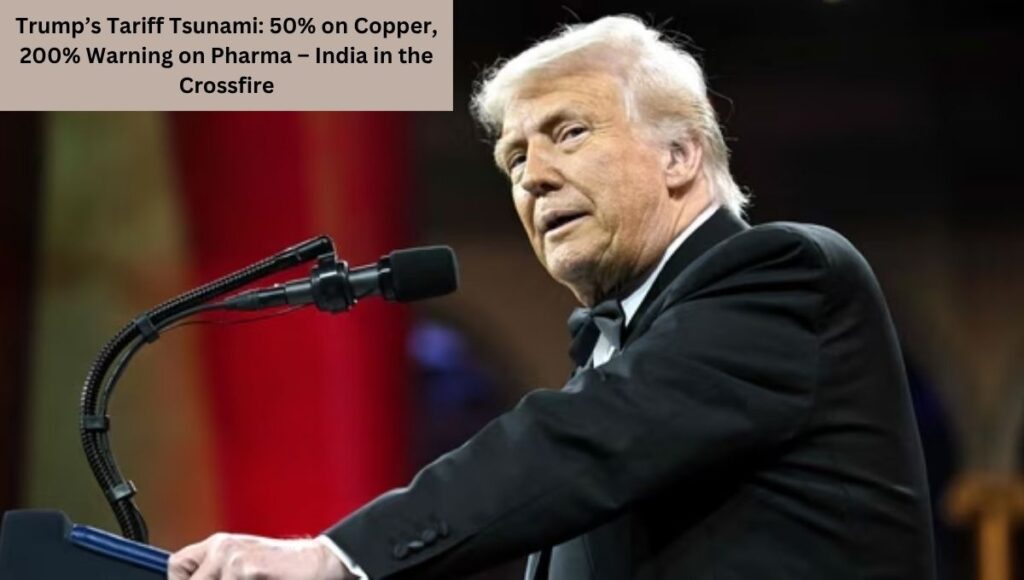
Trump’s Tariff Tsunami: 50% on Copper, 200% Warning on Pharma – India in the Crossfire
Trump Confirms 50% Tariff on Copper
During a cabinet meeting on Tuesday, Trump said, “Today we’re doing copper. I believe the tariff on copper, we’re going to make it 50%.”
Commerce Secretary Howard Lutnick later confirmed the plan in a CNBC interview, noting the copper tariffs would be implemented by late July or August 1.
The tariff is the latest in a string of measures aimed at boosting U.S. manufacturing and reducing reliance on foreign imports.
This announcement follows a Section 232 investigation, which assessed copper imports under the premise of national security. Lutnick said the investigation, originally due by November, has already concluded.
US Copper Demand and Market Response
The U.S. currently imports about 810,000 metric tons of copper annually roughly half its domestic needs.
Following Trump’s comments, Comex copper futures surged over 12% to a record high of $5.896 per pound, before settling at $5.48.
Commodity analysts called it a “liquidity event” with traders stockpiling ahead of the tariff. Saxo Bank’s Ole Hansen warned, “A 50% increase will be a massive tax on consumers of copper.”
Freeport-McMoRan, the largest publicly traded U.S. copper producer, saw shares spike 5% as markets anticipated higher domestic demand.
Why Copper Tariffs Matter to India
India exported nearly $2 billion in copper and copper products in FY2024–25. Of this, $360 million or 17% went to the U.S., making it India’s third-largest market.
The 50% tariff threatens to derail existing contracts and make Indian copper uncompetitive in the American market. While analysts suggest Indian exporters could pivot to other markets, the short-term impact could be painful.
Major Indian firms like Hindustan Copper, SAIL, Vedanta, and Tata Steel saw their stock prices fall by up to 3.5% after the tariff announcement.
Trump’s 200% Tariff Warning on Pharma
Perhaps even more consequential was Trump’s warning about pharmaceutical imports. “If they have to bring the pharmaceuticals into the country, they’re going to be tariffed at a very, very high rate like 200%,” he said.
Although the 200% tariff is not immediate, Trump signaled a year-long grace period for pharmaceutical companies to shift production to the U.S. before penalties are enforced.
India’s Pharma Exports: A Key Target
India is the world’s leading supplier of generic drugs, with the U.S. accounting for 40% of Indian pharma exports.
In FY2024–25, India exported $9.8 billion worth of pharmaceuticals to the U.S., up from $8.1 billion the previous year.
With production hubs in states like Telangana and Himachal Pradesh, India’s cost-effective manufacturing is critical to the U.S. healthcare system.
A 200% tariff could devastate margins, threaten FDA-approved supply chains, and cause shortages in the U.S. generic drug market.
Mini Trade Deal: India’s Last Line of Defense
India and the U.S. are in advanced negotiations over a mini trade deal, which could provide exemptions for key sectors.
Trade officials confirmed that talks have intensified, particularly on copper, pharmaceuticals, and digital trade.
India is pressing for carve-outs before the August 1 deadline, using its strategic importance in technology, climate, and defense to negotiate relief.
Dedollarization, BRICS, and Trump’s Broader Agenda
Trump’s tariff moves align with his growing concern about dedollarization the BRICS bloc’s shift toward alternative currencies and payment systems.
“If we lost the world standard dollar, that would be like losing a world war,” Trump warned, calling BRICS “not a serious group” while imposing a 10% tariff on member nations, including India.
The tariffs are part of a larger economic doctrine aimed at securing dollar dominance by reshaping global trade dependencies.
US Trade Strategy: Beyond Copper and Pharma
Since returning to office, Trump has ordered investigations and/or imposed tariffs on steel, aluminum, lumber, semiconductors, and critical minerals. The copper and pharma tariffs are the most aggressive yet.
Steel and aluminum tariffs were raised to 50%, while new tariffs of 25–40% are proposed for imports from Japan, South Korea, and Germany.
Impact on Indian Markets and Industry
Indian markets reacted swiftly to Trump’s announcements:
- Hindustan Copper: Down 3.5% to ₹264
- SAIL: Down 2.35% to ₹131.82
- Vedanta, Jindal, Tata Steel: Down 1-2%
Fears persist that zinc, nickel, and rare earth elements could be targeted next.
Global Reactions and Concerns
Chile, Canada, and Mexico the top three copper suppliers to the U.S. have all demanded clarity from Washington.
Chile’s Codelco chairman Maximo Pacheco said, “We want to know which copper products are affected and whether the tariff applies to all countries.”
Australia’s Treasurer Jim Chalmers said the pharmaceutical tariff warning is “very concerning” and that Australia is seeking urgent clarification.
The Road Ahead: What India Must Do
India’s best-case scenario lies in a successful mini trade deal before August 1. Key goals include:
- Exemptions for pharma and copper
- Diplomatic pressure via Quad, IPEF, and UN forums
- Leveraging strategic ties on climate, tech, and defense
Failure to secure exemptions could trigger job losses, contract cancellations, stock volatility, and severe revenue shortfalls.
Final Thoughts: A Defining Moment for Global Trade
President Trump’s 50% copper tariff and looming 200% pharmaceutical duty represent a radical escalation of economic nationalism. While they may boost select U.S. industries in the short term, the long-term costs inflation, supply chain disruption, and retaliatory tariffs could be severe.
For India, the stakes are existential. With nearly $10 billion in pharma exports and a rapidly growing copper trade, what happens by August 1 could redefine Indo-U.S. trade relations for years to come.
Also Read: Trump’s 200% Pharma Tariff Could Devastate U.S. Patients and Indian Drugmakers
Also Read: Trump tariffs: 50% on copper, 200% on pharmaceuticals – How it may impact India
Related Posts:
- Tariff After Tariff: Donald Trump Imposes 100%…
- Trump Targets Sri Lanka, BRICS with Sweeping Tariffs
- Trump’s 2025 Gaza Peace Plan Signing and Historic…

- Can the EU and NATO Impose Tariffs on India and…

- 5 Powerful Highlights as Trump Lands Second Nobel…

- 9 Explosive Revelations as Trump Declares His Health…