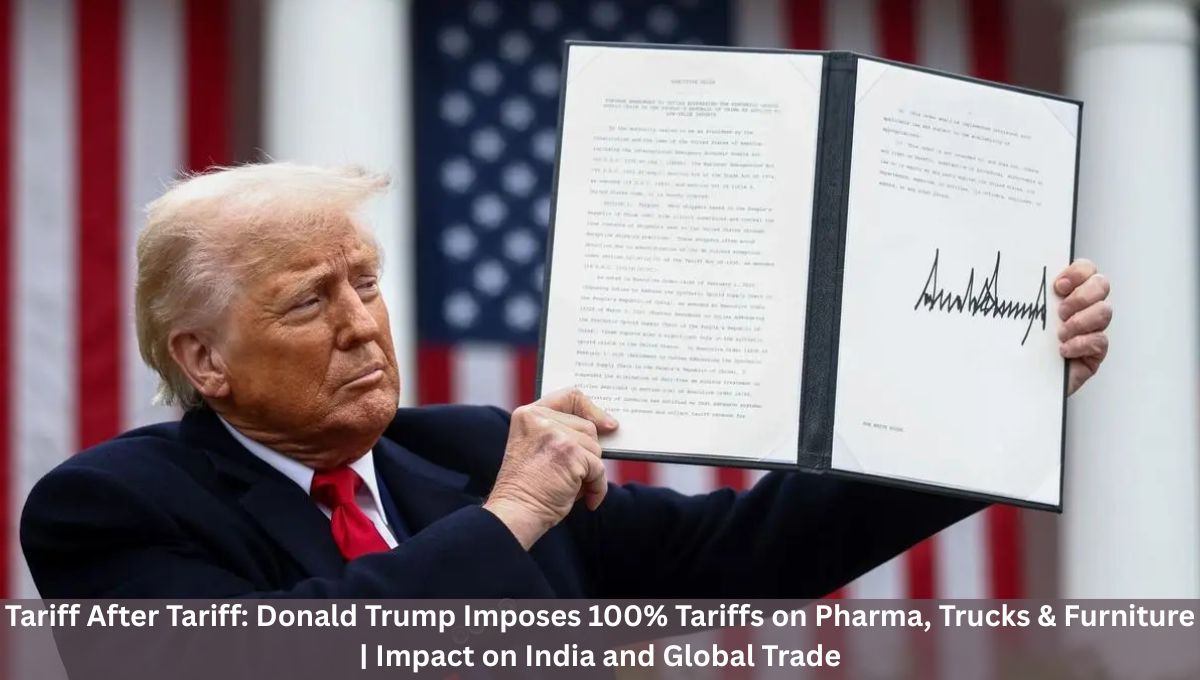
Announcing sweeping Tariffs After Tariffs: Donald Trump Imposes 100% Tariffs on Pharma, Trucks & Furniture | Impact on India and Global Trade. “Tariff pe tariff” has become the new reality of global trade under US President Donald Trump’s second term. On Thursday, Trump unveiled yet another tsunami of tariffs, targeting sectors as diverse as pharmaceuticals, heavy trucks, kitchen cabinets, and upholstered furniture.
The most headline-grabbing announcement is a 100% tariff on branded and patented pharmaceutical imports, set to take effect October 1, 2025. Trump declared that only companies actively building pharmaceutical plants in the United States will be exempt.
This dramatic escalation follows months of tariff blitzes on steel, aluminum, copper, and automobiles. While the Trump administration argues the tariffs will boost domestic manufacturing and secure supply chains, economists and trade experts warn of higher consumer costs, inflationary pressures, and global market disruption.
India, the world’s largest supplier of generic medicines, has been watching closely. While generics are exempt from the current round of tariffs, analysts warn that India cannot afford to be complacent. This article breaks down Trump’s latest tariff offensive, the impact on global trade, the risks for India’s pharmaceutical industry, and the broader geopolitical implications of America’s tariff-first policy.
Tariff After Tariff: Donald Trump Imposes 100% Tariffs on Pharma, Trucks & Furniture | Impact on India and Global Trade
Trump’s New Wave of Tariffs: Full List
1. 100% Tariff on Branded and Patented Pharmaceuticals
In a fiery Truth Social post, Trump wrote:
“Starting October 1st, 2025, we will be imposing a 100% Tariff on any branded or patented Pharmaceutical Product, unless a Company IS BUILDING their Pharmaceutical Manufacturing Plant in America. ‘IS BUILDING’ will be defined as, ‘breaking ground’ and/or ‘under construction.’”
- Effective date: October 1, 2025
- Target: Branded, patented drugs imported from Europe, Japan, and other pharmaceutical hubs
- Exemption: Companies with plants under construction in the US
Trump’s rationale: Reduce reliance on foreign medicine supply chains, push drugmakers to manufacture in the US, and, in his words, “lower drug prices.”
2. 25% Tariff on Heavy Trucks
Trump announced a 25% levy on heavy-duty trucks imported into the United States.
He justified the move as necessary to protect “our Great Heavy Truck Manufacturers like Peterbilt, Kenworth, Mack Trucks, and Freightliner” from “unfair outside competition.”
The measure directly challenges Daimler Truck, Volvo, and other European truck manufacturers, many of which operate out of Mexico and Canada under the USMCA trade deal.
3. 50% Tariff on Kitchen Cabinets and Bathroom Vanities
Furniture and cabinetry imports from Asia, especially China and Vietnam, have surged in recent years. Trump blasted this as “flooding of the US market,” announcing a steep 50% tariff on kitchen cabinets and vanities.
4. 30% Tariff on Upholstered Furniture
To add to the household burden, Trump also slapped a 30% tariff on upholstered furniture. This hits US retailers like Wayfair, RH, and Williams-Sonoma, who rely heavily on imports from Asia.
Why Pharmaceuticals Are the Biggest Target
Trump’s Push for “Made in America” Medicines
Trump’s reasoning for the 100% pharma tariff rests on two pillars:
- National security – Reducing reliance on foreign-made drugs, especially in a post-pandemic world.
- Economic pressure – Forcing multinational drug companies to build plants on US soil.
Eli Lilly has already announced $11.5 billion in new US manufacturing plants since Trump’s threats began. Other drugmakers like Pfizer, Novartis, and Roche are also considering shifting some operations.
But Will Drug Prices Fall?
Trump has claimed tariffs will lower drug costs. Experts disagree.
- Mizuho analyst Jared Holz: “The comment is direct, but its impact may be somewhere between nebulous and negligible.”
- PhRMA industry group: Warns tariffs will divert funds from R&D into tax costs.
- Leerink Partners: Larger drugmakers will likely avoid tariffs, but smaller manufacturers may suffer.
In reality, the 100% tariff may increase prices for US consumers, especially for life-saving branded drugs without generic substitutes.
Also Read: Trump’s 200% Pharma Tariff Could Devastate U.S. Patients and Indian Drugmakers
What It Means for India’s Pharmaceutical Industry
India, dubbed the “Pharmacy of the World,” exports over $21.7 billion in pharmaceuticals annually, with the US as its single biggest market.
- Share of US in India’s pharma exports (FY25): 31%
- Exports to US (2024–25): $3.7 billion in H1 alone
- Generics share: 90% of US prescriptions, supplied largely by Indian firms
Why India Is Safe for Now
Trump’s tariffs target branded and patented drugs, not generics, where India dominates.
- Sudarshan Jain, Indian Pharmaceutical Alliance: “It does not apply to generic medicines.”
- Namit Joshi, Pharmexcil India: “Our contribution lies in simple generics; most Indian companies already operate US manufacturing units.”
But Risks Loom Large
Experts caution that the risk of future tariffs on generics cannot be dismissed.
- VK Vijayakumar, Geojit Investments: “The announcement may have a sentimental impact on pharma stocks. Future tariffs could extend to generics.”
- Choice Institutional Equities: “Ambiguity remains over whether complex generics and specialty medicines may be affected.”
Stock Market Reaction
- Nifty Pharma index fell nearly 2% the day after Trump’s announcement.
- Major stocks like Sun Pharma, Cipla, and Dr. Reddy’s slid sharply.
- Analysts say the fall reflects fear, not fundamentals — but it signals vulnerability.
Also Read: What has Trump said about cutting drug prices?
Trump’s Trade War Timeline
March 2025
- 25% tariff on all steel and aluminum imports.
April 2025
- 25% tariff on all automobile imports.
May 2025
- Tariff extended to auto parts.
June 2025
- Steel and aluminum tariffs doubled to 50%.
August 2025
- 50% tariff on copper imports.
- New country-wide tariffs: 50% on India/Brazil, 30% on South Africa, 20% on Vietnam, 15% on Japan/South Korea.
September 2025
- 100% tariff on branded drugs.
- 25% tariff on heavy trucks.
- 50% tariff on cabinets, 30% on furniture.
Trump has gone from country-wide tariffs to product-specific tariffs, a strategy that allows him to hit politically sensitive industries.
Global Fallout
Europe and the UK
The UK exported $6 billion worth of branded pharmaceuticals to the US in 2024. Germany, Switzerland, and Ireland are also heavily exposed.
Furniture and Cabinet Exports
China and Vietnam exported $12 billion in furniture last year. The 30%–50% tariffs will hammer these industries.
Mexico and Canada
Trump’s truck tariffs complicate USMCA, since Mexico and Canada supply half of US truck imports.
Will Tariffs Backfire?
Inflation Risks
Furniture prices have already jumped 9.5% in the past year due to earlier tariffs. Drug prices could now double for some treatments.
Supply Chain Disruption
Generics may remain exempt, but branded shortages could emerge. Analysts warn the US might ironically rely more on China for critical medicines.
Political Gamble
Trump’s bet: Tariffs will appeal to working-class voters who want jobs back in the US.
But higher prices for healthcare, housing, and trucks may erode voter support.
Conclusion
Donald Trump’s latest tariff blitz underscores his “America First” trade strategy — aggressive, industry-specific, and unapologetically protectionist.
While India is spared immediate damage thanks to its generic dominance, the shadow of future tariffs looms large. For US consumers, the promise of lower drug costs may prove illusory, with shortages and higher prices a real possibility.
For global trade, the message is clear: The world’s largest economy is willing to weaponize tariffs at scale, regardless of allies or supply chain realities.
As Trump declared:
“It’s very simple. If you want to sell here, you build here.” The coming months will reveal whether this tariff tsunami strengthens US manufacturing — or triggers new waves of inflation and trade retaliation worldwide.
Related Posts:
- Donald Trump Imposes 100% Tariff on Foreign-Made…

- Trump’s Tariff Tsunami: 50% on Copper, 200% Warning…
- Trump’s 2025 Gaza Peace Plan Signing and Historic…

- 5 Powerful Highlights as Trump Lands Second Nobel…

- Can the EU and NATO Impose Tariffs on India and…

- What’s Next for Donald Trump After Court Rules His…