Despite ongoing Israeli strikes, Trump Unveils 21-Point Gaza Peace Plan at UNGA: Arab Leaders React, Breakthrough Hopes Rise. United States President Donald Trump formally presented a 21-point peace plan for Gaza on the sidelines of the 80th United Nations General Assembly (UNGA) in New York this week.
The ambitious proposal—dubbed the Trump Gaza Peace Plan—aims to secure a permanent ceasefire, facilitate the release of hostages, and chart a post-war governance framework for Gaza without Hamas. The plan, discussed with Arab and Muslim leaders including those from Saudi Arabia, Qatar, the UAE, Egypt, Jordan, Turkiye, Indonesia, and Pakistan, has sparked cautious optimism in the region.
According to US Special Envoy Steve Witkoff, Washington is “hopeful, even confident” of announcing a breakthrough in the coming days. This article provides a detailed breakdown of Trump’s Gaza peace proposal, regional reactions, and the diplomatic stakes surrounding one of the world’s most intractable conflicts.
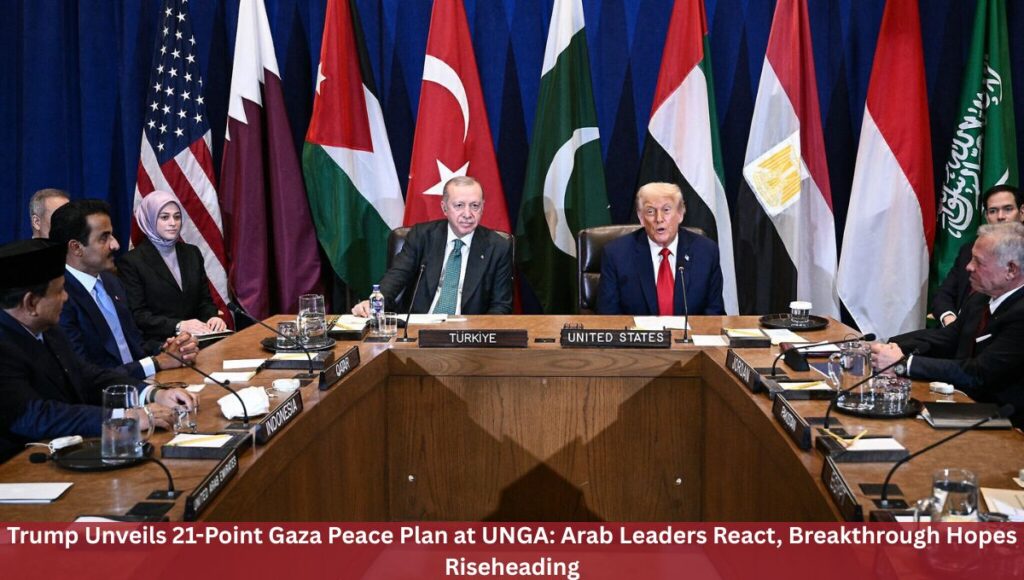
Trump Unveils 21-Point Gaza Peace Plan at UNGA: Arab Leaders React, Breakthrough Hopes Rise
Trump’s 21-Point Gaza Peace Plan: The Core Elements
The 21-point plan was presented to Arab leaders during a closed-door session in New York. According to senior US officials and regional sources, the proposal included several key elements:
- Immediate release of hostages held by Hamas.
- A permanent ceasefire to halt the devastating two-year war.
- Gradual Israeli withdrawal from Gaza.
- Governance framework without Hamas, with possible involvement of the Palestinian Authority.
- Rebuilding and transition programs, with Arab states expected to contribute funds and even troops.
Witkoff emphasized at the Concordia Summit that the plan was designed to “address Israeli concerns as well as the concerns of all neighbors in the region.”
Arab Leaders’ Response: Support With Conditions
While the regional leaders welcomed large parts of the Trump peace plan, they made several significant additions and conditions before agreeing to a final draft.
Key Points Raised by Arab Leaders
- No annexation of the West Bank by Israel.
- Maintain the current status quo in Jerusalem.
- Bring back all hostages held by Hamas.
- Increase humanitarian aid to Gaza.
- Address illegal Israeli settlements.
Diplomats present at the talks described the discussions as “super useful,” with concrete details tackled point by point.
Erdogan: A “Fruitful” Meeting
Turkish President Recep Tayyip Erdogan, one of Israel’s sharpest critics, described the Trump-hosted meeting as “fruitful” and said he was “pleased” with the outcomes.
Trump echoed this sentiment, calling the meeting with “all the big players except Israel” a “success”. Leaders from Egypt, Indonesia, Jordan, Pakistan, Qatar, Saudi Arabia, Turkiye, and the UAE joined the talks.
The Emirati state news agency WAM reported that discussions focused on a permanent ceasefire, hostages’ release, and urgent humanitarian relief.
Israel’s Role: Informed But Not Involved
Interestingly, Israel had no direct involvement in the meeting. Prime Minister Benjamin Netanyahu was briefed on the proposal but has long opposed giving the Palestinian Authority (PA) a role in Gaza’s future.
The plan also explicitly excluded Hamas, in line with US and Israeli demands for the militant group to be disarmed and eliminated.
Still, Arab leaders argued that long-term peace cannot be achieved without addressing Palestinian statehood, Jerusalem’s status, and illegal settlements—issues that Israel has consistently rejected.
Qatar’s Mediation Offer
Qatar, which has historically mediated between Hamas and Israel, offered to continue playing a mediator role—but only if Israel guarantees no future strikes on its territory. This comes after Israel launched a deadly strike in Doha earlier this month, killing Hamas leaders and halting ceasefire talks.
Qatar’s Emir Sheikh Tamim bin Hamad Al Thani told Trump, “We count on you and your leadership … to end this war and to help the people of Gaza.”
The Role of US Special Envoy Steve Witkoff
Steve Witkoff, Trump’s special envoy to the Middle East, has emerged as a central figure in the negotiations. At the Concordia Summit, he underscored that the Trump plan seeks to balance Israeli and Arab concerns while prioritizing hostages and humanitarian relief.
“We’re hopeful and, I might even say, confident that in the next days we could announce some sort of breakthrough,” Witkoff said.
Regional and Global Stakes
The Gaza conflict has killed more than 65,000 Palestinians, mostly civilians, and displaced hundreds of thousands. As international outrage grows, several Western powers—France, Britain, Canada, Australia, Portugal, and others—have formally recognized Palestinian statehood.
Trump strongly criticized these recognitions, saying they “reward Hamas for horrible atrocities.” By contrast, UN Secretary-General Antonio Guterres insisted Palestinian statehood is “a right, not a reward.”
Saudi Arabia and France Push Two-State Solution
The Trump administration’s peace push came just a day after Saudi Arabia and France hosted a conference on the two-state solution, which the US boycotted.
Trump has opposed recognizing a Palestinian state, arguing that doing so encourages Hamas and prolongs conflict. Still, European officials who reviewed the US plan described it as “an authentic renewed effort” to stop Israel from further annexing the West Bank.
Humanitarian Crisis in Gaza: A Driving Factor
The humanitarian situation in Gaza remains catastrophic:
- Mass starvation triggered by Israeli blockades.
- Tens of thousands displaced from Gaza City.
- Medical and educational infrastructure destroyed.
- Daily civilian casualties from ongoing Israeli strikes.
Regional leaders pressed Trump to prioritize aid, shelter, and reconstruction funds as part of the peace plan.
Trump’s Silence After Key Meeting
After his high-stakes meeting with Arab leaders, Trump left the venue without making comments, simply waving to reporters. Turkish President Erdogan later confirmed the talks were “fruitful” and hinted at a forthcoming joint declaration.
Witkoff gave reporters a “thumbs-up” but offered no specifics.
The Proposal for Arab Troops in Gaza
One of the most controversial aspects of Trump’s plan is the idea that Arab and Muslim countries would deploy troops to Gaza to secure Israel’s withdrawal and stabilize the enclave.
- Indonesia has already expressed willingness to provide peacekeepers.
- Other states, including Egypt and Jordan, have remained cautious but open to discussion.
If implemented, this would mark a historic regional intervention in Gaza’s governance and security.
Hamas’s Reported Truce Offer
Adding complexity to the negotiations, Fox News reported that Hamas drafted a letter to Trump proposing a 60-day US-guaranteed truce in exchange for the release of half its remaining captives.
While neither Hamas nor Qatar confirmed the report, it highlights how Trump’s direct involvement is shaping new dynamics.
The Wider Diplomatic Landscape
The Gaza peace talks are unfolding against the backdrop of a deeply polarized international environment:
- The US remains Israel’s staunchest supporter, providing arms and diplomatic cover.
- The UN and EU push harder for Palestinian recognition.
- The Abraham Accords—Trump’s legacy of Arab-Israel normalization—risk collapse if West Bank annexations continue.
As one UN diplomat put it, “The one man who can change things is Donald Trump.”
Analysis: Can Trump Deliver a Breakthrough?
The Trump administration is walking a fine line:
- Appeasing Israel while demanding Arab concessions.
- Excluding Hamas but facing the reality that the group controls Gaza.
- Rejecting Palestinian statehood while trying to rally Arab support.
For many observers, the biggest question is whether Trump’s 21-point Gaza peace plan can achieve more than past failed efforts—or whether it will remain another symbolic diplomatic gesture.
Also Read: Trump administration blocks Palestinian president from attending U.N. meeting in New York
Conclusion
The Trump 21-point Gaza peace plan represents the most detailed US effort to address the war since it erupted nearly two years ago. While Arab leaders welcomed the initiative, they have attached critical conditions regarding Jerusalem, settlements, and humanitarian aid.
Whether Trump can secure a true breakthrough remains uncertain. With Israel still carrying out devastating strikes, Hamas weakened but not eliminated, and millions of Palestinians facing hunger and displacement, the stakes could not be higher.
For now, Trump and his envoy Steve Witkoff are betting that Arab unity and US pressure may finally push the conflict toward a truce. As Trump himself told the Arab leaders at the UNGA: “This war has gone on too long and we want it to end.”
Also Read: US Revokes Visas of Palestinian Officials Ahead of UN General Assembly, Citing Terror Links
Related Posts:
- Trump’s Breakthrough Gaza Ceasefire Deal 2025: Key Insights

- Trump’s 20-Point Gaza Peace Plan Gains Urgent Global…

- Trump’s 2025 Gaza Peace Plan Signing and Historic…

- Dramatic Moments Behind Trump’s Gaza Peace Push and…

- Gaza Peace Deal First Phase Achieved: Trump’s Israel…

- Trump Pushes Gaza Peace Plan: Israeli Exit, Arab…