
While Trump threatens to levy 10% tariffs on BRICS-aligned nations, Brazilian President Lula to Trump: ‘We Don’t Want an Emperor’ as BRICS Rejects US Tariff Threat. As the July 9 trade deadline nears, U.S. President Donald Trump escalated his economic pressure campaign, threatening a 10% additional tariff on any country siding with BRICS, the fast-expanding bloc of emerging economies.
In a Truth Social post, Trump warned: “Any Country aligning themselves with the Anti-American policies of BRICS will be charged an ADDITIONAL 10% Tariff. There will be no exceptions to this policy.” The statement came just hours after BRICS leaders concluded a two-day summit in Rio de Janeiro, where they issued a powerful joint declaration condemning U.S.-Israeli airstrikes on Iran and calling for a new, multipolar global order.
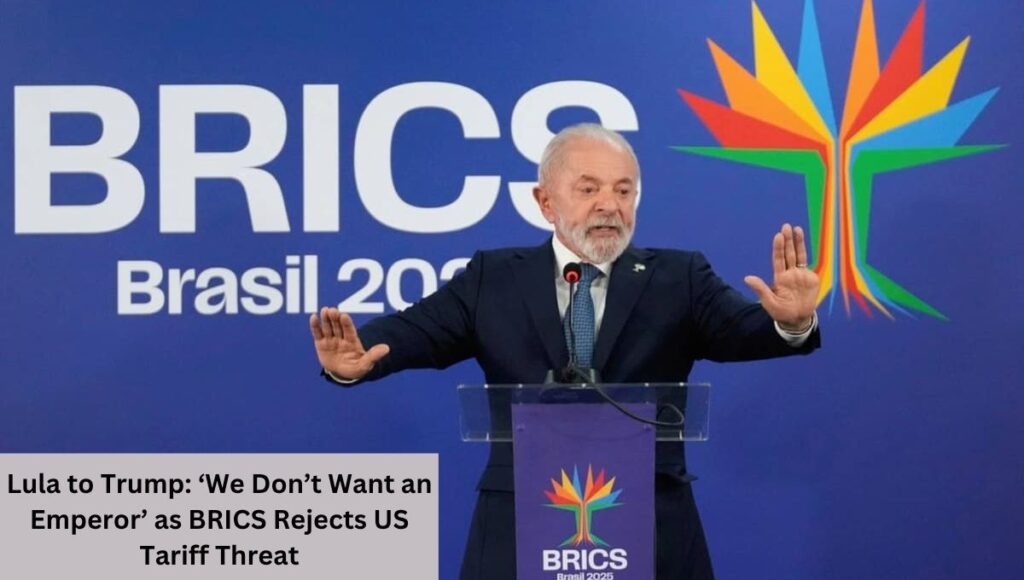
Lula to Trump: ‘We Don’t Want an Emperor’ as BRICS Rejects US Tariff Threat
Lula: “We Don’t Want an Emperor”
Responding to Trump’s post, Brazilian President Luiz Inácio Lula da Silva criticized the U.S. leader’s tone and tactics: “The world has changed. We don’t want an emperor.”
Lula’s remark resonated across the Global South, encapsulating widespread frustration with what many view as U.S. economic and military coercion.
His words set the tone for a summit defined by unity against unilateralism and a renewed push for economic independence.
BRICS Leaders: “We Promote Cooperation, Not Confrontation”
The BRICS bloc now made up of Brazil, Russia, India, China, South Africa, Iran, Egypt, Ethiopia, Indonesia, and the UAE unanimously rejected Trump’s characterization of the group as anti-American.
“Trade and tariff wars have no winners, and protectionism offers no way forward,” said China’s Foreign Ministry spokesperson Mao Ning.
She added that BRICS represents “openness, inclusivity, and win-win cooperation,” emphasizing the bloc’s support for peaceful development over confrontation.
South African President Cyril Ramaphosa agreed, stating that tariffs should not be used as a tool for coercion and calling on the U.S. to accept the rise of multiple global power centers.
Condemnation of U.S.-Israeli Airstrikes on Iran
The summit took a bold turn with a joint BRICS condemnation of recent U.S.-Israeli military strikes on Iran’s nuclear sites.
The declaration accused the U.S. and its allies of violating international law and escalating global instability. This statement is widely believed to have prompted Trump’s latest tariff threat.
The U.S. and Israel maintain that the strikes were preventive measures against Iran’s nuclear ambitions, while Iran insists it has no intention of developing nuclear weapons.
The BRICS response reflects the bloc’s growing willingness to engage in geopolitical affairs, particularly when their members are targeted.
Trump’s Tariff Campaign: No Exceptions
President Trump’s latest tariff threat continues his “America First” trade doctrine. As part of this strategy:
- A 90-day tariff pause, announced in April, is set to expire July 9.
- Commerce Secretary Howard Lutnick confirmed tariffs will take effect August 1.
- Trump’s administration has prepared 15+ tariff letters to be dispatched this week.
“They’re going to be tariffs. The tariffs are going to be tariffs,” Trump said, signaling no further delay.
According to Treasury Secretary Scott Bessent, negotiations have intensified, with several nations submitting last-minute proposals.
“My mailbox was full last night with new offers,” Bessent told CNBC.
Trade Agreements Reached So Far
Despite the tensions, a few countries have secured trade deals with the U.S.:
United Kingdom
- Tariffs on cars and parts reduced from 27.5% to 10% (up to 100,000 units).
- Aerospace tariffs eliminated.
- UK dropped taxes on U.S. ethanol and beef.
Vietnam
- Vietnamese exports to the U.S. taxed at 20%.
- U.S. exports to Vietnam face no tariffs.
- Goods trans-shipped through Vietnam face 40% duties.
China (Partial Deal)
- U.S. tariffs on some goods reduced from 145% to 30%.
- China’s tariffs cut from 125% to 10%.
- China dropped some non-tariff countermeasures, including export restrictions on rare minerals.
Negotiations with the EU remain unresolved, particularly on steel, aluminium, and automobiles.
BRICS Pushes for Dollar Independence
Another key friction point is BRICS’s push to reduce global dependence on the U.S. dollar. While the idea of a common BRICS currency has lost momentum, leaders discussed:
- Local currency trade mechanisms
- Cross-border digital payment systems
- Strengthening BRICS’s New Development Bank
President Lula emphasized that trade should not require U.S. dollar mediation:
“The world needs to find a way that our trade relations don’t have to pass through the dollar… Our central banks must begin this dialogue.”
The initiative reflects frustration with dollar volatility and U.S.-driven sanctions regimes.
BRICS Calls for Global Financial Reform
Beyond trade, the bloc reiterated demands for IMF reform, UN Security Council expansion, and fairer global governance structures. The summit also supported:
- Iran and Ethiopia’s inclusion in the WTO
- A BRICS Multilateral Guarantees Platform to boost infrastructure financing
- A BRICS AI declaration promoting data transparency and ethical tech development
Geopolitical Flashpoints: Gaza, Kashmir, and Global Terrorism
The BRICS summit also tackled several global crises:
- Gaza: Condemned Israeli military operations and called for a “just and lasting peace.”
- Palestine: Expressed support for statehood and diplomatic solutions.
- Kashmir: Condemned the recent Pahalgam terrorist attack, urging global counter-terrorism efforts.
The bloc stressed the need for cross-border financial tracking to dismantle terror networks and welcomed India’s proposal for a BRICS Counterterrorism Task Force.
Climate Commitments Amid Global Uncertainty
Despite geopolitical tensions, climate change remained on the BRICS agenda. Brazil presented its Tropical Forests Forever Facility, a proposed global fund to protect endangered rainforests.
- China and the UAE expressed strong support.
- Brazil aims to promote this fund at COP30 later this year.
In contrast, President Trump has rolled back domestic environmental regulations and opposed global climate agreements, such as the Paris Accord.
Growing BRICS Influence Worries Washington
Formed in 2009, BRICS has grown into a powerful economic bloc. At the 2025 Rio Summit, the group hosted its largest gathering yet, with 10 full members and more than 30 countries interested in joining.
Lula compared BRICS to the historic Non-Aligned Movement, saying: “With multilateralism under attack, our autonomy is in check again… BRICS is the heir to the Non-Aligned Movement.”
With over 50% of the global population and 40% of world GDP, BRICS presents a serious challenge to Western-centric global governance.
Challenges Ahead: Unity in Diversity
While the BRICS alliance is growing, its internal diversity spanning democracies, monarchies, and authoritarian states poses coordination challenges.
Still, analysts say the bloc’s shared interest in reducing Western dominance outweighs ideological divides for now.
The launch of joint projects like multilateral lending guarantees and cross-border payments may serve as unifying tools in the years ahead.
Final Thoughts: A Pivotal Moment for Global Trade
As Trump’s August 1 tariff deadline looms, nations face a stark choice: fall in line with U.S. trade terms or risk steep economic penalties.
But this time, the Global South is pushing back. The BRICS bloc is not just resisting American pressure it is proposing an alternative framework for international trade, diplomacy, and finance.
Whether this moment leads to a new economic Cold War or a more equitable global order will depend on how both sides navigate the months ahead.
For now, Lula’s declaration echoes across capitals in the developing world: “We don’t want an emperor.”
Also Read: “I Won’t Call Trump”: Lula Defiant After US Tariff Hike on Brazil
Also Read: Donald Trump threatens ‘un-American’ BRICS countries with 10 percent tariff
Related Posts:
- “I Won’t Call Trump”: Lula Defiant After US Tariff…

- Lula Slams Trump’s 50% Tariff as “Unacceptable…

- Trump Escalates Trade War: 50% Tariff on Brazil Over…

- Modi and Lula Unite as Trump’s Tariffs Disrupt Global Trade

- US President Donald Trump Fuels Third-Term…

- What’s Next for Donald Trump After Court Rules His…