
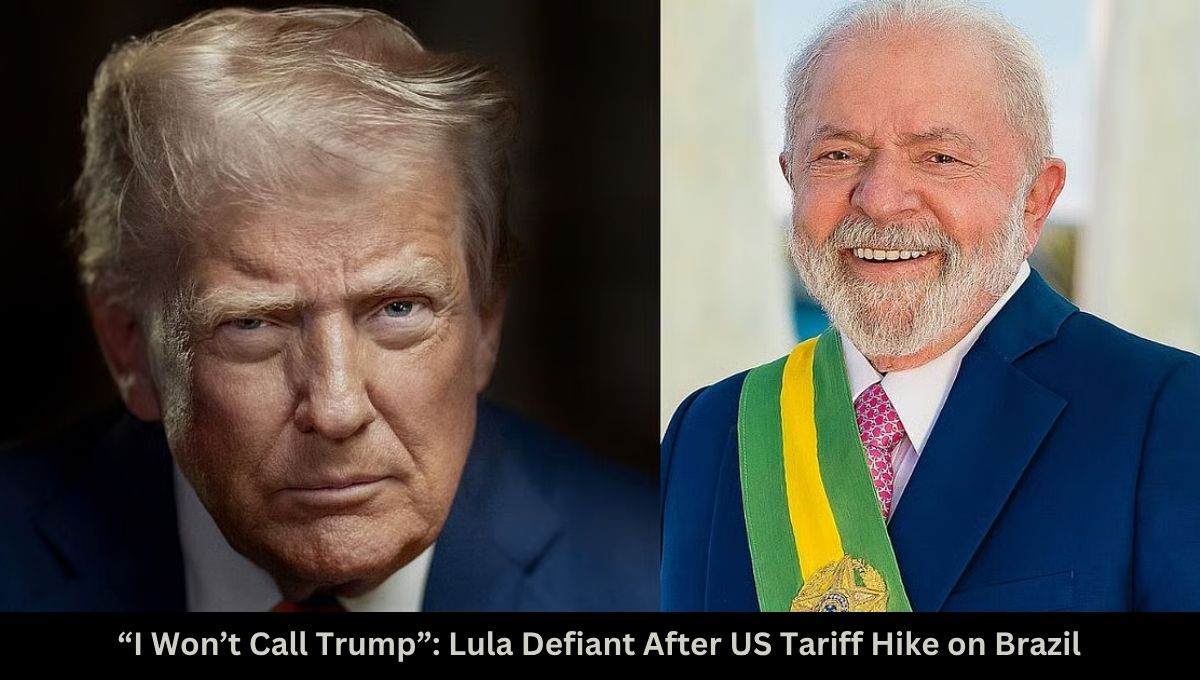
On growing rift with Trump’s tariff, Lula said, ‘I won’t call Trump’: Lula Defiant After US Tariff Hike on Brazil. In a bold move that underscores the deepening US-Brazil diplomatic rift, Brazilian President Luiz Inácio Lula da Silva has rejected US President Donald Trump’s offer to discuss escalating trade tensions.
Instead, Lula stated he would prioritize talks with BRICS allies, including Prime Minister Narendra Modi of India and Chinese President Xi Jinping. This comes in response to Washington’s controversial decision to impose a 50% tariff on Brazilian imports, a move that Lula has denounced as “unjustifiable” and a serious blow to bilateral relations.
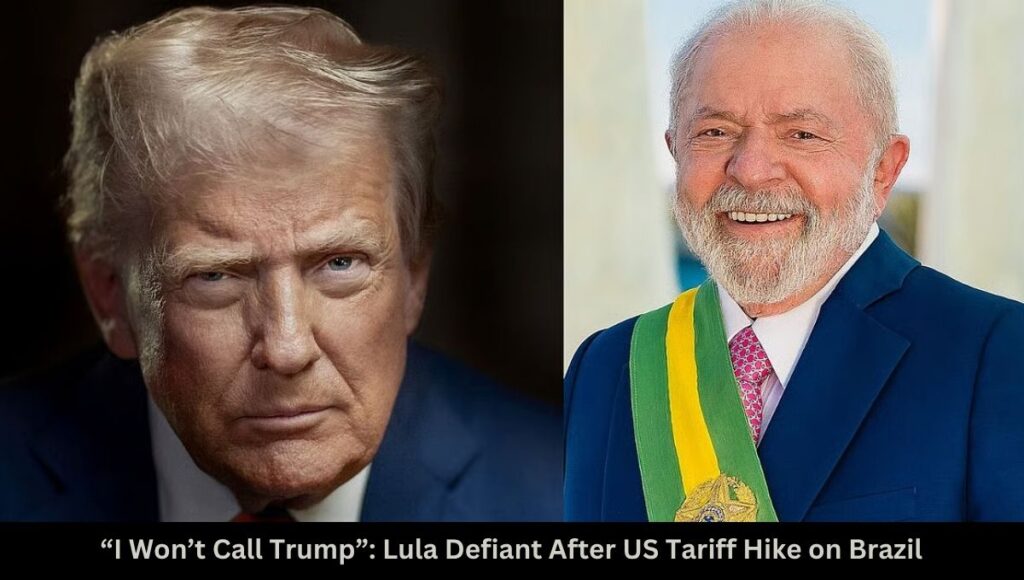
“I Won’t Call Trump”: Lula Defiant After US Tariff Hike on Brazil
Lula to Trump: “He Doesn’t Want to Talk”
Addressing reporters in Brasília, Lula made it crystal clear:
“I won’t call Trump. He doesn’t want to talk.”
This sharp retort was delivered just days after Trump publicly said Lula could “call him anytime” to discuss the situation. Despite Trump’s remarks, Lula declined the offer, citing what he sees as a one-sided stance from the US administration.
Rather than engaging Washington directly, Lula said he will focus on dialogue with leaders from the BRICS alliance. “I will call Xi Jinping. I will call Prime Minister Modi. I won’t call Putin, because he can’t travel now. But I will call many presidents,” Lula stated during a public address.
Tariff War: US Imposes 50% Duties on Brazilian Imports
At the heart of the diplomatic fallout is Trump’s decision to impose a 50% tariff on Brazilian goods, up from a previous 10% base level.
The move, justified by Trump as retaliation against “unfair trade practices” and Brazil’s handling of the Jair Bolsonaro trial, has drawn sharp rebukes from Brasília.
“It was the most regrettable day in the bilateral relationship between Brazil and the United States,” Lula said.
The new tariffs will affect a wide range of Brazilian exports, including coffee, beef, and textiles sectors vital to Brazil’s economy.
Bolsonaro Trial Adds Fuel to the Fire
The situation escalated further following the house arrest of former President Jair Bolsonaro, who is facing charges for allegedly plotting a coup attempt after losing the 2022 election.
In response, the US State Department criticized Brazil’s judicial process, accusing the Supreme Court and Justice Alexandre de Moraes of silencing political opposition.
Moraes, who is overseeing Bolsonaro’s trial, has been sanctioned under the US Global Magnitsky Act.
“The people running Brazil did the wrong thing,” Trump said, linking the trial to the trade dispute.
Lula, however, has condemned the US reaction as unacceptable interference in Brazil’s internal affairs.
Lula: Brazil Will Fight Tariffs Through WTO
Doubling down on his position, Lula confirmed that Brazil will challenge the US tariffs at the World Trade Organization (WTO).
“We will resort to all possible measures, starting with the WTO, to defend our interests. We will not tolerate economic coercion masked as diplomacy,” he said.
According to Brazilian officials, the tariffs violate international trade agreements and represent economic blackmail tied to political conditions namely, the handling of Bolsonaro’s legal troubles.
Finance Minister Open to Dialogue But Lula Draws a Line
Interestingly, Brazilian Finance Minister Fernando Haddad took a softer tone, welcoming Trump’s openness to a call.
“That’s great,” Haddad said of Trump’s comment. “I’m sure Lula feels the same.”
However, Lula quickly clarified that any future negotiations must be based on mutual respect and equality, not under threats or pressure.
“From now on, [the US] needs to know we have things to negotiate. We have size, we have a stance, we have economic and political interests to bring to the table.”
BRICS at the Center of Brazil’s Trade Shift
Lula’s emphasis on reaching out to Modi and Xi reflects Brazil’s ongoing pivot toward non-Western economic alliances, particularly BRICS.
Trump has expressed concern that BRICS policies may undermine the US dollar, and has threatened an additional 10% tariff on nations supporting BRICS-led de-dollarization efforts.
Despite Washington’s warnings, Lula is doubling down.
“Brazil today is not as dependent on the United States as it once was,” he said.
This shift in strategy includes pursuing alternatives to the dollar in foreign trade, a move long advocated within the BRICS bloc.
COP30: Lula Will Still Invite Trump
In a surprising gesture amid the escalating rhetoric, Lula said he still intends to invite Trump to COP30, the upcoming UN Climate Change Conference set to be hosted in Belem, Para, Brazil in November.
“I will call Trump to invite him to COP30 and find out his opinion on the climate issue,” Lula said. “If he doesn’t attend, it’s because he doesn’t want to but it won’t be for lack of education, friendliness, or democracy.”
Brazil Turns to China and Asia for Trade Expansion
As tensions with the US rise, Lula’s government is working to diversify its trade partners. This week, China approved 183 new Brazilian coffee exporters, a significant win for the nation’s agricultural sector.
China already accounts for 28% of Brazil’s exports, compared to 12% for the United States.
“Brazil depends on the United States, that’s true, but also on BRICS countries, on Europe, on Mercosur,” said Planning Minister Simone Tebet.
Tebet emphasized that nearly half of Brazil’s agribusiness exports go to Asia, and that trade with the US is no longer central to Brazil’s economic strategy.
Which Brazilian Sectors Are Hit the Hardest?
While exemptions in Trump’s executive order reduce some of the immediate pain, about 36% of Brazilian exports to the US remain affected.
Key impacted sectors include:
- Coffee (Brazil is the world’s largest grower)
- Beef and meat products
- Textiles and footwear
- Fresh fruits and seafood (especially from Brazil’s Northeast region)
“A large number of firms that sell to the U.S. were not covered [by exemptions],” warned Luis Otavio Leal, chief economist at G5 Partners.
The Northeast, reliant on low-value, labor-intensive exports, is expected to bear the brunt of the economic fallout.
Economists: Tariff Impact Limited, But Uneven
Despite the steep 50% tariff headline, the economic damage may be limited, economists say.
Thanks to a strong commodity base, Brazil can redirect exports elsewhere, albeit at modest discounts.
- XP economist Luiza Pinese cut her GDP impact forecast by half to just 0.15 percentage points.
- Goldman Sachs maintained Brazil’s 2025 GDP growth forecast at 2.3%, citing “notable exemptions.”
- Some analysts say the tariff could help reduce domestic food prices in the short term due to increased supply.
Brazil’s Trade Flexibility: A Hidden Strength
Brazil’s trade-to-GDP ratio just 36% is among the lowest in the developing world, making it less vulnerable to trade shocks compared to countries like Mexico or Thailand.
“Much of Brazil’s exports are commodities easily redirected to different markets,” noted Thiago Carlos of PIMCO.
This low reliance on trade gives Brazil greater policy flexibility and resilience in the face of external shocks.
Government to Roll Out Support Measures
Recognizing the uneven impact across sectors and regions, the Lula administration is preparing stimulus packages and support programs for affected industries.
“We’ll take all necessary steps to protect jobs and exports,” said Tebet.
The government aims to protect vulnerable workers and small firms, especially those not covered by the tariff exemptions.
Conclusion: Brazil Charts an Independent Path
President Lula’s refusal to call Trump sends a powerful diplomatic message: Brazil will not be coerced into talks under pressure. His turn toward BRICS diplomacy, commitment to WTO action, and trade realignment signal a strategic shift that may have long-term implications for global trade balances. The US-Brazil relationship now stands at a crossroads.
Whether it deteriorates further or finds new equilibrium will depend on how both governments navigate the coming months and whether diplomacy, not pressure, wins the day.
Also Read: Lula Slams Trump’s 50% Tariff as “Unacceptable Blackmail” Amid Bolsonaro Trial Tensions
Also Read: Open to US trade talks if Brazil treated as an equal, says Lula da Silva
Related Posts:
- Modi and Lula Unite as Trump’s Tariffs Disrupt Global Trade

- Xi Jinping, Lula, and Jaishankar Call for BRICS…

- Trump Targets BRICS With 10% Tariffs: A Dollar…
- BRICS Denounces Trump Tariffs, Condemns Iran Strikes…
- Lula Slams Trump’s 50% Tariff as “Unacceptable…

- Lula to Trump: ‘We Don’t Want an Emperor’ as BRICS…
