

Intensifying tensions with Tariff’s, Trump Escalates Trade War: 50% Tariff on Brazil Over Bolsonaro Trial. In an unprecedented move, President Donald Trump has announced a 50% tariff on all Brazilian imports, effective August 1, 2025. The steep duty, the highest imposed on any single country in Trump’s latest trade blitz, directly targets Brazil’s prosecution of former President Jair Bolsonaro, which Trump branded a “witch hunt.”
The decision immediately escalated diplomatic tensions between Washington and Brasília, drawing swift condemnation from Brazilian President Luiz Inácio Lula da Silva, who called it an attack on Brazil’s judicial sovereignty. It also signals a return to Trump’s signature “America First” protectionism, now fused with personal political grievances.
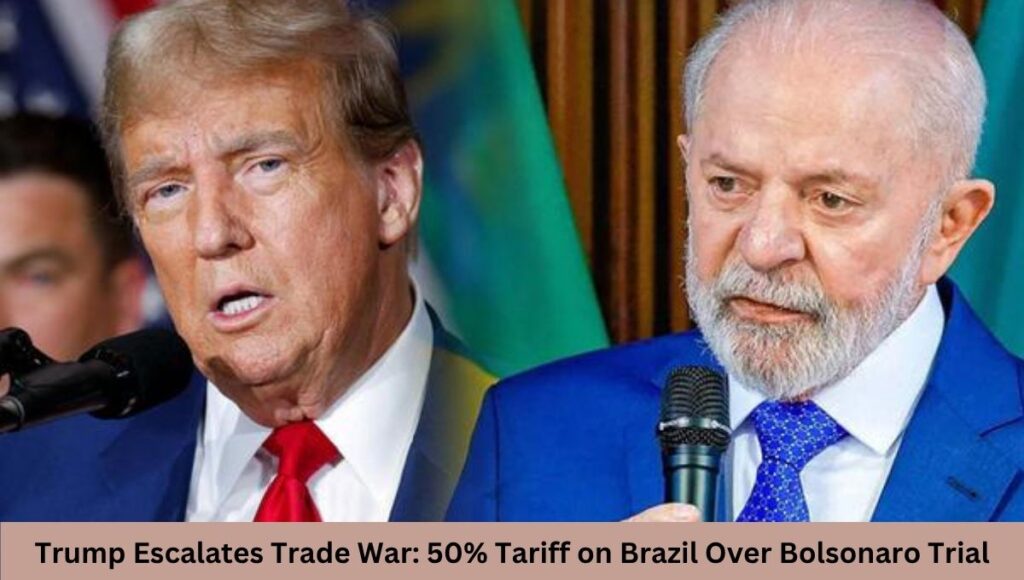
Trump Escalates Trade War: 50% Tariff on Brazil Over Bolsonaro Trial
Bolsonaro Trial: The Spark Behind Trump’s Trade Offensive
The tariff announcement follows weeks of growing acrimony over Bolsonaro’s ongoing trial in Brazil.
The far-right leader, often referred to as the “Trump of the Tropics,” stands accused of attempting to subvert the 2022 presidential election results, which he lost to Lula.
Prosecutors allege he encouraged a failed coup, culminating in the January 2023 storming of government buildings in Brasília.
Trump, echoing language he has used to describe his own legal troubles, condemned the prosecution as a “political disgrace” and a “direct attack on democracy.”
“They have done nothing but come after him, day after day, night after night,” Trump wrote on Truth Social, demanding Brazil “LEAVE BOLSONARO ALONE.”
Trump’s Letter to Lula: From Trade to Trial
Trump’s stance wasn’t just rhetoric. In a formal letter addressed to President Lula and shared publicly, Trump accused the Brazilian judiciary of political persecution, alleging censorship of American tech firms and unfair economic practices.
He vowed to initiate a Section 301 investigation into Brazil’s digital trade policies and warned of further measures.
“Brazil’s insidious attacks on free elections will not go unpunished,” the letter stated. It was a striking blend of trade policy and political intervention, as Trump praised Bolsonaro as “a strong partner of the United States” and urged Lula to immediately end the trial.
Lula Responds: “No One Is Above the Law”
President Lula fired back, calling Trump’s comments “interference in Brazil’s sovereign legal process.” Speaking from the BRICS summit in Rio, Lula rejected any foreign pressure to alter judicial proceedings, stating:
“Brazil is a sovereign nation with independent institutions and will not accept any form of tutelage.”
He further warned that any unilateral tariff action would be met with countermeasures under Brazil’s Law of Economic Reciprocity, hinting at possible tariffs on U.S. exports.
Brazil’s Ministry of Foreign Affairs summoned the U.S. ambassador to lodge an official protest, while lawmakers across the political spectrum called Trump’s actions “imperialist overreach.”
50% Tariff Could Cripple U.S.–Brazil Trade Ties
The economic implications of Trump’s tariff are significant. Brazil is the second-largest steel exporter to the United States, after Canada, shipping more than 4 million tons in 2024 alone.
Key U.S. industries particularly aerospace, industrial machinery, and energy rely on Brazilian imports and, crucially, on export markets in Brazil.
The U.S. currently enjoys a $6.8 billion trade surplus with Brazil, meaning it sells more goods there than it buys.
Analysts warn that retaliatory tariffs from Brazil could severely impact U.S. manufacturers, potentially leading to job losses and price hikes in domestic markets.
Copper Tariffs: National Security or Strategic Messaging?
In a parallel move, Trump also imposed a 50% tariff on copper imports, citing national security reasons. Copper, essential to defense, electronics, and energy infrastructure, is now at the center of his broader reshoring push.
“Copper is the second most used material by the Department of Defense,” Trump declared. “This 50% tariff will reverse the Biden Administration’s stupidity.” Market reaction was swift.
Copper futures jumped 13.1%, reaching a record high of $5.69 per pound, signaling both supply concern and investor volatility.
Critics, however, argue that the U.S. is structurally dependent on foreign copper and that tariffs may hurt domestic manufacturers by raising input costs.
BRICS Summit Blowback: Trump Calls Group “Anti-American”
Trump’s rhetoric extended beyond Brazil to the wider BRICS alliance Brazil, Russia, India, China, and South Africa accusing the bloc of seeking to undermine the U.S. dollar’s dominance.
At the BRICS summit in Rio, member states discussed trading in local currencies and developing an alternative financial system, heightening U.S. concerns.
“Anybody that’s in BRICS is getting a 10 percent charge pretty soon,” Trump warned.
He described BRICS as “anti-American” and accused it of trying to “destroy the dollar”, declaring that:
“Losing the global standard dollar would be like losing a world war. We can’t let that happen.” These comments sparked global alarm and raised the specter of a currency conflict layered atop the trade war.
Global Tariff Blitz: 22 Countries Targeted
Trump’s letter to Lula was part of a larger global tariff campaign, with 22 countries receiving formal notices this week. Other nations hit with tariffs effective August 1 include:
- Algeria, Iraq, Libya, Sri Lanka – 30%
- Brunei, Moldova – 25%
- Philippines – 20%
- South Korea, Japan – 25%
Unlike Brazil, most countries were targeted due to trade deficits rather than political motives. Still, the administration made clear that any retaliatory actions would lead to even steeper tariffs.
“A letter means a deal,” Trump said, signaling that failure to comply will trigger automatic enforcement.
Trump’s Protectionism Meets Populist Politics
Trump’s economic team has framed the tariff blitz as a “course correction” to decades of imbalanced trade. However, the Bolsonaro exception stands out.
By explicitly linking trade penalties to a foreign prosecution, Trump is blending populist politics with foreign policy in an unprecedented way.
In exchange for dropping tariffs, Trump has offered companies an exemption if they relocate operations to the U.S., reinforcing his pro-manufacturing agenda.
“Any company relocating operations to the U.S. will be exempt from these tariffs,” Trump said.
This carrot-and-stick approach has drawn criticism from economists who warn that supply chains can’t be restructured overnight, and that global partners may seek non-dollar alternatives in retaliation.
Bitcoin Rallies on Geopolitical Instability
In a surprise twist, Bitcoin surged to an all-time high of $112,000, as investors sought protection from what they saw as mounting global risk. Analysts attributed the spike to:
- Demand for non-fiat “hard assets”
- Institutional interest through ETFs
- Global unease over trade disruptions and inflation
“Bitcoin is acting like gold in times of crisis,” said Adam Guren, CIO of Hunting Hill Global Capital. “This cycle, the demand is structural, regulated, and sticky.”
As Trump’s economic nationalism gains traction, some nations are exploring digital assets as an alternative to dollar-based trade especially in the BRICS bloc.
Bolsonaro’s Shadow in U.S. Politics
The intertwining of Bolsonaro’s legal troubles and Trump’s foreign policy is emblematic of a larger trend: the globalization of populist politics. Both men:
- Refused to concede after losing elections
- Incited or inspired riots
- Claimed political persecution
- Maintain large, loyal voter bases
Bolsonaro, currently barred from running in 2026, thanked Trump for his support and called on the international community to condemn Brazil’s judiciary. His sons have reportedly lobbied U.S. officials to sanction Brazilian judges involved in the case.
Conclusion: Trade Policy or Political Retaliation?
Trump’s 50% tariff on Brazil over Bolsonaro’s trial is not just an economic policy it’s a geopolitical gambit. The decision marks a turning point where political loyalty and populist alliances shape foreign economic relations.
Critics argue that such moves undermine global institutions like the WTO and erode faith in legal neutrality. Supporters see it as a bold assertion of American interests and values. With August 1 fast approaching, Brazil’s next move could determine whether this becomes a short-lived spat or the start of a major 21st-century trade war with political roots and global consequences.
Also Read: Trump’s Brazil Tariff: A 50% Political Gamble with Global Implications
Related Posts:
- Lula Slams Trump’s 50% Tariff as “Unacceptable…

- Brazil’s Jair Bolsonaro is Sentenced to 27 Years for…

- 7 Explosive Developments as Brazil Jails Jair Bolsonaro

- Jair Bolsonaro Diagnosed with Skin Cancer After…

- Bolsonaro Condemns Brazil Supreme Court, Courts…

- “I Won’t Call Trump”: Lula Defiant After US Tariff…
