

A shocking Trump’s Brazil Tariff: A 50% Political Gamble with Global Implications. President Donald Trump’s decision to impose a sweeping 50% tariff on Brazilian imports has shocked economists and diplomats. The justification? What Trump describes as “political persecution” of former Brazilian President Jair Bolsonaro.
Unlike typical trade moves motivated by deficits or national security, this action stems from ideological alignment and loyalty. Trump’s letter to Brazilian President Luiz Inácio Lula da Silva openly criticized the ongoing trial of Bolsonaro, calling it a “witch hunt.” The decision marks an aggressive intrusion into Brazil’s judicial affairs.
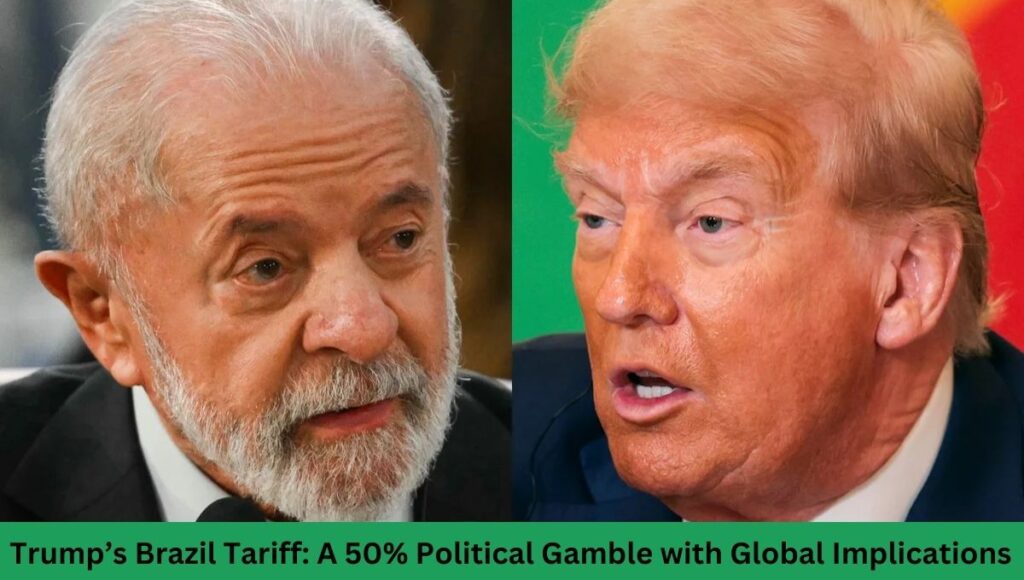
Trump’s Brazil Tariff: A 50% Political Gamble with Global Implications
Bolsonaro and Trump: An Unprecedented Political Alliance
Bolsonaro, often called the “Trump of the Tropics,” has echoed Trump’s political strategies and populist tone.
His son, Eduardo Bolsonaro, now based in the U.S., has been lobbying American lawmakers to intervene in the judicial process.
Trump’s tariff threat reinforces their transnational right-wing alliance.
Justice Alexandre de Moraes, who is overseeing Bolsonaro’s trial, has drawn attention for clamping down on misinformation and suspending platforms like Elon Musk’s X and Rumble.
Trump and U.S. conservatives argue these moves amount to censorship, fanning political flames on both sides.
Lula’s Firm Response: ‘Brazil Is No Colony’
In response, Lula reaffirmed Brazil’s independence and rejected any external influence on its judiciary.
“Brazil is a sovereign nation with independent institutions and will not accept any form of tutelage,” he posted on X.
Lula also warned of reciprocal tariffs under Brazil’s Law of Economic Reciprocity.
Brazil is the first of 22 countries recently targeted by Trump’s trade threats to publicly signal retaliation. This escalating tension signals a break from traditional economic diplomacy.
Trade Imbalance? The Numbers Say Otherwise
Trump’s usual rationale of correcting unfair trade balances doesn’t hold here. In fact, the U.S. had a $6.8 billion trade surplus with Brazil in 2024.
Major exports include aircraft, fuel, and machinery, which means retaliatory tariffs from Brazil could hurt U.S. industries.
Brazilian imports have already faced a 10% tariff since April. The 50% hike, slated for August 1, could escalate unless diplomatic solutions emerge.
Coffee, Orange Juice, and Ethanol in the Crosshairs
Coffee Crisis Brewing
Brazil provides nearly one-third of the green coffee beans consumed in the U.S. A 50% tariff could severely disrupt this flow. Coffee futures jumped 1.3% following the announcement.
Brands like Starbucks, Dunkin’, and Maxwell House may face rising costs and pass them on to consumers.
Michael Nugent of MJ Nugent & Co. noted, “A tariff of this size would all but shut down that flow. Brazilian exporters won’t absorb it. U.S. roasters can’t.”
Orange Juice Supply Threatened
The U.S. depends heavily on Brazilian orange juice, especially after domestic crops were hit by citrus greening. Futures surged 6% after the tariff announcement, indicating imminent price hikes.
Ethanol’s Symbolic Impact Though Brazil exports little ethanol to the U.S., its inclusion in the tariff signals the expansive nature of the trade threat.
Analysts say the broader concern is how it reflects on cross-border supply chains.
Copper Tariffs Signal a Broader Agenda
Trump also slapped a 50% tariff on copper imports, citing national security. The U.S. imports half its copper from countries like Chile, China, and Canada.
Prices surged 13.1%, the biggest jump since 1968. This could raise costs across sectors from electronics to defense, adding pressure on industries amid already rising inflation.
BRICS Summit and the Sovereignty Debate
The timing of the tariff aligns with the recent BRICS summit in Rio de Janeiro. Lula’s defiant remark, “We don’t want an emperor,” was widely seen as a rebuke to Trump.
BRICS countries issued a joint statement condemning “indiscriminate tariffs,” suggesting geopolitical resistance is mounting.
Many analysts believe Trump’s discomfort with BRICS’s growing influence contributed to his targeting of Brazil.
Will Exemptions Soften the Blow?
U.S. Agriculture Secretary Brooke Rollins hinted at possible exemptions for essential commodities like coffee.
Starbucks may absorb some impact through diversified sourcing, but Nestle-distributed products could see a 3.5% cost increase. Smaller chains like Dutch Bros might fare better.
Still, Cecafe, Brazil’s coffee export association, warned the tariffs could make U.S. shipments unfeasible.
Lula’s Political Calculus: Strength in Crisis?
Facing a tough reelection in 2026, Lula may use the confrontation to galvanize support. “If Lula plays this right, it becomes a moment of strength not weakness,” said Prof. Oliver Stuenkel of the Getulio Vargas Foundation.
Brazil’s centrist and nationalist voters have largely rejected Trump’s threats, with Senator Alessandro Vieira tweeting, “No citizen… can tolerate foreign aggression against Brazil.”
Bolsonaro Base Faces Economic Risks
Ironically, Bolsonaro’s strongest base agribusiness could suffer the most. Tariffs on coffee, beef, and juice may hurt Brazil’s rural economy.
Eduardo Bolsonaro continues to court MAGA allies, but the backlash against perceived U.S. interference could isolate them further.
Brazil’s Limited Exposure as a Buffer
Brazil sends just 12% of its exports to the U.S., compared to nearly double that to China. Economists call the impact “marginal and manageable,” with Goldman Sachs predicting only a 0.3–0.4% dip in GDP.
The Sao Paulo Federation of Industries urged restraint and diplomacy, emphasizing that the conflict is political not economic.
Outlook: No Easy Off-Ramp
With Lula legally unable to intervene in Bolsonaro’s trial and Trump unlikely to back down, a quick resolution seems unlikely. Retaliatory tariffs remain on the table, and businesses on both sides are bracing for impact.
Diplomatic efforts may soften some blows, but the broader damage to global trade norms is already visible.
Conclusion: Ideology Over Economics?
Trump’s Brazil tariff move is driven more by ideology than trade logic. While Brazil may weather the storm, the precedent of using tariffs to influence foreign judicial matters could damage the credibility of U.S. trade policy.
This isn’t just about coffee or copper it’s about the future of diplomacy in a politically polarized world.
Also Read: Trump Escalates Trade War: 50% Tariff on Brazil Over Bolsonaro Trial
Also Read: Brazil vows to match US tariffs after Trump threatens 50% levy
Related Posts:
- Lula Slams Trump’s 50% Tariff as “Unacceptable…

- Brazil’s Jair Bolsonaro is Sentenced to 27 Years for…

- 7 Explosive Developments as Brazil Jails Jair Bolsonaro

- Bolsonaro Condemns Brazil Supreme Court, Courts…

- Jair Bolsonaro Diagnosed with Skin Cancer After…

- Trump Escalates Trade War: 50% Tariff on Brazil Over…
