
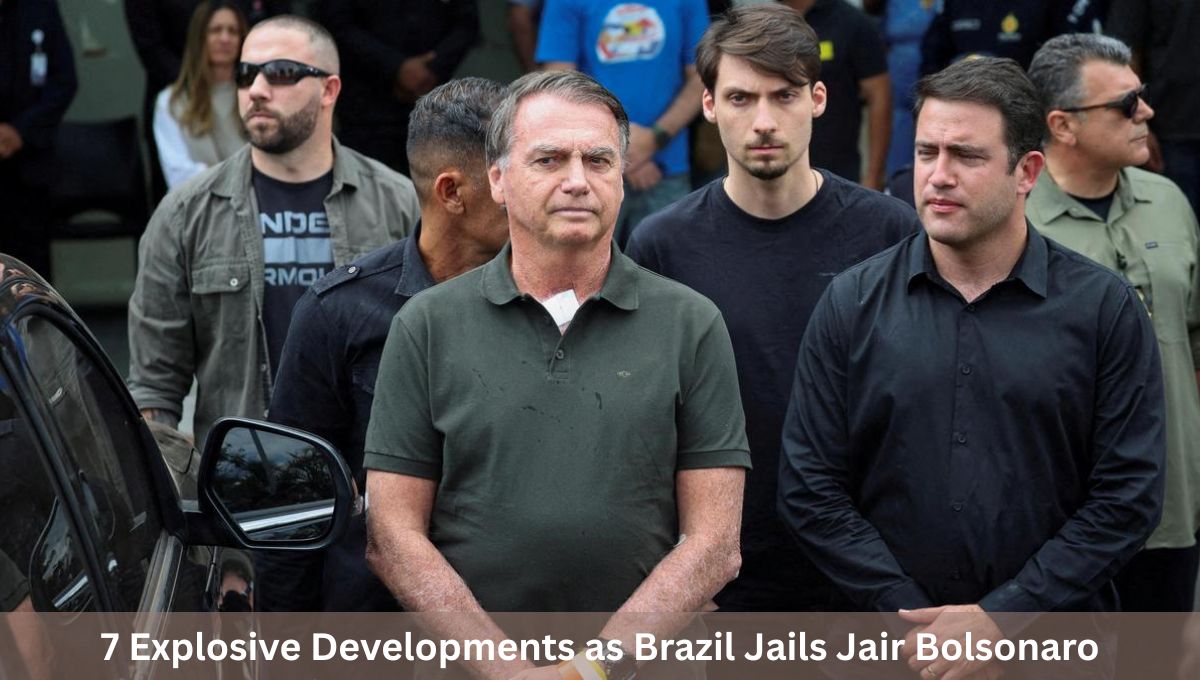
7 Explosive Developments as Brazil Jails Jair Bolsonaro and starts his 27-Year prison term for a failed coup plot. Brazil has entered one of the most defining moments of its modern political history. Former President Jair Bolsonaro, once one of Latin America’s most powerful right-wing leaders, has been ordered by Brazil’s Supreme Court to begin serving his 27-year prison sentence for plotting a coup to stop Luiz Inácio Lula da Silva from taking office after the contentious 2022 election.
With this ruling, Brazil becomes one of the few democracies in the world to imprison a former head of state for an attempted coup — and the consequences ripple far beyond Bolsonaro himself. This article breaks down the dramatic ruling, the legal and political fallout, the implications for Brazil’s 2026 presidential race, and what Bolsonaro’s imprisonment means for the country’s democracy.
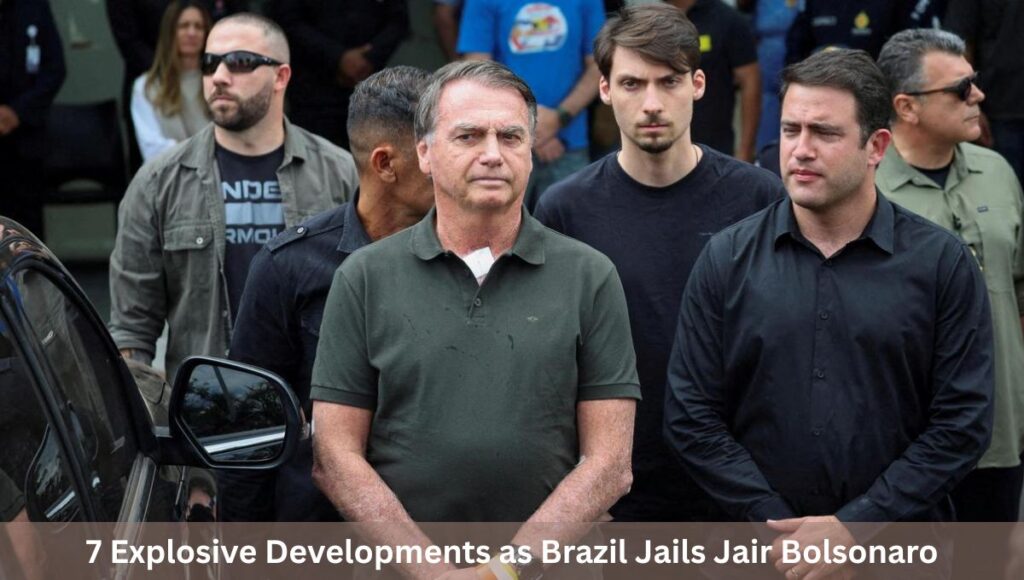
7 Explosive Developments as Brazil Jails Jair Bolsonaro
A Historic Order: Supreme Court Demands Bolsonaro Begin His 27-Year Sentence
On Tuesday, Brazil’s Supreme Court declared that all of Bolsonaro’s appeals had been exhausted. Justice Alexandre de Moraes, who has overseen much of the case, ruled that the conviction for attempting a coup, subverting democratic rule, leading an armed conspiracy, and inciting the January 8 attacks was now legally final.
Bolsonaro, 70, will begin serving his sentence at the Federal Police headquarters in Brasília, where he has already been held since Saturday. Authorities removed him from house arrest after he allegedly attempted to tamper with his court-mandated ankle monitor using a soldering iron.
The justices also rejected his legal team’s plea for house arrest on humanitarian grounds, concluding that the former president posed both a flight risk and a continued threat to democratic stability.
Background: How the Coup Plot Unraveled
The 2022 Election and Bolsonaro’s Refusal to Concede
After losing the 2022 presidential election to Lula da Silva, Bolsonaro refused to concede publicly.
Behind the scenes, according to court documents and police investigations, Bolsonaro and senior allies pursued a plan to overturn the election:
- Undermine the legitimacy of Brazil’s voting machines
- Pressure military leaders to intervene
- Draft a decree to declare a “state of exception”
- Prevent Lula from assuming office
- Plot violence, including discussions about assassinating Lula and Vice President Geraldo Alckmin
- Propose arresting and executing Justice Alexandre de Moraes
These findings were detailed in an 884-page federal police report and later discussed openly in Supreme Court rulings.
January 8: The Brazilian Capitol Riot
One week after Lula took office, Bolsonaro supporters stormed the Three Powers Plaza, attacking the Supreme Court, Congress, and presidential palace.
Investigators found that:
- Bolsonaro had incited the violence
- His aides had coordinated online disinformation networks
- Supporters hoped military intervention would restore Bolsonaro to power
Over 1,500 people were arrested.
The Military Refusal That Collapsed the Coup
The coup attempt ultimately failed because army and air force commanders refused to participate.
Without military backing, the elaborate scheme collapsed — but the legal consequences did not.
Why Bolsonaro Was Declared a Flight Risk
Bolsonaro’s recent behaviour deeply influenced the Supreme Court’s decision.
The Ankle Monitor Incident
Last weekend, police discovered damage to his ankle monitor.
Bolsonaro admitted he tried to open the device with a soldering iron, claiming medication-induced “paranoia” and “hallucinatory side effects.”
Justice de Moraes, however, viewed it differently. The court cited:
- “Very serious indications of a possible attempt to flee.”
- Bolsonaro’s brief stay at the Hungarian Embassy in 2024
- A letter pleading for asylum in Argentina
- His history of international connections, including close ties with Donald Trump
These concerns led the Court to order immediate detention.
Living Conditions: Bolsonaro’s Special Prison Cell
Bolsonaro will not be placed in the general prison population. Instead, he is housed in:
- A secure officers’ ward
- A room with air-conditioning, private bathroom, TV, mini-fridge, and bed
- A section of the Federal Police headquarters reserved for high-risk detainees
Authorities say this arrangement ensures safety due to his former presidential status and the polarized political environment.
Bolsonaro’s Health: The Core of His Defense Strategy
His attorneys argued that Bolsonaro’s medical condition is fragile, telling the court he:
- Suffers complications from the 2018 stabbing attack
- Experiences uncontrollable hiccups
- Has severe gastric issues, including esophagitis and gastritis
- Has pulmonary infections
- Has sleep apnea, requiring a CPAP machine
- Has been hospitalized three times in recent months
Family members said after visiting him:
“He is extremely fragile and psychologically devastated.”
— Carlos Bolsonaro
However, the Court ruled that the police facility can adequately provide the “full-time medical care” he requires.
A Wider Conspiracy: Generals and Ministers Also Begin Their Sentences
Alongside Bolsonaro, several high-profile co-conspirators have also begun serving long prison terms:
- Gen. Augusto Heleno – Former Minister for Institutional Security
- Gen. Paulo Sérgio Nogueira de Oliveira – Former Defence Minister
- Alexandre Ramagem – Former intelligence chief, sentenced to 16 years (now a fugitive in the U.S.)
Their sentences range from 19 to 26 years.
The Supreme Court also ordered a military tribunal to consider stripping Bolsonaro of his rank as captain — a symbolic and political blow.
International Fallout: Trump, Tariffs, and a Cooling Alliance
The case has drawn international attention, especially due to Bolsonaro’s close ties with Donald Trump.
In August, Trump:
- Called the case a “witch hunt”
- Imposed 50% tariffs on select Brazilian exports in protest
- Pressured Brazil to drop the charges
But after Bolsonaro’s arrest last weekend, Trump’s response was notably restrained:
“That’s too bad.”
Analysts say this reflects shifting priorities and a weakening of the Bolsonaro-Trump political alliance.
The Supreme Court’s Expanding Power — and Concerns About Overreach
Bolsonaro’s presidency forced Brazil’s judiciary to adopt an unprecedented role in:
- Policing online disinformation
- Investigating threats against democratic institutions
- Overseeing elections
- Initiating the “fake news inquiry”
- Regulating social media networks
- Authorizing raids, wiretaps, and arrests
Many Brazilians support the firm judicial stance against authoritarian threats. Others fear the Court has become too powerful — especially because Brazilian institutions have historically avoided prosecuting former presidents.
Political scientists argue that this expansion of judicial power is not due to judicial ambition, but because Congress refused to act, leaving the Court to “do the dirty work.”
What Bolsonaro’s Imprisonment Means for Brazil’s Right Wing
Bolsonaro had been the unifying figure of Brazil’s conservative movement for a decade. His imprisonment creates a significant leadership vacuum.
The Right Loses Its Champion
Without Bolsonaro:
- The Liberal Party (PL) loses its central political identity
- Rival right-wing figures may scramble for influence
- The movement risks fragmentation
The 2026 Election Landscape Is Transformed
President Lula da Silva, now 80, has already announced plans to run in 2026.
But the conservative side now lacks a clear contender.
Potential right-wing successors include:
- Tarcísio de Freitas – Governor of São Paulo
- Romeu Zema – Governor of Minas Gerais
- Michelle Bolsonaro – A possibility among Bolsonaro loyalists
Still, none have Bolsonaro’s national traction — or his polarizing charisma.
Lula’s Role: A Country Still Healing From Deep Divisions
Lula, who once spent 580 days in prison before his conviction was overturned, now leads a country still deeply divided.
Bolsonaro’s imprisonment:
- May ease institutional tension
- But risks energizing the radical right
- Could spark protests among die-hard supporters
- Could push Brazil toward further political polarization
Lula has avoided triumphalism, calling instead for “respect for institutions” and “democratic stability.”
Bolsonaro’s Political Future: Banned Until 2060
Beyond the prison sentence, Bolsonaro faces:
- A political ban until 2060
- Criminal charges in several other cases
- Possible loss of military rank
- Massive fines for “bad faith litigation”
- Investigations into corruption, foreign gifts, and misuse of public funds
Even if freed early for medical reasons, Bolsonaro cannot legally hold office again.
His era is effectively over.
A Nation at a Crossroads: What Happens Next
Brazil’s response has global implications.
A Warning to Future Leaders
Brazil signals that:
- Attempting a coup has consequences
- No leader is above the democratic order
- Institutions — though imperfect — can resist authoritarian pressure
A Message to the World
While the U.S. has struggled to prosecute its own January 6 leadership, Brazil acted swiftly and decisively.
Political scientists argue that Brazil has become:
“A global case study in democratic self-defense.”
But Risks Remain
Brazil’s democracy is stronger—but also more strained:
- The judiciary’s role has grown
- Politics remain polarized
- The right wing is in disarray
- Bolsonaro loyalists may still mobilize
This is not the end of political turbulence — but it is the end of Bolsonaro’s political dominance.
Conclusion: Bolsonaro’s Fall Marks a Turning Point in Brazilian Democracy
The imprisonment of Jair Bolsonaro is more than a legal outcome — it is a defining moment for Brazil’s democracy.
It marks:
- The collapse of the most aggressive authoritarian threat since the military dictatorship
- A Supreme Court willing to defend democratic institutions
- A conservative movement forced into re-evaluation
- An upcoming election reshaped by the absence of its most polarizing figure
Whether Brazil continues toward democratic consolidation or steps deeper into polarization will depend on choices made in the months ahead.
But one thing is clear:
For the first time, a former president has been jailed for trying to overthrow an election — and Brazil has shown the world what accountability looks like.
Also Read: Trump Escalates Trade War: 50% Tariff on Brazil Over Bolsonaro Trial
Also Read: Who Is President Jair Bolsonaro, And Why Was He Sentenced To 27 Years In Prison
Related Posts:
- Brazil’s Jair Bolsonaro is Sentenced to 27 Years for…

- Jair Bolsonaro Diagnosed with Skin Cancer After…

- Bolsonaro Condemns Brazil Supreme Court, Courts…

- Lula Slams Trump’s 50% Tariff as “Unacceptable…

- “I Won’t Call Trump”: Lula Defiant After US Tariff…

- Modi and Lula Unite as Trump’s Tariffs Disrupt Global Trade
