
Kabul, October 10, 2025 —
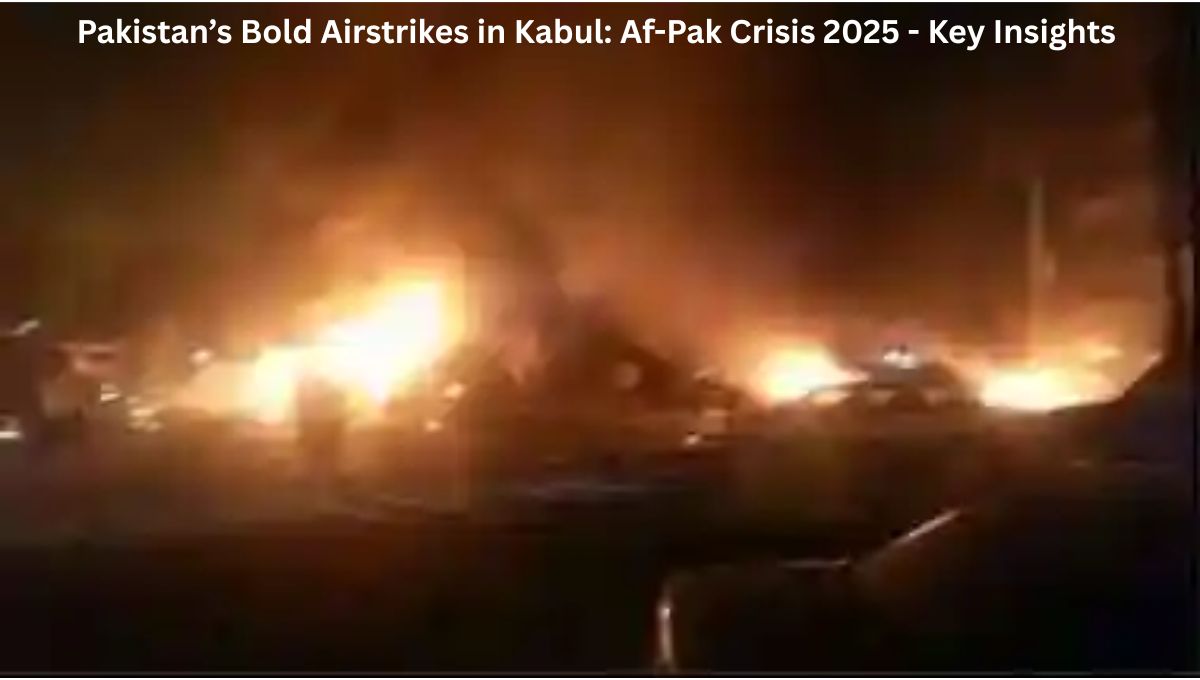
Pakistan’s Bold Airstrikes in Kabul: Af-Pak Crisis 2025 – Key Insights on targeting TTP hideouts. Afghanistan’s capital was rocked late Thursday by powerful explosions that Afghan officials said were the result of Pakistani airstrikes targeting Tehreek-e-Taliban Pakistan (TTP) hideouts.
The strikes, among the most significant cross-border operations in years, came just as Taliban Foreign Minister Amir Khan Muttaqi began a landmark visit to India — an overlap that underscored the growing complexity of South Asia’s shifting alliances.
Local media in Kabul reported at least two large explosions near Shahid Abdul Haq Square around 9:50 p.m. local time. Residents described hearing the roar of aircraft overhead followed by flashes of light and automatic gunfire. Though the Taliban administration played down the incident, witnesses confirmed the attacks targeted a residential compound believed to be a TTP safe house.
Pakistan’s Bold Airstrikes in Kabul: Af-Pak Crisis 2025 – Key Insights
1. Airstrikes Target TTP Chief Amid Rising Border Violence
According to intelligence sources quoted by local Afghan outlets, the strike was aimed at TTP chief Noor Wali Mehsud, who has led the group since 2018.
Pakistani news networks briefly claimed Mehsud had been killed, but he later issued an audio statement denying his death and asserting that he was “safe and alive.”
Under Mehsud, the TTP has carried out hundreds of attacks on Pakistani security forces, including a deadly ambush on October 8 that left 11 soldiers dead, among them two senior officers.
Pakistan’s military accuses the Taliban-led government in Kabul of harboring the TTP, allowing it to operate from Afghan territory despite repeated complaints and security talks.
The Tehreek-e-Taliban Pakistan, ideologically aligned with the Afghan Taliban but organizationally separate, has become Islamabad’s most potent internal threat since the U.S. withdrawal from Afghanistan in 2021.
The group’s operations have surged this year, making 2025 the bloodiest year since 2009 with over 900 Pakistani soldiers killed in TTP-linked attacks.
2. ‘Enough Is Enough,’ Says Pakistan’s Defence Minister
Pakistan’s Defence Minister Khawaja Asif warned on Wednesday that Islamabad’s patience had “run out” with the Afghan Taliban over the TTP issue. Speaking in the National Assembly, he accused Kabul of ignoring multiple warnings.
“Enough is enough. We can no longer tolerate the use of Afghan soil against Pakistan,” Asif said.
He later added on social media that Pakistan was “paying in blood” for its decades of hosting Afghan refugees, writing, “We are paying the price of 60 years of hospitality to six million Afghan guests.”
The minister’s remarks were widely seen as a precursor to Thursday night’s strikes, which analysts say were timed to send a message both to Kabul and to the visiting Afghan foreign minister in New Delhi.
3. Taliban Downplays the Incident, Confirms ‘Explosions Under Probe’
Taliban spokesperson Zabihullah Mujahid acknowledged that explosions were heard in Kabul but sought to reassure residents.
“The sound of an explosion was heard in the city of Kabul. However, no one should worry; the situation is under control. The investigation is underway,” he posted on X.
He later reiterated that there were no reports of casualties or damage, though local outlets such as Tolo News and Amu TV cited eyewitnesses describing multiple blasts and the sight of aircraft in the sky.
Videos circulating online showed emergency lights and confusion near Abdul Haq Square, a district housing key government buildings, including Afghanistan’s intelligence headquarters.
The Taliban interior ministry said it was assessing whether the explosions were linked to foreign air operations or local security incidents.
Also Read: Pakistan’s blitzkrieg of airstrikes on Kabul escalates tensions with Afghanistan
4. Amir Khan Muttaqi’s Landmark Visit to India
The timing of the strike could hardly have been more symbolic. Just hours earlier, Taliban Foreign Minister Amir Khan Muttaqi landed in New Delhi for a week-long diplomatic visit — his first official trip to India since the Taliban seized power in August 2021.
Indian External Affairs Ministry spokesperson Randhir Jaiswal welcomed Muttaqi, saying, “We look forward to engaging discussions with him on bilateral relations and regional issues.”
During the visit, Muttaqi is scheduled to meet External Affairs Minister S. Jaishankar and National Security Adviser Ajit Doval, marking the highest-level India-Afghanistan dialogue in four years.
His trip follows a UN-approved travel exemption allowing the Taliban minister to attend international conferences, including the Moscow Format Consultations earlier this month.
India, while not formally recognizing the Taliban regime, has pursued pragmatic engagement, reopening a limited diplomatic presence in Kabul in 2022 and providing humanitarian aid such as wheat and medicine.
The Taliban’s recent condemnation of the Pahalgam terror attack, which killed 26 people in India, was viewed in New Delhi as a positive signal of Kabul’s desire for stability and regional cooperation.
5. Pakistan’s Strategic Message: A Warning to Both Kabul and New Delhi
Security analysts in Islamabad say the Kabul airstrikes were as much a strategic warning as a counterterrorism measure.
“The message is clear — Pakistan wants to show that it retains the ability and willingness to strike across borders if its security is compromised,” said a retired Pakistani brigadier based in Rawalpindi.
The strikes coincided with Amir Khan Muttaqi’s presence in India, a fact that many observers interpret as an attempt to remind both Kabul and New Delhi of Pakistan’s regional leverage.
“This was a symbolic strike — to assert that Pakistan won’t tolerate Afghan-India cooperation that sidelines Islamabad,” said an Afghan political analyst in Kabul.
Also Read: Operation Sindoor: India Strikes 9 Terror Bases in Historic Tri-Services Offensive
Reactions and International Concerns
Former U.S. envoy to Afghanistan Zalmay Khalilzad described the incident as a “huge escalation” that could destabilize the region. “Today’s Pakistani strikes against Afghanistan’s capital are a huge escalation and pose dangerous risks,” he wrote on X.
Khalilzad accused both countries of “recklessly backing opposing militant groups,” noting that the Taliban have targeted Islamic State fighters inside Pakistan while Islamabad allegedly supports anti-Taliban factions.
“Military escalation between Pakistan and Afghanistan is not the answer. There is an alternative with better prospects: negotiations between Kabul and Islamabad,” he said.
The United Nations Assistance Mission in Afghanistan (UNAMA) expressed “deep concern” over reports of cross-border air operations, urging restraint and calling for the protection of civilians.
Field Marshal Munir’s Tetra-Crisis
The airstrikes also reflect a growing crisis within Pakistan’s military establishment. Field Marshal Asim Munir, the army chief, faces what analysts are calling a “tetra-crisis”: simultaneous unrest along the Afghan border, an insurgency in Balochistan, political instability at home, and strained ties with India.
Since January 2025, Pakistan has suffered record-high casualties in militant attacks, prompting the army to intensify operations under “Operation Sindoor” in Khyber-Pakhtunkhwa and Baluchistan.
At the same time, Pakistan’s economy remains fragile, with inflation soaring and foreign reserves at precarious levels.
Munir has reportedly sought U.S. military assistance to upgrade Pakistan’s F-16 fleet and acquire new AIM-120C5 AMRAAM missiles, echoing previous Cold War-era military deals struck under generals Zia-ul-Haq and Pervez Musharraf.
In exchange, Pakistan is reportedly offering rare-earth mineral concessions and access to Pasni port, providing Washington a potential logistical corridor into Central Asia.
The Ghost of Bagram and the New Great Game
The Kabul strike also comes against the backdrop of renewed U.S. interest in the region. In September, President Donald Trump called on the Taliban to hand over Bagram Airbase to the U.S., describing it as a “strategic outpost in the fight against terror.” The request was swiftly rejected by Kabul and criticized by Moscow and Beijing.
An October 9 statement from the Moscow Format Consultations on Afghanistan — involving Russia, India, China, and Iran — opposed any reintroduction of U.S. troops in Afghanistan, warning it would “destabilize the delicate regional balance.”
Analysts believe Pakistan’s latest actions may be designed to reassert its relevance in Washington’s Afghan calculus while reminding the Taliban that Islamabad remains the key security player along the Durand Line.
Afghanistan’s Response: Caution and Defiance
While the Taliban leadership avoided direct condemnation, senior Afghan officials privately expressed anger at the violation of their sovereignty.
A government source in Kabul told local media that the airspace breach was “unacceptable” and that the Taliban’s defense ministry was reviewing options for a formal protest.
So far, the Taliban government has sought to avoid escalation, given its focus on improving ties with regional powers — notably India, Russia, and Iran — and its desire for eventual international recognition.
“The Taliban understand that open confrontation with Pakistan could isolate them further,” said an Afghan political observer. “But these strikes also expose their vulnerability and challenge their claim to have secured the country.”
Civilian Impact and Unconfirmed Reports
Despite initial fears, there were no confirmed civilian casualties from the Kabul blasts, according to Taliban officials. However, humanitarian groups warned that any resumption of cross-border hostilities could worsen Afghanistan’s already fragile situation, where two-thirds of the population relies on aid.
Videos shared online showed frightened families fleeing residential blocks, though no verified footage of damage has emerged. Internet outages and restricted access have hampered independent verification.
A witness in Shar-e-Naw, a busy district in Kabul, told Reuters, “The windows shook violently, and I saw bright flashes. Everyone thought the city was under attack again.”
India’s Cautious Observation
India has so far avoided direct comment on the airstrikes, with officials saying they are “monitoring developments closely.”
Muttaqi’s visit, however, continues as planned. A senior Indian official said on background that New Delhi’s engagement with Kabul focuses on humanitarian and economic cooperation, not military matters.
Analysts say Pakistan’s action could backfire diplomatically by pushing the Taliban closer to India. “If Islamabad’s intent was to intimidate Kabul, it might end up strengthening India-Afghanistan ties,” said a South Asia expert at Delhi’s Observer Research Foundation.
Regional and Global Repercussions
The airstrikes add another flashpoint to a region already under strain from multiple crises — from Iran-Pakistan border skirmishes to U.S. re-engagement efforts and China’s growing influence in Central Asia.
The Trump administration is reportedly exploring a new “Stability Framework for South and Central Asia,” under which Washington could mediate between Islamabad and Kabul. Observers say this would mark the ninth global conflict in which Trump has sought to broker peace in 2025.
For now, both Afghanistan and Pakistan appear locked in a dangerous cycle of retaliation and mistrust, with few channels of communication open.
Conclusion: The New Fault Line in South Asia
Pakistan’s October 9 airstrikes on Kabul mark a turning point in the long and turbulent Af-Pak relationship.
What began as a partnership of convenience during the U.S. war on terror has devolved into a confrontation between two ideologically similar but strategically divergent regimes.
As Afghanistan deepens its outreach to India and Pakistan grapples with internal and external pressures, the risk of further escalation remains high.
For millions of civilians along the Durand Line, the renewed conflict threatens to reopen old wounds — and reshape the geopolitical balance of South Asia once again.
Related Posts:
- Afghanistan–Pakistan Border Clashes 2025: Key Facts…

- Pakistan–Afghanistan Border Conflict 2025: Ceasefire…

- 7 Alarming Signs of Escalation as Pak-Afghan…
- 8 Shocking Developments in the Pakistan–Afghanistan…
- 5 Key Takeaways as Pakistan–Afghanistan Peace Talks…

- 7 Shocking Details: 13-Year-Old Executes Man Before…
