

Washington, October 10, 2025 —
Gaza Ceasefire 2025: Crucial Role of US Troops heading to Israel after deal brokered by President Trump. The White House issued a clarification Friday, dismissing media reports suggesting that US troops were being sent to Israel as part of a peace monitoring mission for the recently brokered ceasefire with Hamas in Gaza.
White House Press Secretary Karoline Leavitt said the reports were “not true” and had been “taken out of context.” She clarified that up to 200 US personnel, already stationed at US Central Command (CENTCOM), would help monitor the Gaza ceasefire agreement from Israel and coordinate with other international forces, but no American troops will be deployed into Gaza.
The announcement came amid intense diplomatic efforts led by US President Donald Trump to secure a long-awaited ceasefire and hostage release deal following two years of conflict that devastated the Gaza Strip.
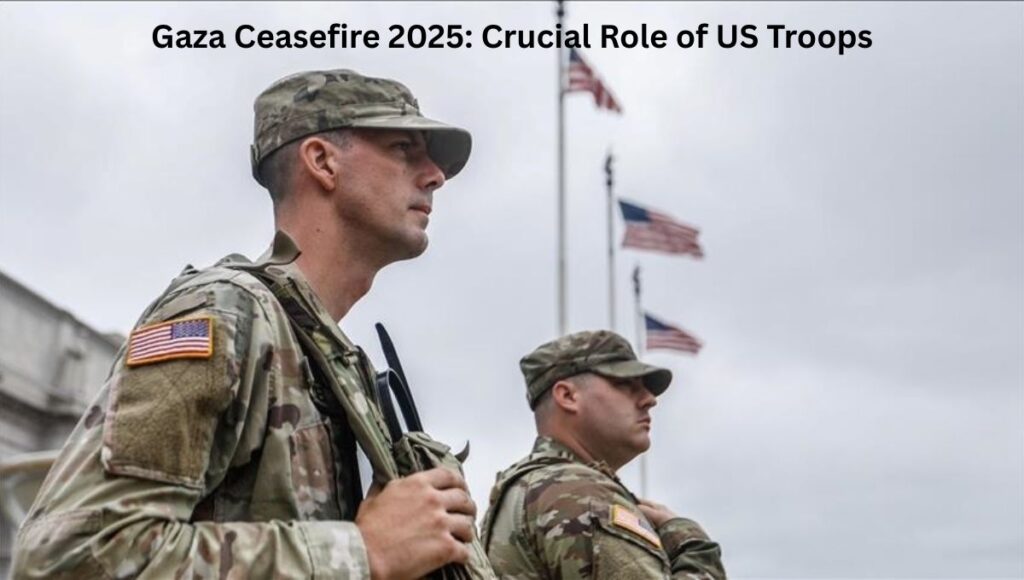
Gaza Ceasefire 2025: Crucial Role of US Troops
1. The Civil-Military Coordination Center (CMCC)
The US military is establishing a Civil-Military Coordination Center (CMCC) in Israel, intended to manage humanitarian aid flows, logistics, and security support for the Gaza ceasefire.
According to officials, the CMCC will be staffed by approximately 200 US service members with expertise in planning, transportation, logistics, security, and engineering. In addition to American personnel, the center is expected to include military representatives from Egypt, Qatar, Turkey, and the UAE.
The role of the CMCC is strictly coordination, integrating multinational forces and ensuring smooth operations without direct combat or deployment inside Gaza.
2. Background: Gaza Ceasefire and Humanitarian Crisis
The ceasefire follows an intense period of violence in Gaza, triggered by Hamas’ October 7, 2023 attack on Israel, which killed over 1,200 Israelis and saw 251 hostages captured.
Over the two years of conflict, more than 67,000 Palestinians have been killed as Israel launched repeated military operations in Gaza. The humanitarian situation deteriorated severely, prompting urgent calls from the United Nations and international actors to facilitate aid access and ensure civilian protection.
The first phase of the ceasefire includes the release of hostages in exchange for Palestinian prisoners held in Israel. Sources indicate that about 20 hostages are still alive, and their release is expected within 72 hours of the ceasefire taking effect.
3. White House Clarification: No Combat Role
Media reports had claimed that US troops were being sent to Israel to directly support the ceasefire, including potential operations in Gaza. White House Press Secretary Leavitt stressed that these claims were inaccurate:
“Up to 200 US personnel, who are already stationed at CENTCOM, will be tasked with monitoring the peace agreement in Israel. They will work alongside other international forces on the ground. No American troops will enter Gaza.”
Officials emphasized that the CMCC will serve as a coordination hub, liaising with Israeli defense forces and multinational partners to ensure aid delivery and operational security, but it will not engage in combat or occupy Gaza territory.
Also Read: Gazans stream towards wrecked homes as Israeli forces pull back under ceasefire
4. International Partnership in Monitoring
The US is not acting alone. The CMCC is expected to integrate military representatives from Egypt, Qatar, Turkey, and possibly the UAE, alongside humanitarian organizations and private-sector partners.
The international presence aims to enhance credibility and ensure fair oversight of ceasefire implementation, hostages’ safe release, and the flow of humanitarian aid.
Officials stressed that the international team is designed to cool regional tensions and pave the way for future normalization talks between Israel and Arab nations.
5. Donald Trump’s Role in Gaza Diplomacy
US President Donald Trump played a central role in negotiating the ceasefire. In addition to halting hostilities, the plan includes hostage exchange and a blueprint for Gaza’s stabilization and reconstruction.
Trump has proposed creating an international body called the “Board of Peace”, which would oversee post-war governance in Gaza, coordinate humanitarian aid, and support demilitarization. Former British Prime Minister Tony Blair is expected to participate in this oversight mechanism.
Trump expressed optimism about lasting peace but acknowledged the challenges ahead, noting that temporary pauses in conflict are far more common than durable agreements.
Also Read: Trump’s Breakthrough Gaza Ceasefire Deal 2025: Key Insights
6. Humanitarian Aid and Infrastructure Support
The ceasefire plan anticipates a substantial increase in humanitarian aid entering Gaza. Officials reported that 400–600 trucks per day will deliver food, medicine, and other essential supplies.
The CMCC will coordinate with Israeli forces and international partners to ensure aid reaches the intended areas efficiently and securely.
The United Nations, led by Secretary-General António Guterres, has affirmed its readiness to facilitate operations:
“We are prepared to move – now. Full access for aid workers is essential to support the people of Gaza.”
7. Future Governance of Gaza: Uncertainty Remains
While the ceasefire addresses immediate humanitarian and security concerns, several critical questions remain unresolved, including:
- Who will govern Gaza post-conflict?
- What role will Hamas play after the ceasefire?
- How will Israel’s withdrawal from certain areas be managed?
Officials clarified that Hamas is excluded from the administrative role in Gaza under the plan. Instead, the Board of Peace and a multinational stabilization force may temporarily oversee governance, reconstruction, and demilitarization efforts.
8. US Military and Regional Strategy
The deployment of 200 US troops, though limited to Israel, signals a renewed American presence in the Middle East and demonstrates US commitment to maintaining regional stability.
Experts note that the CMCC provides the US with:
- A platform to coordinate humanitarian assistance
- An opportunity to influence Gaza’s post-war stabilization
- A framework to support future normalization agreements between Israel and Arab nations
Trump’s previous experience in the Abraham Accords, which facilitated normalization deals with UAE, Bahrain, Morocco, and Sudan, positions him to leverage regional partnerships for peace expansion, with Saudi Arabia, Indonesia, and other nations being potential candidates for future agreements.
9. Release of Hostages and Prisoner Exchange
The ceasefire deal includes the release of 48 hostages held by Hamas. Palestinian sources indicate that the bodies of deceased hostages will be returned gradually as Israeli forces withdraw and coordinate with the international force.
Israel, in exchange, is expected to release approximately 2,000 Palestinian prisoners, including over 200 serving life sentences. Hamas has already submitted lists of hostages and requested prisoner exchanges, facilitating the first phase of the agreement.
This exchange is seen as a crucial trust-building measure, with the international task force helping monitor compliance and ensuring security protocols are observed.
10. Challenges and Skepticism
Despite optimism surrounding the ceasefire, many analysts caution that the agreement does not constitute a permanent peace deal.
Aaron David Miller, former US Middle East advisor, remarked:
“It is not a peace agreement. It is not a guaranteed end to the war.”
The implementation phase will require rigorous monitoring, coordination among international actors, and compliance from all parties to prevent further escalation.
11. Strategic Implications for the Region
The US deployment and the ceasefire deal have multiple regional implications:
- Reinforces US influence in Middle East peace processes
- Enhances coordination with partner nations on humanitarian and security issues
- Signals that the international community will supervise Gaza stabilization
- Potentially sets the stage for future Arab-Israeli normalization agreements
Analysts warn, however, that political tensions within Israel, Palestinian territories, and neighboring countries could challenge the durability of the agreement.
12. Next Steps for Trump’s Gaza Plan
The Trump administration is preparing to:
- Deploy US troops to Israel to form the core of CMCC
- Coordinate with international military partners and NGOs
- Monitor humanitarian aid flows into Gaza
- Oversee the release of hostages and prisoners
- Facilitate post-war stabilization via the Board of Peace
- Engage in regional diplomacy for normalization agreements
Trump has expressed confidence that these steps will contribute to a long-term resolution, although he acknowledges the complexity of Gaza’s political landscape and the ongoing risks of renewed violence.
Conclusion: A Fragile but Promising Ceasefire
The Gaza ceasefire represents a momentous milestone after two years of devastating conflict. While the deployment of 200 US troops to Israel is limited and primarily logistical, it signals a strong commitment to monitoring, coordination, and humanitarian support.
The coming days will test the effectiveness of international coordination, the release of hostages, and the integration of multinational stabilization efforts.
As global eyes focus on Gaza, the success of this plan could reshape regional alliances, influence future normalization agreements, and demonstrate the role of coordinated diplomacy in mitigating prolonged conflicts in the Middle East.
Related Posts:
- Trump’s Historic Gaza Ceasefire Deal 2025: A…

- Israel–Hamas Ceasefire Under Strain: 4 More Hostage…

- Trump’s Gaza Warning: ‘Kill Hamas’ Threat After…
- Trump’s 20-Point Gaza Peace Plan Gains Urgent Global…

- Dramatic Moments Behind Trump’s Gaza Peace Push and…

- Trump’s Breakthrough Gaza Ceasefire Deal 2025: Key Insights
