In a landmark military Operation Sindoor: India Strikes 9 Terror Bases in Historic Tri-Services Offensive. The Indian Armed Forces launched Operation Sindoor in the early hours of Wednesday, May 7, 2025, targeting nine terrorist sites in Pakistan and Pakistan-Occupied Kashmir (PoK).
This precision tri-services strike—coordinated between the Indian Army, Navy, and Air Force—was a direct response to the horrific Pahalgam terror attack on April 22 that claimed 26 lives, including 25 Indians and one Nepali tourist.
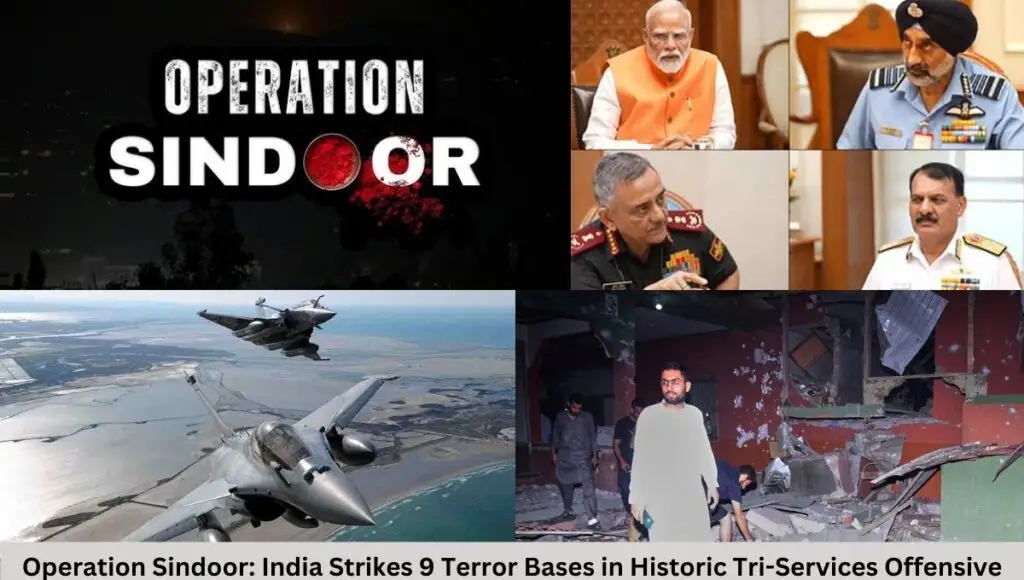
Operation Sindoor: India Strikes 9 Terror Bases in Historic Tri-Services Offensive
What We Know So Far
- Timing of the Strikes: Missiles were launched at approximately 1:44 AM.
- Targets: Nine terror sites linked to groups including Jaish-e-Mohammed (JeM), Lashkar-e-Taiba (LeT), and Hizbul Mujahideen (HM).
- Strike Locations:
- Markaz Subhan Allah, Bahawalpur – JeM
- Markaz Taiba, Muridke – LeT
- Sarjal, Tehra Kalan – JeM
- Mehmoona Joya, Sialkot – HM
- Markaz Ahle Hadith, Barnala – LeT
- Markaz Abbas, Kotli – JeM
- Maskar Raheel Shahid, Kotli – HM
- Shawai Nalla Camp, Muzaffarabad – LeT
- Syedna Bilal Camp, Muzaffarabad – JeM
According to the Defence Ministry, “no Pakistani military facilities were targeted” and the focus was on dismantling terrorist infrastructure fueling cross-border violence.
First Visuals and Eyewitness Accounts
Visuals released from Pakistani social media accounts show massive orange fireballs erupting from the sites, followed by plumes of black smoke. In one video, panic-stricken civilians can be seen praying and fleeing as explosions rock the area. The strikes reportedly used air-launched standoff weapons like the SCALP missile and Hammer smart bombs.
Political and Public Reactions
India
- Prime Minister Narendra Modi vowed to chase the perpetrators of the Pahalgam attack “to the ends of the Earth.”
- Asaduddin Owaisi (AIMIM) praised the operation, stating, “Pakistan’s terror infrastructure must be completely destroyed.”
- Jairam Ramesh (Congress) expressed full support for the armed forces, emphasizing national unity.
- Tejashwi Yadav and Shiv Sena congratulated the armed forces and PM Modi, hailing the mission as a strong response to terrorism.
- Victims’ Families: Asvari Jagdale and Aishanya Dwivedi, daughters and wives of victims respectively, expressed emotional relief, calling the strikes a “real tribute.”
Pakistan’s Response and Military Retaliation
In a strongly worded statement, Pakistani Prime Minister Shehbaz Sharif labeled the strikes “an act of war,” asserting Pakistan’s right to retaliate. Soon after, heavy artillery shelling was reported along the LoC in Poonch and Rajouri, resulting in the deaths of three Indian civilians.
Pakistani authorities also claimed to have shot down five Indian fighter jets, though India has only confirmed one crash in Wuyan village, Kashmir, where an aircraft hit a school building. The pilot was taken to hospital, and investigations are ongoing.
Global Diplomatic Developments
India has briefed counterparts in the United States, United Kingdom, Russia, Saudi Arabia, and the UAE, emphasizing the operation’s focus on terrorist infrastructure. The United Nations Security Council held closed-door consultations, with calls for de-escalation. While no official UNSC statement was released, Pakistan claimed that its concerns were heard.
U.S. Secretary of State Marco Rubio urged both nations to “reopen a dialogue channel” to prevent further escalation, while analysts warned that the high-intensity nature of these strikes could provoke a major military response from Pakistan.
Why These Targets Were Chosen
Each location held strategic and symbolic value:
- Bahawalpur: Headquarters of JeM and home to founder Masood Azhar.
- Muridke: LeT’s largest training and indoctrination center.
- Kotli & Gulpur: Training hubs for suicide bombers and launchpads for attacks in Jammu and Kashmir.
- Mehmoona & Sialkot: Known Hizbul Mujahideen sites.
- Barnala & Sarjal: Key infiltration corridors into Indian-administered Kashmir.
- Muzaffarabad: A long-time sanctuary for LeT and JeM operatives.
Operation Sindoor: A Historic Moment
This is India’s first tri-services strike since the 1971 Indo-Pak war and marks a shift in New Delhi’s counter-terror posture—from defensive diplomacy to decisive preemption. With national sentiment swelling and global eyes watching, the situation remains volatile.
India has called for enhanced civil defence readiness across 244 districts, while commercial flights in northern India have been suspended as a precautionary measure.
Also Read: 24 Strikes, 9 Terror Camps, 70 Killed: India Rained Hell For 25 Minutes