
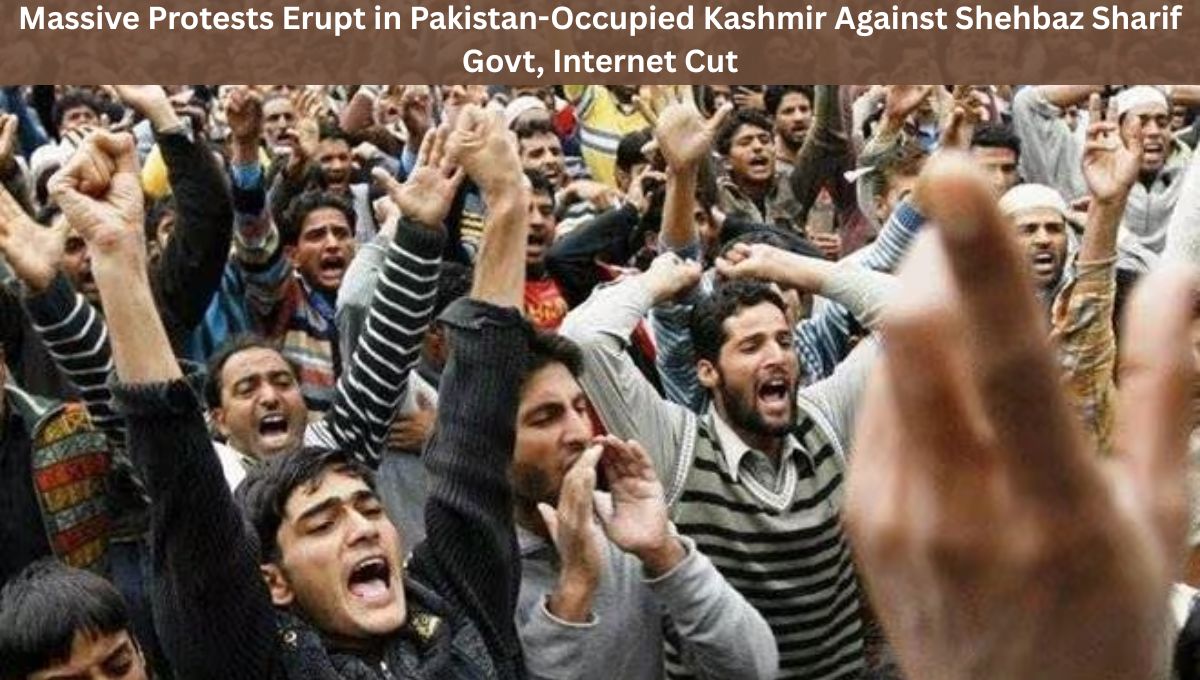
Massive Protests Erupt in Pakistan-Occupied Kashmir Against Shehbaz Sharif Govt, Internet Cut, troops deployed amid fears of escalation. Pakistan-Occupied Kashmir (PoK) has erupted in one of the largest civilian uprisings in decades. Thousands of residents across Mirpur, Kotli, Rawalakot, Neelum Valley, and Muzaffarabad have taken to the streets in mass demonstrations against the Shehbaz Sharif-led Pakistan government, accusing it of decades-long exploitation, corruption, and denial of fundamental rights.
The protests, spearheaded by the Awami Action Committee (AAC), began with a “shutter-down and wheel-jam strike” and have since expanded into a region-wide movement.
What began as anger over subsidised flour, unfair electricity tariffs, and corruption has now evolved into a political flashpoint that Islamabad fears could escalate into broader calls for Azadi (freedom) from Pakistan. The Pakistani government, rattled by the scale of dissent, has responded with heavy troop deployment, internet blackouts, and security crackdowns. Yet, the uprising shows no signs of losing momentum.
Massive Protests Erupt in Pakistan-Occupied Kashmir Against Shehbaz Sharif Govt, Internet Cut
Why Are the Protests Happening in PoK?
The AAC has presented a 38-point charter of demands to Islamabad, centering on economic relief, political reforms, and representative governance. The most contentious demands include:
- Abolition of 12 Assembly seats reserved for Kashmiri refugees living in Pakistan, which locals argue undermines representative governance in PoK.
- Subsidised flour to counter rising inflation.
- Fairer power tariffs tied to the Mangla and Neelum-Jhelum hydropower projects that supply electricity to Pakistan but leave PoK residents in darkness.
- Implementation of long-delayed constitutional reforms promised by Islamabad.
AAC leader Shaukat Nawaz Mir made it clear:
“Our campaign is not against any institution, but for the bona fide rights of our people that have been denied for over seven decades. Enough is enough. Either deliver on rights or face the wrath of the people.”
This statement encapsulates the deep resentment simmering across PoK — resentment fueled by decades of economic neglect, political marginalisation, and systemic corruption.
Also Read: Enough is enough: Thousands in POK erupt in protest against Pak government
Crackdown: Internet Shutdown and Heavy Deployment
In anticipation of the protests, Islamabad resorted to cutting mobile networks, landlines, and internet services across the region. Rights groups condemned the move as a deliberate attempt to silence digital mobilisation and prevent global exposure of the unrest.
Security convoys, including paramilitary Rangers from Punjab and over 2,000 police personnel from Islamabad, have been stationed across sensitive districts. Entry and exit points have been sealed, while flag marches by security forces aim to intimidate civilians.
District Magistrate Mudasser Farooq defended the crackdown, claiming:
“Maintaining peace is a shared responsibility of the administration, police, and citizens. We have no quarrel with anyone, but our mission of public service will continue at all costs.”
However, activists accuse Islamabad of preparing for a violent suppression of dissent.
The Refugee Seats Controversy
At the heart of the political unrest lies the issue of 12 legislative assembly seats reserved for Kashmiri refugees from J&K. These were introduced under the 13th Amendment to Act 74 in 2018, which locals argue distorts representative governance and gives Islamabad an indirect lever to control PoK’s political machinery.
The AAC has demanded the abolition of these seats, calling them an “undemocratic privilege.” For residents, these refugee constituencies symbolize Islamabad’s stranglehold on their political rights.
AAC’s 38-Point Charter of Demands
The AAC’s charter has gained wide traction among locals. Its demands are rooted in economic justice, governance reforms, and resource-sharing agreements. Key points include:
- Subsidised flour and essential goods to ease the inflation burden.
- Power tariffs linked to local generation costs, since PoK generates massive electricity but pays inflated rates.
- Scrapping of refugee-reserved seats in the Assembly.
- Reform of local governance structures to curb corruption and elite privileges.
- Renegotiation of hydropower agreements to ensure locals benefit from resources extracted from their region.
PoK’s History of Uprisings
This is not the first time PoK has erupted in protest. In 2023 and 2022, similar demonstrations were held against inflated electricity bills, subsidy withdrawals, and constitutional amendments aimed at consolidating Pakistan’s control.
- In May 2023, protests broke out over electricity generated at the Mangla Dam, as locals demanded power at cost price.
- In 2022, demonstrators burned tyres and blocked highways against the 15th Amendment, which they claimed stripped the region of autonomy.
- Even earlier, PoK has been a hotbed of dissent, with locals accusing Islamabad of exploiting its resources while neglecting development.
The current protests, however, appear to be the largest grassroots civilian mobilisation in decades, cutting across class, ethnic, and regional lines.
Fear of Escalation
Security sources in Islamabad are reportedly alarmed that these protests could morph into separatist demands. The AAC’s push to eliminate refugee-reserved assembly seats is seen as a direct challenge to Pakistan’s proxy-democracy model in PoK.
Intelligence reports suggest that if the protests are violently suppressed, it could fuel youth radicalisation against Pakistan itself — shifting the theatre of instability from Indian-administered Kashmir to Pakistan’s own occupied territory.
Also Read: Rising Tensions Between India and Pakistan: Strikes, Denials, and Escalation in Kashmir
The situation, sources warn, remains volatile and unpredictable.
Diaspora Involvement
The protests are not confined to PoK. Diaspora communities in the UK, US, and EU have signaled support, preparing to amplify testimonies, protest images, and campaigns internationally.
Observers note that the involvement of diaspora networks could turn this local agitation into a global human rights issue, placing additional diplomatic pressure on Islamabad.
Islamabad’s Political Dilemma
The Shehbaz Sharif government, already under fire for economic mismanagement and political instability, faces a serious credibility crisis.
On one hand, acceding to the AAC’s demands could weaken Islamabad’s control over PoK. On the other hand, a violent crackdown risks international condemnation and could fuel separatist sentiment.
For now, the AAC has temporarily suspended the protests, fearing a crackdown, but has vowed to resume agitation from October 15 if demands remain unmet.
Voices from the Ground
Locals describe the movement as a fight for dignity and survival:
- “We generate electricity but live in darkness.”
- “We pay taxes but have no representative governance.”
- “We are treated like colonies, not citizens.”
The slogans echo a deep-rooted anger at Pakistan’s decades-long policies of systemic exploitation.
What Lies Ahead?
The coming weeks are critical. If Islamabad responds with dialogue and reforms, tensions may ease. But if the government resorts to force and intimidation, PoK could witness an unprecedented spiral of resentment, indefinite lockdowns, and even separatist radicalisation.
Either way, the protests have already exposed the fragile fault lines in Pakistan’s governance of the region. For many in PoK, this is not just a protest — it is a reckoning for seven decades of denial and neglect.
Conclusion
The mass protests in Pakistan-Occupied Kashmir are not just about subsidies or tariffs. They reflect decades of frustration, systemic neglect, and a demand for dignity.
For Islamabad, this movement is a wake-up call. For PoK’s people, it is the beginning of a long-overdue fight for their rights. As the AAC prepares for its next phase of agitation, the world will be watching closely — not just to see how Islamabad responds, but whether PoK’s struggle transforms into a defining movement against Pakistan’s control.
Related Posts:
- 7 Heartbreaking Facts About Venezuela's Earthquake Disaster

- 5 Major Takeaways from the US Supreme Court's…

- 7 Dead in Explosive Iran Protests as Economic Anger…

- 7 Powerful Facts About Ayatollah Ali Khamenei’s…
- Afghanistan–Pakistan War 2025: Inside the 48-Hour Ceasefire

- Trump’s 20-Point Gaza Peace Plan Gains Urgent Global…
