

Exchange of artillery with Rising Tensions Between India and Pakistan: Strikes, Denials, and Escalation in Kashmir. India and Pakistan, two nuclear-armed neighbors with a history of conflicts, have found themselves locked in an escalating confrontation over disputed Kashmir. Recent developments have brought both nations to the brink of further military action, with multiple attacks reported, casualties rising, and calls for international intervention. Here’s a detailed overview of the latest developments surrounding the conflict and the ongoing hostilities along the Line of Control (LoC).
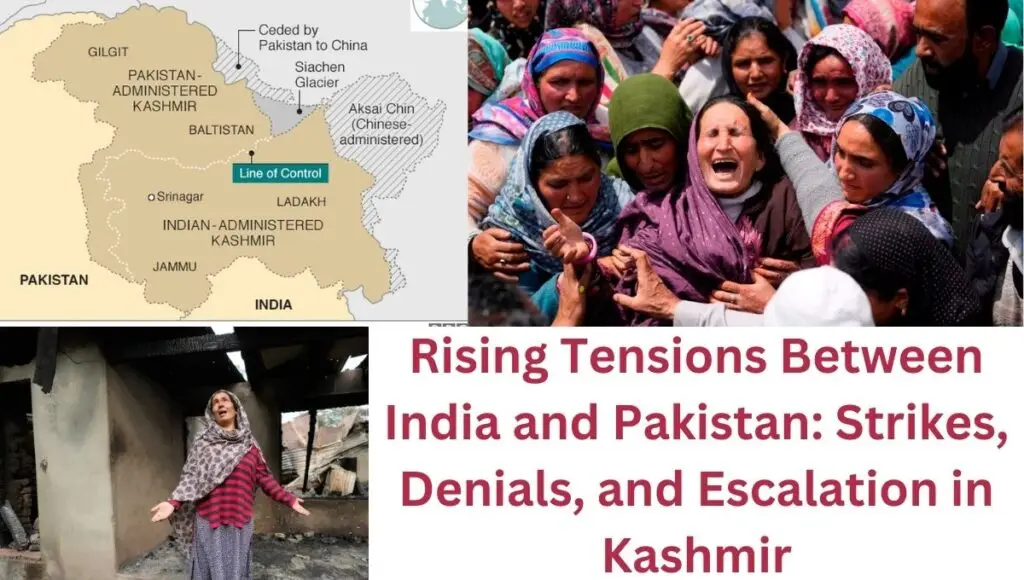
Rising Tensions Between India and Pakistan: Strikes, Denials, and Escalation in Kashmir
Pakistan Denies Role in India’s Military Base Strikes
India has accused Pakistan of launching an assault on its military bases with drones and missiles, targeting key locations in Jammu, Udhampur, and Pathankot. However, Islamabad has firmly denied these claims.
Pakistan’s Defense Minister, Khawaja Asif, stated that the country had not carried out any such attacks, adding that they would never strike and then deny it.
The Indian Army reported successfully thwarting these attacks, which involved multiple blasts in Jammu city and surrounding areas. These incidents occurred late Thursday evening as the region plunged into a blackout.
Both nations are accusing each other of escalating military action, raising fears of a larger conflict between the two countries, which have fought multiple wars over the Kashmir region.
Pakistan Responds to Indian Airstrikes
In retaliation for Pakistan’s alleged missile attacks, India conducted airstrikes targeting what it claimed were Pakistani military sites and terrorist infrastructure. Indian military officials confirmed neutralizing air defense systems in Lahore and other locations, but these claims have been refuted by Pakistan.
The tension increased when Pakistan’s military spokesperson reported Indian drones attacking various locations in Pakistan’s provinces, which caused civilian casualties.
The series of airstrikes from both sides—Indian missile attacks on Pakistan on Wednesday and Pakistan’s artillery fire on Indian-administered Kashmir—have exacerbated the already volatile situation.
Calls for de-escalation from international leaders have grown louder, as global stakeholders worry about the risk of further military clashes.
Intense Artillery Fire in Uri and Kupwara
Amid the escalating conflict, Pakistani artillery intensified its fire across the Line of Control (LoC), targeting the Uri and Kupwara regions in Jammu and Kashmir. A tragic incident occurred in Uri’s Baramulla district, where a woman was killed, and four other civilians were injured when their vehicle was hit by a Pakistani shell.
This attack was part of a larger artillery barrage that caused widespread damage to homes and infrastructure.
The Indian Army responded with proportional counterattacks. As artillery exchanges continued, over 60,000 civilians were evacuated from the region, taking refuge in government shelters or with relatives in safer areas.
Casualties and Humanitarian Impact
The consequences of this renewed conflict have been devastating, with both countries reporting significant casualties. Pakistani authorities claim that 31 people were killed and 57 others were injured due to Indian airstrikes and artillery fire in Pakistan-administered Kashmir.
Meanwhile, India reported the deaths of 16 civilians, including three women and five children, from Pakistani artillery fire.
The impact on civilians has been severe, especially in regions like Uri and Kupwara, where entire neighborhoods have been damaged by mortar shells. Authorities have enforced blackouts across the Kashmir Valley as a precautionary measure, and schools in the affected areas remain closed.
International Reactions and Calls for De-Escalation
The international community has expressed deep concern over the rising violence between India and Pakistan. The United Nations, along with other global leaders, has called for restraint from both sides and emphasized the need for diplomatic dialogue to prevent further bloodshed.
U.S. Vice President JD Vance has publicly stated that the conflict between India and Pakistan is not America’s business, despite urging both countries to de-escalate.
With the conflict involving two nuclear-armed nations, the risks of it spiraling into a larger regional war remain high, prompting calls for an urgent ceasefire and diplomatic efforts.
Impact on Daily Life in India and Pakistan
As the military confrontation continues, normal life has been severely disrupted. In India, major cities such as Chandigarh, Jammu, and Srinagar have been placed under heightened security, and airstrikes have caused widespread disruptions in airports across the region.
The Indian government has even closed 24 airports, including those in Jammu, Srinagar, and Amritsar, as a precautionary measure against potential aerial attacks.
Similarly, Pakistani cities like Lahore, Gujranwala, and Rawalpindi have been targeted by Indian drones, leading to civilian casualties and widespread panic. Markets in both countries have also felt the economic effects, with Indian stock markets experiencing a drop as tensions escalate.
India’s Military Actions and Retaliation
India’s military, under its Operation Sindoor, has successfully intercepted Pakistani drones and missiles aimed at critical infrastructure in several northern and western cities. Despite Pakistan’s claims of shooting down Indian fighter jets, India has not commented on this assertion.
However, India has reiterated that its actions are in response to Pakistan’s provocations, and the country remains committed to defending its sovereignty.
The Road Ahead: Diplomacy or Escalation?
With both nations accusing each other of aggression and continuing military actions, the question remains whether the situation will de-escalate or spiral into a larger conflict.
The international community is closely monitoring developments, with pressure mounting on both India and Pakistan to prioritize diplomacy over military action.
The Kashmir region, long a flashpoint in India-Pakistan relations, remains at the heart of this ongoing struggle, with both sides firmly entrenched in their positions. As civilian casualties continue to rise, and the humanitarian situation worsens, the world awaits a resolution to this dangerous crisis.
Conclusion
The conflict between India and Pakistan has entered a new phase, marked by military strikes, artillery exchanges, and a growing death toll. The situation remains highly volatile, and the potential for further escalation remains a serious concern for global peace.
While both sides deny each other’s claims of aggression, the humanitarian impact of the violence continues to mount, affecting thousands of civilians caught in the crossfire. The need for diplomacy and dialogue has never been more urgent.
Also Read: Rising tensions resurface Pakistan’s credibility problem– and India’s backfiring policy on Kashmir
Related Posts:
- 7 Heartbreaking Facts About Venezuela's Earthquake Disaster

- 5 Major Takeaways from the US Supreme Court's…

- Afghanistan–Pakistan War 2025: Inside the 48-Hour Ceasefire

- 7 Powerful Facts About Ayatollah Ali Khamenei’s…

- 11 Explosive Revelations From Ted Cruz’s Leaked…

- 7 Powerful Measures: Trump Sanctions Russian Oil…
