In a closed-door UNSC Meeting on Pahalgam Terror Attack: Pakistan Faces Tough Questions, No Outcome Reached. The United Nations Security Council (UNSC) held a closed-door meeting on Monday to discuss the escalating diplomatic and security tensions between India and Pakistan following the deadly Pahalgam terror attack on April 22, which claimed the lives of 26 civilians, including tourists and a local pony operator in Jammu and Kashmir.
The attack, believed to be carried out by Pakistan-based terror group Lashkar-e-Taiba, has reignited global concerns about the fragile peace in the region.
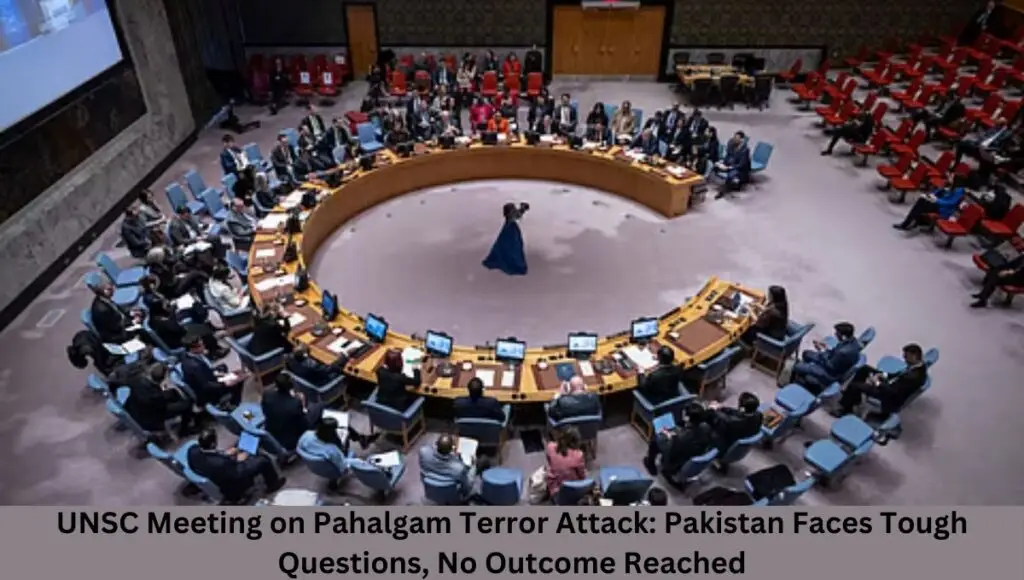
UNSC Meeting on Pahalgam Terror Attack: Pakistan Faces Tough Questions, No Outcome Reached
Pakistan Calls for Closed Consultations, Faces Backlash
The UNSC meeting was called at the request of Pakistan, which is currently serving as a non-permanent member of the 15-nation body. Islamabad aimed to raise concerns over what it termed a deteriorating security situation and accused India of military provocation.
However, according to diplomatic sources, the move backfired. Several UNSC members questioned Pakistan’s role, grilled it over the possible involvement of Lashkar-e-Taiba in the Pahalgam attack, and flagged its recent missile tests and nuclear rhetoric as destabilizing actions.
UNSC Members Reject Pakistan’s Narrative
Despite Islamabad’s attempts to bring international attention to the Kashmir issue, many UNSC envoys dismissed the “false flag” narrative being pushed by Pakistan. Notably, even China did not support Pakistan’s position during or after the meeting, sources confirmed.
UNSC members instead emphasized the need for accountability for the terror attack, especially since the victims were reportedly targeted based on their religion.
While Pakistan’s Permanent Representative to the UN, Asim Iftikhar Ahmad, tried to deflect blame and accused India of breaching the Indus Waters Treaty, the Council made no move to accept or act on these claims. The meeting concluded without any official statement, resolution, or press release, effectively isolating Pakistan diplomatically.
UN Chief Urges Restraint, Condemns Terror Attack
UN Secretary-General António Guterres issued a strong condemnation of the Pahalgam terror attack hours before the UNSC consultations. “Targeting civilians is unacceptable – and those responsible must be brought to justice through credible and lawful means,” Guterres said.
Stressing the seriousness of the current India-Pakistan standoff, he warned, “Now is the time for maximum restraint and stepping back from the brink. A military solution is no solution.”
Guterres noted that tensions between the nuclear-armed neighbors are at their “highest in years” and emphasized his ongoing efforts to urge both sides to resolve issues through dialogue.
India Responds Firmly to the Terror Attack
Following the attack, Prime Minister Narendra Modi vowed swift and decisive justice. India has since undertaken several punitive measures against Pakistan, including the suspension of the Indus Waters Treaty, cancellation of visa services, and closure of airspace to Pakistani flights.
The Indian Army has also responded to repeated ceasefire violations by Pakistani forces along the Line of Control.
To prepare for any further escalation, India’s Ministry of Home Affairs has directed states to conduct civil defense mock drills, including blackout exercises, air raid sirens, and evacuation drills in strategic areas.
UNSC Expresses Concern Over Pakistan’s Nuclear Posture
The UNSC members expressed concern over Pakistan’s escalatory nuclear rhetoric and its recent missile tests, both of which were seen as provocative actions that risk further instability in South Asia.
These developments were raised as major issues during the meeting, with several countries urging Pakistan to exercise restraint and avoid further provocation.
Cyber Attacks Add to Tensions
Amid the diplomatic crisis, the Pakistan Cyber Force, a hacker group, claimed responsibility for a cyber-attack on Indian defense-related websites. They alleged they had breached sensitive data from the Military Engineer Services and the Manohar Parrikar Institute of Defense Studies and Analysis.
However, Indian authorities have denied these claims, stating that no significant data breach occurred.
Indian defense sources also revealed that additional Pakistani hacker groups made unsuccessful attempts to breach other defense websites, including Armored Vehicle Nigam Limited, which was taken offline temporarily for a security audit.
Pakistan’s UNSC Move Deemed Pointless
Despite its efforts, Pakistan’s UNSC initiative failed to gain traction. No member, including close allies, supported its request for a press statement or resolution. The meeting ended inconclusively, with envoys reiterating that India-Pakistan issues should be resolved bilaterally, not through international forums.
Greek Ambassador Evangelos Sekeris, who holds the rotating presidency of the UNSC for May, described the meeting as “productive and helpful,” while a Russian diplomat stated, “We hope for de-escalation.” Meanwhile, Tunisian diplomat Khaled Mohamed Khiari described the situation as “volatile” and emphasized the UN’s call for peaceful dialogue.
Conclusion: A Call for Peace Amid Rising Tensions
As the world watches closely, the UNSC’s inaction highlights the limitations of international diplomacy when it comes to longstanding regional conflicts. The Pahalgam terror attack has triggered a complex web of military, diplomatic, and cyber responses, but global leaders, including Antonio Guterres, continue to press for dialogue over confrontation.
While India remains firm on its course to hold the perpetrators accountable, Pakistan’s efforts to internationalize the Kashmir issue seem to have met with increasing resistance. The road ahead for both nations lies in calm diplomacy and responsible governance—not further escalation.
Also Read: Pahalgam terror attack: Security Council meeting ends without statement; nations seek de-escalation
Related Posts:
- Pahalgam Terror Attack: 26 Tourists Killed in…

- Rising Tensions Between India and Pakistan: Strikes,…
- 5 Major Takeaways from the US Supreme Court's…

- Pakistan Brings Kashmir and Water Dispute to the…
- 7 Powerful Facts About Ayatollah Ali Khamenei’s…
- 7 Heartbreaking Facts About Venezuela's Earthquake Disaster