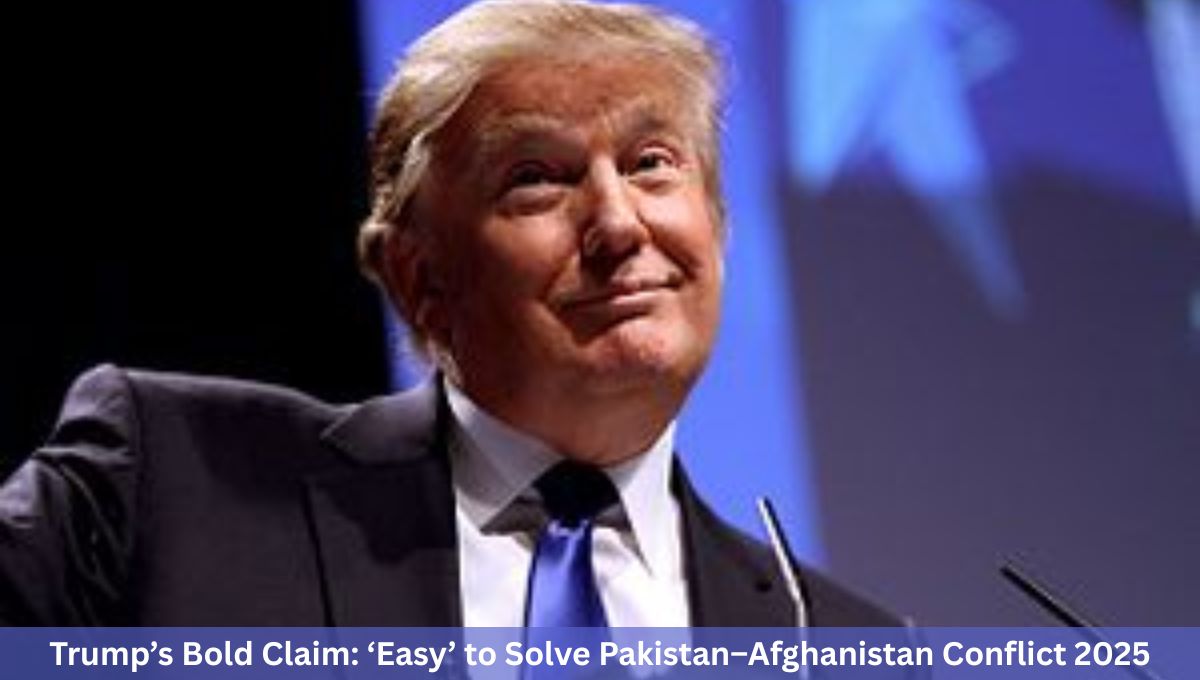
Trump’s Bold Claim: ‘Easy’ to Solve Pakistan–Afghanistan Conflict 2025 amid fresh South Asian tensions. US President Donald Trump on Friday said it would be “easy” for him to resolve the ongoing conflict between Pakistan and Afghanistan, declaring that he has already “solved multiple global wars” during his tenure.
Speaking during a working lunch with Ukrainian President Volodymyr Zelenskyy at the White House, Trump referred to the renewed fighting along the Pakistan–Afghanistan border, saying:
“Although I do understand that Pakistan attacked, or there is an attack going on with Afghanistan. That’s an easy one for me to solve if I have to solve it. In the meantime, I have to run the USA, but I love solving wars. You know why? I like stopping people from being killed, and I’ve saved millions and millions of lives.”
Trump’s comments came as tensions between the two nuclear-armed neighbours flared again, following Pakistani airstrikes in Afghanistan’s Paktika province that killed at least 10 civilians, including local cricketers. Afghan officials described the incident as a “breach of the ceasefire”, warning that “Afghanistan will retaliate.”
The fragile truce, which had been extended for 48 hours, expired at 6 p.m. local time on Friday. Reports later suggested that both sides were preparing for peace talks in Doha, but the airstrikes reignited hostilities before any agreement could take hold.
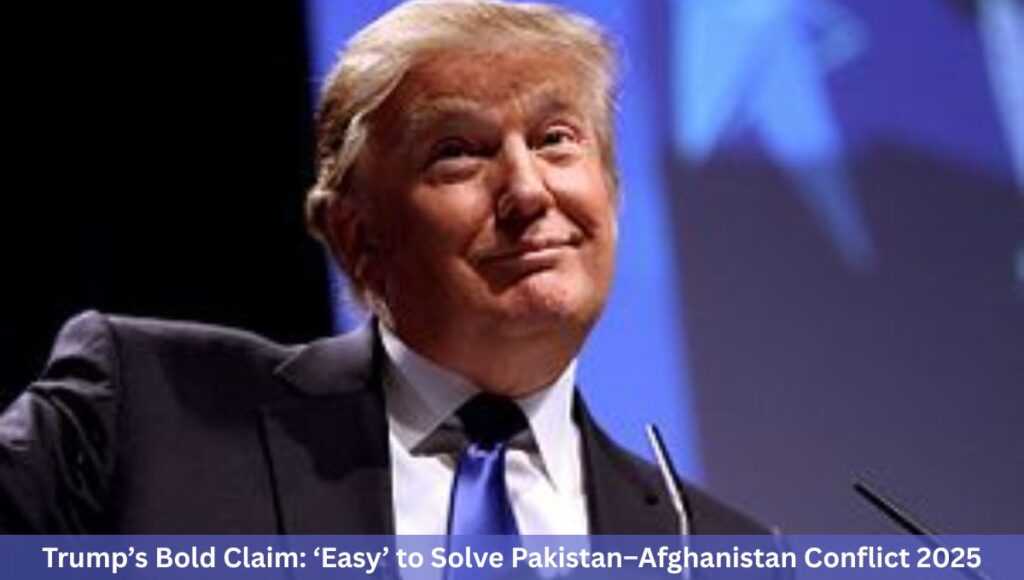
Trump’s Bold Claim: ‘Easy’ to Solve Pakistan–Afghanistan Conflict 2025
‘That’s an Easy One for Me to Solve’: Trump’s Confidence on Display
Trump, who frequently touts his self-proclaimed record as a global peacemaker, positioned the Pakistan–Afghanistan conflict as another problem he could resolve swiftly.
Referring to the deadly clashes, Trump said:
“Although I do understand that Pakistan attacked, or there is an attack going on with Afghanistan. That’s an easy one for me to solve if I have to solve it.”
He framed his foreign policy approach around saving lives rather than pursuing recognition, adding:
“I love solving wars. You know why? I like stopping people from being killed, and I’ve saved millions and millions of lives.”
The president also reiterated his long-standing claim that he has “solved eight wars” worldwide, asserting that his administration’s diplomacy has prevented larger conflicts.
“I have solved eight wars. Go to Rwanda and the Congo, talk about India and Pakistan. Look at all of the wars that we solved, and every time I solved, when they say if you solve the next one, you’re gonna get the Nobel Prize,” Trump said.
Trump Revisits His Nobel Peace Prize Frustration
In a familiar refrain, Trump again lamented that he had never received the Nobel Peace Prize, despite what he described as “historic” conflict resolutions achieved under his leadership.
“I didn’t get a Nobel Prize. Somebody got it who is a very nice woman. I don’t know who she is, but she was very generous. I don’t care about all that stuff. I just care about saving lives,” he told reporters.
The 2025 Nobel Peace Prize went to Venezuelan opposition leader María Corina Machado, who, in her acceptance speech, dedicated part of the award to Trump, acknowledging his support for Venezuela’s democratic movement.
Observers noted that Trump appeared gratified but dismissive of the gesture, using it instead to reiterate his belief that his administration’s peace initiatives were underappreciated by international institutions.
Ceasefire Collapses as Pakistan Launches New Airstrikes
Trump’s comments coincided with breaking developments in South Asia, where Pakistan carried out overnight airstrikes inside Afghanistan’s Paktika province, killing at least ten people, according to AFP.
A senior Taliban official told the agency:
“Pakistan has broken the ceasefire and bombed three locations in Paktika. Afghanistan will retaliate.”
Afghan media outlets reported that three local cricketers from Urgun district were among the dead. The Afghanistan Cricket Board (ACB) described the attack as a “cowardly strike” that had targeted innocent civilians.
The ACB said in a statement:
“The Afghanistan Cricket Board expresses its deepest sorrow and grief over the tragic martyrdom of the brave cricketers from Urgun District in Paktika Province, who were targeted this evening.” “The ACB considers this a great loss for Afghanistan’s sports community and the cricketing family,” it added.
Pakistan’s military, meanwhile, said it had targeted militant hideouts linked to the Tehreek-e-Taliban Pakistan (TTP), or Pakistani Taliban. Officials claimed the operation was a response to a suicide bombing earlier that day in North Waziristan, which killed seven soldiers and injured 13 others.
According to the Associated Press, Islamabad maintains that its operations are “precision strikes” aimed at terrorist sanctuaries, not civilians.
Regional Reaction: Kabul Vows Response, Doha Talks in Doubt
Afghanistan’s Taliban government condemned the airstrikes as a violation of sovereignty and said it would review its participation in the scheduled Doha peace talks.
Taliban spokesperson Zabihullah Mujahid told Ariana News that the Afghan side had been instructed to maintain the truce as long as Pakistan refrained from further attacks.
“If they do, then you have every right to defend your country,” Mujahid told Afghan forces in a televised address.
A high-level Afghan delegation, led by Defence Minister Mullah Muhammad Yaqoob, had been expected in Doha for discussions mediated by Qatar and Saudi Arabia, with Pakistan’s Defence Minister Khawaja Asif also slated to attend.
However, the overnight airstrikes have thrown the talks into uncertainty. Diplomats told Reuters that “mutual trust has collapsed again”, complicating efforts to de-escalate the crisis.
Also Read: Chinese suspect India’s role in Pakistan-Afghanistan conflict
Trump’s Broader Diplomatic Claims: From India–Pakistan to Ukraine
Trump’s Pakistan–Afghanistan remarks came as part of a broader narrative he has cultivated — that of a global deal-maker and peace broker.
He revisited his past claims about helping defuse tensions between India and Pakistan, asserting that his intervention “saved millions of lives” by preventing nuclear escalation.
“The Prime Minister of Pakistan said I saved millions of lives. Look at Pakistan and India as an example. That would have been a bad one — two nuclear nations,” Trump said.
He was referring to the May escalation following India’s Operation Sindoor, during which New Delhi conducted precision strikes on nine terrorist camps in Pakistan and Pakistan-occupied Jammu and Kashmir after the Pahalgam terror attack that killed 26 civilians.
India has repeatedly rejected Trump’s mediation claims, reaffirming that all issues with Pakistan, including those concerning Jammu and Kashmir, must be resolved bilaterally.
Still, Trump pointed to his past involvement as proof of his effectiveness, contrasting his record with that of his predecessors:
“To the best of my knowledge, we’ve never had a president who solved one war. Not one. Bush started a war — a lot of them did. But I saved tens of millions of lives.”
Trump Links South Asia and Ukraine: ‘This Will Be Number Nine’
In the same briefing, Trump pivoted to the Russia–Ukraine war, expressing confidence in his ability to broker peace there as well.
“This will be number nine. We are going to have success with this (Ukraine) war,” he said, adding, “That’s an easy one for me to solve if I have to solve it.”
He revealed that he had recently held an hour-long call with Russian President Vladimir Putin, describing “great progress” in their discussions and announcing plans for an upcoming meeting in Budapest, Hungary.
“President Putin and I will meet in Budapest, Hungary, to see if we can bring this inglorious war to an end,” Trump wrote on Truth Social.
The White House said the Zelensky–Trump meeting was focused on humanitarian aid and reconstruction plans, but Trump’s comments about Pakistan and Afghanistan drew immediate attention for their timing and tone — coming as fighting reignited along the Durand Line.
Conflict Context: Pakistan and Afghanistan Trade Blame
The renewed clashes along the border followed weeks of cross-border attacks, artillery exchanges, and drone strikes.
Earlier this week, the Taliban claimed to have captured 25 Pakistani army posts, killing 58 soldiers and wounding 30 others — a claim Islamabad denied. Pakistan’s military said it had lost 23 personnel but killed more than 200 “Taliban and affiliated terrorists.”
At the heart of the dispute are security and sovereignty concerns. Pakistan accuses the Taliban government of harbouring TTP militants who stage attacks inside Pakistani territory, while Kabul accuses Islamabad of violating Afghan sovereignty and carrying out air raids under the pretext of counter-terrorism.
Friday’s airstrikes — the deadliest since the Taliban’s return to power in 2021 — have pushed the neighbours to the brink of open war, analysts warn.
US Stance and Global Response
The US State Department declined to comment directly on Trump’s remarks but reiterated Washington’s support for “regional stability and diplomatic dialogue.”
A spokesperson told reporters, “We continue to urge both Pakistan and Afghanistan to exercise restraint and engage in constructive dialogue to resolve border disputes peacefully.”
The United Nations Assistance Mission in Afghanistan (UNAMA) also issued a statement condemning civilian casualties and calling for an immediate cessation of hostilities.
Neighbouring China and Iran, both of which maintain close ties to Kabul and Islamabad, have expressed concern that continued clashes could destabilise regional trade corridors and derail cross-border infrastructure projects.
Analysis: Trump’s Rhetoric vs. Regional Reality
Analysts say Trump’s claim that the Pakistan–Afghanistan conflict is “easy to solve” overlooks deep-rooted historical and ideological tensions that have defied resolution for decades.
“Both sides are driven by internal politics and nationalist narratives,” said Islamabad-based analyst Huma Yusuf. “For Washington, the situation is a reminder of how limited external influence remains in this part of the world.”
Others noted that Trump’s self-promotion fits his long-standing communication style — projecting confidence while simplifying complex global crises.
“Trump often speaks in absolutes — every problem is ‘easy’ or ‘tremendous’ — but the Pakistan–Afghanistan dynamic is one of the most intractable in the world,” said foreign policy expert Michael Kugelman of the Wilson Center.
Still, Trump’s comments may resonate with his domestic base, where his image as a decisive, no-nonsense leader remains central to his political identity.
Conclusion: Boast or Blueprint?
Donald Trump’s declaration that resolving the Pakistan–Afghanistan conflict would be “easy” underscores his continued reliance on bold, self-assured rhetoric in discussing foreign policy. Whether viewed as political bravado or genuine confidence, his remarks have once again drawn attention to a region facing renewed violence and humanitarian suffering.
For now, Pakistan and Afghanistan remain locked in a dangerous cycle of retaliation, their ceasefire shattered and diplomatic efforts in limbo. Trump’s words, echoing across global headlines, add another layer of drama — and perhaps distraction — to one of South Asia’s most volatile flashpoints.
As the bombs fall in Paktika and diplomats scramble in Doha, the former real-estate mogul turned president seems certain of one thing: “That’s an easy one for me to solve if I have to solve it.”
Also Read: 5 Key Signs the U.S.–Brokered Gaza Peace Deal Faces Strain