

5 Key Signs the U.S.–Brokered Gaza Peace Deal Faces Strain as Washington urges patience. The U.S.–brokered Gaza peace deal, hailed by President Donald Trump as a “historic turning point” in the Middle East, is showing early signs of strain. Days after its announcement, U.S. officials remain publicly optimistic, while Israeli leaders grow increasingly impatient over what they describe as Hamas’ slow compliance with key terms — particularly the handover of deceased hostages’ remains.
Two senior U.S. advisers told reporters that the White House remains committed to the process despite “hiccups in implementation,” emphasizing that both Israel and Hamas appear to be following through on their commitments.
But their remarks came just hours after Israeli officials warned that the military could resume operations in Gaza if progress stalls. “This is a very delicate situation after two years of war, and a lot could still occur,” one U.S. adviser said. “Right now, the intention is to keep working with both parties, getting them to show restraint, and creating the right conditions for a demilitarization of Gaza to occur.”
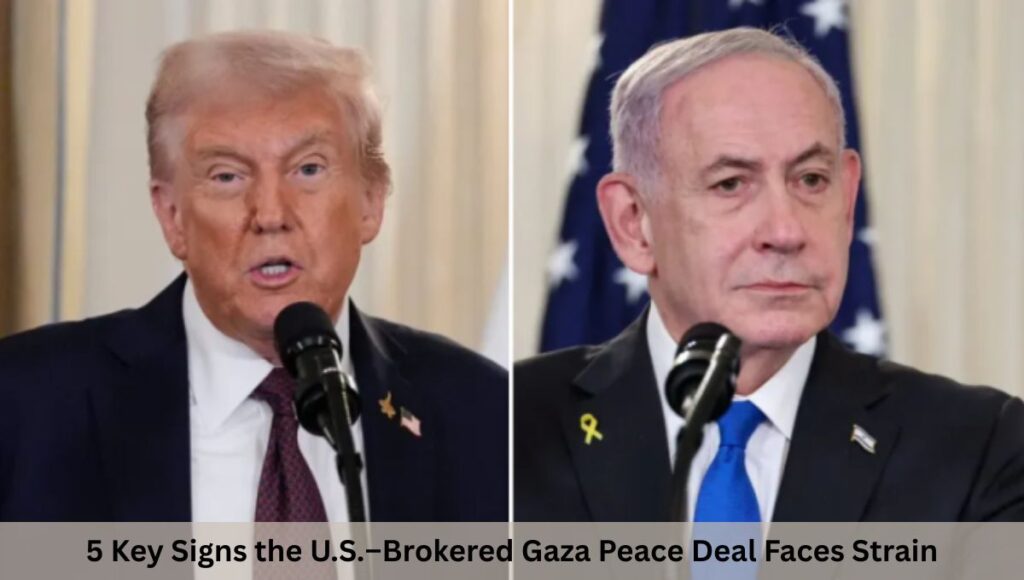
5 Key Signs the U.S.–Brokered Gaza Peace Deal Faces Strain
Washington Urges Patience Amid Rising Israeli Pressure
The Biden administration — still managing fallout from two years of regional instability — is eager to portray the agreement as a functional, phased roadmap toward calm. Officials insist that both sides are adhering to the first stage of Trump’s 20-point peace plan, which includes humanitarian measures and the retrieval of deceased hostages.
However, Israeli leaders argue that Hamas’ slow handover of bodies amounts to a breach of the ceasefire terms. In response, U.S. officials have pushed back against this characterization, urging Israel to maintain restraint. “The understanding we had with them was to get all the live hostages out, which they did honor,” the U.S. adviser explained. “Now, we have a mechanism in place with mediators to get as many bodies out as possible.”
The comments reflect growing divergence between Washington’s emphasis on gradual diplomacy and Israel’s urgency for closure. Prime Minister Benjamin Netanyahu’s government faces pressure from domestic groups, including the Hostages and Missing Families Forum, which has called for halting all steps toward the ceasefire until all remains are returned.
Violence Inside Gaza Complicates Implementation
The deal’s first phase has been further complicated by reports of internal violence in Gaza. Hamas fighters have allegedly executed Palestinian rivals accused of collaborating with Israel, prompting alarm in Washington. The U.S. Central Command (CENTCOM) issued a rare public statement urging Hamas to “immediately suspend violence against innocent civilians.”
Adm. Brad Cooper, head of CENTCOM, described the peace deal as “a historic opportunity” that must not be squandered. “Hamas should seize it fully by standing down, strictly adhering to President Trump’s 20-point peace plan, and disarming without delay,” Cooper said.
A U.S. official added that mediators are working to “send a message” urging Hamas to stop the violence. “We’re working with Israel to create some space in the safe zone behind the yellow line for people who feel threatened,” the official noted.
Also Read: Trump’s Gaza Deal Faces First Test: Can He Keep Netanyahu Onboard?
U.S. and Israel Discuss ‘Safe Zone’ for Gazans
As reports of Hamas executions mount, the U.S. and Israel have begun discussing the creation of a “safe zone” inside Gaza. The area, positioned behind Israel Defense Forces’ withdrawal line, would provide refuge to civilians fearing retribution from Hamas.
“This is really in response to reports of Hamas executing rivals,” one U.S. official said. “Israel is very committed to creating safety for the people of Gaza who want to live in peace.” The idea, officials say, was met “with enthusiasm” in Jerusalem.
The proposed zone would mark a significant step in redefining Israel’s post-war security architecture, providing safe passage and humanitarian relief while preserving the broader ceasefire. However, the logistics — including control, access, and international monitoring — remain unresolved.
Egypt and Qatar Press for Progress as Phase Two Stalls
Regional mediators, including Egypt and Qatar, are working intensively to salvage momentum. An Egyptian diplomatic source told Asharq Al-Awsat that “talks for the second phase have not practically begun,” citing on-the-ground difficulties and “Israel’s clear exploitation of loopholes.”
“There is a need to deploy international forces to avert future complications,” the source said, noting that Egypt is pressing for a multinational security presence in Gaza. “Theoretically, we are in the second phase, as President Trump says, but practically it hasn’t started.”
Qatari Foreign Ministry spokesperson Majed Al-Ansari echoed similar concerns, confirming that “difficult discussions have begun on how to secure and manage the situation.” Negotiations are underway in Sharm El-Sheikh to prevent a lapse between phases.
Trump’s Firm Tone and Israel’s Reluctance
During a White House meeting with Argentine President Javier Milei, Trump reaffirmed his commitment to enforcing compliance. “If they don’t disarm, we will disarm them — quickly and perhaps violently,” he warned, underscoring the administration’s readiness to act if Hamas resists demilitarization.
Israeli officials, however, remain skeptical about Hamas’ intentions. Interior Security Minister Itamar Ben-Gvir and Shas party leader Aryeh Deri have both called for halting aid and freezing the ceasefire process until all bodies are returned. “We must not allow Hamas to drag this out,” Deri said, urging the government to “immediately halt all parts of the agreement until Hamas returns the bodies.”
Meanwhile, some Israeli commentators suggest Netanyahu’s government may be leveraging the issue to maintain political leverage and manage domestic backlash from bereaved families.
Humanitarian Issues: Rafah Crossing and Aid Flows
The reopening of the Rafah crossing has become another flashpoint. Following the return of four hostages’ remains, Israel decided to reopen the crossing with Egypt and allow humanitarian aid to enter Gaza, scrapping earlier plans to reduce aid convoys.
According to Reuters, the crossing is expected to reopen Thursday. The move followed intense mediation and was seen as a concession to U.S. and Egyptian pressure. Nevertheless, the volume of aid and restrictions on goods remain contentious issues, as both Israel and Hamas accuse each other of violating terms.
“The issue isn’t just disarmament — it’s also Israel’s plan to demolish tunnels,” said an Egyptian source. “These are complex issues that can’t be resolved quickly. The situation is opaque, and no one knows what tomorrow will bring for Gaza.”
Search Efforts for Hostages’ Remains Intensify
Under the ceasefire agreement, Hamas is required to hand over 28 bodies of Israeli hostages. So far, 12 have been returned. Hamas claims it is struggling to locate the remaining remains “beneath the rubble” after two years of conflict. To assist, Turkey has dispatched a team of 81 search and recovery experts, marking Ankara’s re-entry into Gaza diplomacy.
A source familiar with the talks said Qatar and Turkey are pressuring Hamas to expedite the process. “Israel understood from the outset that this would take time,” the source said, adding that Washington has conveyed to mediators that it opposes any delays.
Despite occasional misidentifications — including one instance where a Palestinian collaborator’s body was mistaken for a hostage — both sides have so far avoided labeling such incidents as breaches of the deal.
Phase Two: The Hard Road to Demilitarization
The next stage of the Gaza peace plan, focused on Hamas’ disarmament and the transition to a new security framework, is considered the most challenging. “Getting that done is a very hard feat,” a U.S. adviser said. “It’s not realistic to think everyone will just drop their arms and walk away.”
Analysts note that many within Hamas fear retribution or loss of influence, making full disarmament unlikely without international security guarantees. Egypt’s proposal to deploy peacekeepers under UN authorization has yet to gain Israeli approval.
Palestinian researcher Kamal Al-Zughoul said Trump remains “determined to complete the stages of the agreement,” but warned that “if Hamas fails to locate the remaining bodies, things will get complicated, and new talks will be needed.”
Also Read: Trump’s 2025 Middle East Peace Trip: Inside Mission ‘War Is Over’
Regional Implications and Diplomatic Stakes
The Gaza deal, while fragile, is being closely watched across the Middle East. For Egypt, it represents a test of its role as mediator and stabilizer. For Qatar and Turkey, it’s an opportunity to reaffirm their influence. And for the United States, it’s a high-stakes effort to prove that diplomacy can succeed where war failed.
“Developments must be monitored minute by minute,” an Egyptian source said. “Unlike the first phase, completed within hours, the next stages will take longer.”
Washington’s strategy now hinges on sustaining momentum without appearing to concede to either side. “We’re not leaving until everybody comes home,” one U.S. adviser said. “That’s our commitment — and that’s what this peace needs to hold.”
Conclusion: Hope and Uncertainty in Equal Measure
As the first fragile ceasefire holds, the gap between U.S. optimism and Israeli skepticism underscores the challenges ahead. With Hamas struggling to locate remains, Israel threatening to resume hostilities, and Egypt urging an international force, the Gaza peace deal remains at a crossroads.
For now, both sides are abiding by the truce — but the coming weeks will determine whether the U.S.-brokered plan evolves into a lasting peace or collapses under mutual distrust.
Related Posts:
- 5 Key Developments as Israel Confirms Hamas Handed…

- Israel–Hamas Ceasefire Under Strain: 4 More Hostage…

- Trump’s Breakthrough Gaza Ceasefire Deal 2025: Key Insights

- Trump’s Historic Gaza Ceasefire Deal 2025: A…

- Gaza Peace Deal First Phase Achieved: Trump’s Israel…

- Dramatic Moments Behind Trump’s Gaza Peace Push and…
