10 Million March: ‘No Kings’ Protests Sweep Across U.S., denouncing Trump’s policies. Millions of Americans flooded the streets on Saturday, October 18, for the massive “No Kings” protests, denouncing what they called President Donald Trump’s growing authoritarian tendencies and concentration of executive power.
From New York’s Times Square to Los Angeles, Washington D.C., Chicago, and Miami, crowds gathered in record numbers, waving signs that read “Democracy, Not Monarchy” and “The Constitution Is Not Optional.” Organizers said nearly seven million people joined peaceful demonstrations across all 50 states, making it one of the largest protest days in modern U.S. history.
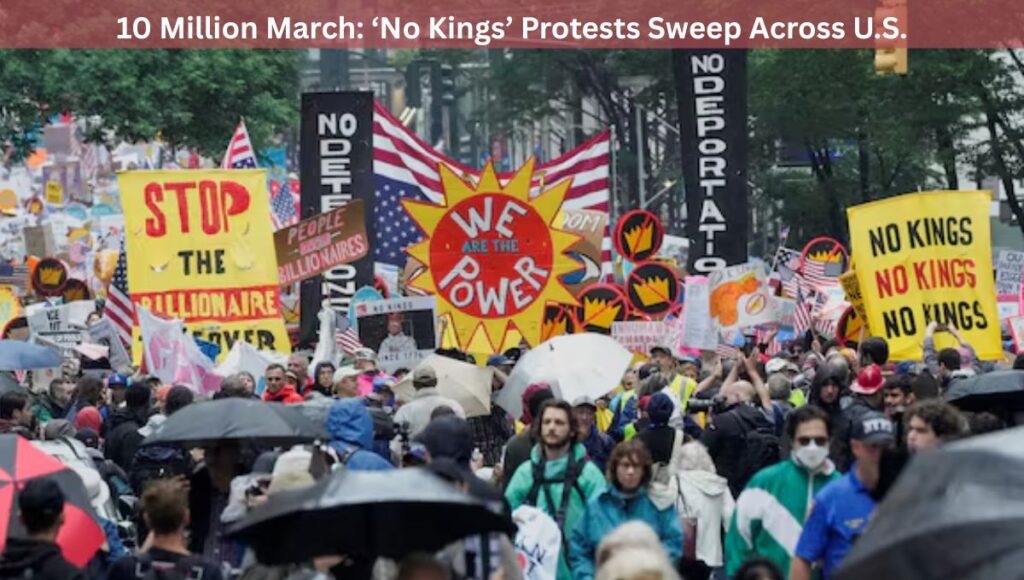
10 Million March: ‘No Kings’ Protests Sweep Across U.S.
A Nation Mobilized: Protests Sweep Across 2,700 U.S. Cities
According to organizers, more than 2,700 rallies were held across the country under the No Kings banner — a coalition of progressive and civic organizations formed earlier this year to oppose what they describe as “monarch-like behavior” from the Trump administration.
In New York City, thousands filled Times Square and surrounding streets. Chants of “This is what democracy looks like!” echoed through midtown Manhattan as drums beat in rhythm with the movement.
The New York Police Department reported over 100,000 participants across the five boroughs and confirmed that no protest-related arrests were made. In Chicago’s Grant Park, Boston Common, and Miami’s Torch of Friendship, similar scenes unfolded as people gathered peacefully with flags, banners, and musical performances.
In Los Angeles, demonstrators filled Grand Park, where speakers called for the restoration of democratic checks and balances. “We refuse to be silenced by fear,” said Lisa Gilbert, co-president of Public Citizen and one of the movement’s national organizers.
‘We Love America, Not Hate It’: Protesters Speak Out
Participants described a mixture of fear, frustration, and determination. Beth Zasloff, a writer from New York, said she joined because she sees “a move toward fascism and an authoritarian government.”
“It gives me hope to be out here with so many people who still care about democracy,” she said.
Massimo Mascoli, a 68-year-old retired engineer from New Jersey, said he recognized echoes of Italy’s 20th-century fascism in the Trump era. “We cannot count on the Supreme Court, the Congress, or even the government right now,” he said. “We’re fighting for the soul of this country.”
In Washington, D.C., crowds filled the National Mall, where Senator Bernie Sanders delivered a rousing address. “We’re not here because we hate America,” Sanders said. “We’re here because we love America — and because we refuse to live under a president who believes he is above the law.”
Democratic Leaders Join the Movement
Prominent Democrats including Senate Minority Leader Chuck Schumer, Senators Bernie Sanders, Cory Booker, Chris Murphy, and Adam Schiff joined the rallies or shared solidarity messages online.
“We have no dictators in America. And we won’t allow Trump to erode our democracy,” Schumer wrote on X (formerly Twitter), sharing photos from the New York march.
Schiff thanked participants nationwide: “This is what democracy looks like. Thank you, America, for speaking out.”
Murphy posted a video of the turnout in Connecticut, describing it as “breathtaking” and predicting that the day “will go down as the biggest peaceful protest in our nation’s 250-year history.”
Trump Responds: ‘I’m Not a King’
President Donald Trump, in a preview clip of a Fox News interview set to air Sunday, addressed the demonstrations directly.
“A king! This is not an act,” Trump said. “They’re referring to me as a king. I’m not a king.”
Since returning to the White House in January, Trump has expanded the scope of presidential authority through executive orders dismantling parts of the federal government, deploying the National Guard to cities despite state opposition, and urging prosecutors to pursue his political adversaries.
Critics warn that these moves are unconstitutional and represent a threat to American democracy. Trump, however, insists his actions are necessary “to rebuild a country in crisis,” dismissing accusations of fascism as “hysterical.”
Massive but Peaceful: A ‘Love America Rally’
Despite Republican leaders branding the events as “anti-American,” Saturday’s protests remained overwhelmingly peaceful.
According to Dana Fisher, a sociologist at American University who studies activism, Saturday could mark the largest protest turnout in U.S. history.
“The main goal of this day of action is to build collective identity among people who feel persecuted or anxious due to Trump’s policies,” Fisher said. “It’s not going to change the president’s mind overnight, but it can embolden elected officials at all levels.”
Across cities, marching bands, street performers, and community groups transformed the rallies into vibrant, democratic celebrations. In Portland, Oregon, protesters carried a massive banner with the U.S. Constitution’s preamble, while others wore inflatable frog costumes, a symbol of resistance popularized in previous protests.
Republican Pushback: ‘Hate America Rally’
The White House and Republican lawmakers denounced the demonstrations, calling them politically motivated.
House Speaker Mike Johnson labeled the movement “the Hate America rally,” accusing participants of being “Antifa types” and “Marxists in full display.”
Texas Governor Greg Abbott and Virginia Governor Glenn Youngkin activated their state National Guards in anticipation of unrest, though troops were largely kept off the streets.
Democratic state officials criticized the move. Texas Democrat Gene Wu argued, “Sending armed soldiers to suppress peaceful protests is what kings and dictators do — and Greg Abbott just proved he’s one of them.”
The Global Ripple: Protests Spread Beyond U.S. Borders
The No Kings message resonated worldwide. Demonstrations were held outside the U.S. embassies in London, Berlin, Madrid, and Rome, with protesters expressing solidarity with Americans.
In London, hundreds gathered outside the U.S. Embassy, chanting, “No Kings, No Dictators.” Similar rallies took place in Toronto, where signs read “Hands off Canada,” a jab at Trump’s trade and climate policies.
Inside the Movement: What the ‘No Kings’ Coalition Stands For
The No Kings coalition describes itself as a grassroots alliance of progressive organizations, civil rights groups, and community leaders united by a common goal: defending democracy.
According to the movement’s website, their mission is “to ensure that no one — not even the president — is above the law.” The group lists several key issues motivating the protests:
- Trump’s immigration raids and border enforcement
- Cuts to public education and healthcare programs
- Environmental rollbacks
- Attacks on free speech and press freedom
- Use of executive orders to bypass Congress
“In June, we did what many claimed was impossible,” the organization stated. “We peacefully mobilized millions of people to declare with one voice: America has no kings.”
From June to October: A Movement Gains Momentum
Saturday’s demonstrations followed a first wave of rallies in June, which coincided with Trump’s 79th birthday and the U.S. Army’s 250th anniversary. Critics accused the president of turning those celebrations into a self-congratulatory spectacle rather than a military commemoration.
Organizers claim more than five million people joined the June marches. Since then, the movement has expanded its network across universities, unions, and online platforms.
“Now, President Trump has doubled down,” read a statement from the coalition, citing concerns about ICE detentions, gerrymandering, and suppression of dissent.
A Divided Nation: Public Opinion on Trump
The protests come amid a deeply polarized American political landscape.
A Reuters/Ipsos poll conducted this week found that 40% of Americans approve of Trump’s performance, while 58% disapprove — roughly matching his average rating during his first term. His approval stood at 47% in January, when he began his second term.
Historically, presidents tend to lose support as their terms progress. Joe Biden, for instance, began 2021 with a 55% approval rating, which dropped to 46% by October that year.
Trump’s supporters say his policies are reasserting American strength, while opponents argue he is undermining democratic norms and weaponizing federal power.
Inside the Capital: ‘We Won’t Be Silenced’
In Washington D.C., thousands rallied at the National Mall and near the Capitol Reflecting Pool, waving signs that read “Democracy Defends Itself” and “No One Is Above the Law.”
“We won’t be silenced,” shouted a group of young protesters from Maryland. One sign, simply reading “I Am Antifa,” drew both cheers and criticism.
Chuck Epes, 76, who carried that sign, explained: “It just means I support peace, a liveable wage, healthcare, and equality for all. That’s not radical — that’s American.”
Organizers Emphasize Nonviolence
Despite attempts by some political figures to paint the protests as disruptive, organizers said the movement was strictly peaceful.
The American Civil Liberties Union (ACLU) trained tens of thousands of volunteer marshals in de-escalation and legal observation techniques.
“There is no greater threat to authoritarianism than patriotic people-power,” said Ezra Levin, co-founder of Indivisible, one of the key organizing partners.
“Trump thrives on fear and division. What we saw today was courage and unity.”
A Turning Point for American Activism
Analysts say the No Kings movement represents a resurgence of civic engagement not seen since the 2020 racial justice protests.
“This is about preserving democracy itself,” said Dr. Karen Beckett, a political historian at Columbia University. “The slogans may be new, but the sentiment is timeless — citizens reminding their government that power belongs to the people.”
From students and teachers to retirees and veterans, protesters spanned generations and backgrounds. Many carried pocket-sized copies of the U.S. Constitution as symbolic shields.
Trump’s Absence and Political Implications
President Trump spent the day at his Mar-a-Lago estate in Florida, where he reportedly met advisers ahead of next week’s policy announcements. His absence from Washington, D.C. — where the largest rally unfolded — drew criticism from opponents.
Political analysts suggest the protests could reinvigorate Democratic momentum ahead of the 2026 midterm elections, while also testing Trump’s political resilience amid ongoing legal challenges and public backlash.
‘Democracy Is Not Optional’: The Message Echoes
As night fell, lights illuminated handwritten banners in cities across the country — “Democracy Is Not Optional,” “No Kings,” and “We The People.”
Despite the political divide, Saturday’s events demonstrated a peaceful yet powerful act of collective resistance, uniting millions under a shared belief in constitutional limits and citizen rights. “The real takeaway,” said Fisher, “isn’t about Trump. It’s about Americans rediscovering the strength of democracy — and their willingness to defend it.”
Also Read: “No Kings” Protests Rock Nation as Trump Celebrates Military Parade and Birthday
Also Read: ‘Block Everything’ protests sweep across France, scores arrested
Related Posts:
- 10 Explosive Facts About ‘No Kings’ Protests as…
- Trump Threatens ‘War’ on Chicago: National Guard…
- Trump Deploys 300 National Guard Troops to Chicago…
- Trump Vows to “Liberate” Los Angeles Amid Troop…
- “No Kings” Protests Rock Nation as Trump Celebrates…
- Pentagon Withdraws 2,000 National Guard Troops From…