As the protests decline Pentagon Withdraws 2,000 National Guard Troops From Los Angeles Amid Ongoing Immigration Raids. The U.S. Department of Defense has announced the immediate withdrawal of 2,000 National Guard troops from Los Angeles. These troops were deployed in early June amid protests against the Trump administration’s aggressive immigration raids.
The move comes after weeks of legal battles, rising public criticism, and mounting political pressure from California officials, including Governor Gavin Newsom and Los Angeles Mayor Karen Bass. The decision marks a major shift in the federal government’s controversial deployment of military forces in domestic immigration enforcement a strategy that has faced pushback from civil rights groups, state leaders, and city officials.
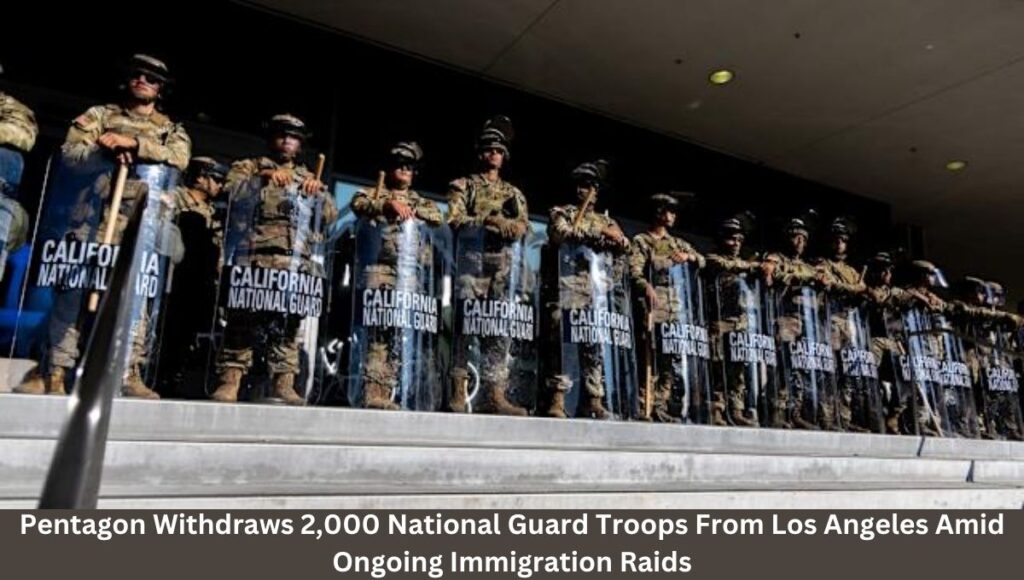
Pentagon Withdraws 2,000 National Guard Troops From Los Angeles Amid Ongoing Immigration Raids
Background: Why Were the Troops Deployed?
In early June, President Donald Trump authorized the deployment of approximately 4,000 California National Guard soldiers and 700 active-duty Marines to Los Angeles.
The troops were ordered to protect federal property and support immigration agents during large-scale enforcement operations by the Department of Homeland Security (DHS) and Immigration and Customs Enforcement (ICE).
This federal move came despite fierce opposition from California Governor Gavin Newsom, who filed a lawsuit challenging the legality of deploying the National Guard without state consent.
A U.S. District Court initially ruled that the president’s actions were unconstitutional. However, the Ninth Circuit Court of Appeals temporarily reversed that ruling, allowing the Trump administration to retain control of the National Guard while the case proceeds.
Federal Justification and Pentagon Statement
On Tuesday, Pentagon spokesman Sean Parnell confirmed that 2,000 National Guard troops would be “released from the federal protection mission,” stating that “lawlessness in Los Angeles is subsiding.”
Parnell commended the troops for “answering the call” and claimed their efforts had helped de-escalate protests and stabilize conditions around federal buildings.
However, the withdrawal does not apply to all deployed forces. Roughly 2,000 National Guard troops and 700 Marines will remain in Los Angeles, continuing to support DHS and ICE in executing immigration raids throughout Southern California.
Gavin Newsom Slams Deployment as ‘Political Theater’
Governor Newsom issued a sharply worded statement following the partial troop withdrawal. “For more than a month, the National Guard has been pulled away from their families, communities, and civilian work to serve as political pawns for the president in Los Angeles,” he said.
Newsom further criticized the lack of clear objectives for the remaining deployed troops: “They continue without a mission, without direction, and without any hopes of returning to help their communities.”
He urged the Department of Defense and President Trump to “end this theatre and send everyone home now.”
Los Angeles Mayor Karen Bass Calls Troop Exit a ‘Retreat’
Los Angeles Mayor Karen Bass echoed similar sentiments, calling the withdrawal of 2,000 troops a “retreat” that was made possible by the unity and resilience of Angelenos.
“This happened because the people of Los Angeles stood united and stood strong,” Bass said during a press briefing.
“Our soldiers are trained to fight and kill foreign enemies in foreign lands. There was never a need for them here before. And there isn’t a need for them now.”
She praised legal action against the Trump administration and peaceful protests as key drivers behind the withdrawal.
Bass also confirmed that she had directed city employees to only allow federal agents into city buildings with valid arrest warrants, as part of a broader effort to protect immigrant communities.
Legal Battle Over Deployment Continues
The legal case against the deployment remains unresolved. The initial district court ruling deemed Trump’s unilateral deployment of the National Guard unlawful.
However, the appeals court lifted that ruling temporarily, citing national security concerns.
Civil rights groups like the ACLU of Southern California have also filed lawsuits challenging the constitutionality of arrests made during the immigration raids.
One federal judge recently ruled that DHS had conducted stops and detentions in Los Angeles without probable cause, and ordered a halt to targeting individuals based solely on race, language, or occupation.
Immigration Raids Continue in Southern California
Even with the partial military withdrawal, federal immigration enforcement continues in full force. According to DHS figures, over 2,792 undocumented immigrants have been arrested in Los Angeles since the deployment began.
Notably, a series of raids at legal marijuana farms last week resulted in the arrest of over 300 individuals and the death of one person. Several others were injured during the chaotic operation.
The use of military forces to support immigration enforcement without invoking the 1807 Insurrection Act has raised serious concerns about the militarization of immigration policy.
Civil liberties advocates argue that the military’s involvement in domestic law enforcement sets a dangerous precedent.
National Guard and Firefighting Readiness
Governor Newsom’s office warned that California’s wildfire preparedness has suffered due to the ongoing troop deployment.
In a statement, the governor revealed that National Guard firefighting crews are operating at just 40% capacity, even as wildfires begin to emerge across the state during the hot summer months.
“This deployment isn’t just unnecessary it’s irresponsible,” Newsom said. “Our communities need these troops back to prepare for and respond to wildfires.”
Historical Context and Political Fallout
This marks the first time since 1965 that a U.S. president has deployed National Guard troops to a state against the will of the sitting governor.
The federalization of state military forces particularly in sanctuary cities like Los Angeles underscores the intensifying battle between red and blue states over immigration policy.
Los Angeles, once part of the Mexican Empire, has long been home to large populations of Central and South American immigrants.
As a sanctuary city, L.A. has enacted local policies aimed at shielding undocumented residents from federal deportation efforts.
President Trump, however, has pledged to deport millions of undocumented immigrants, ramping up raids at workplaces, farms, and urban communities previously considered low-risk.
Public Opinion on Immigration is Shifting
Interestingly, a recent national poll suggests that public support for immigration has grown, while backing for mass deportations has decreased.
The poll indicates that many Americans favor pathways to citizenship and legal protections for long-term undocumented residents, rather than harsh enforcement tactics.
Despite this, Trump has doubled down on immigration as a centerpiece of his 2025 agenda relying increasingly on military force and executive power to bypass state resistance.
What’s Next?
The withdrawal of 2,000 troops may signal a shift in strategy or simply a temporary pause. With legal battles still unfolding and ICE operations ongoing, the broader implications of this deployment remain unclear.
California leaders are continuing to demand a complete troop withdrawal, the return of the National Guard to their civilian responsibilities, and a halt to what they describe as the federal government’s abuse of power.
As the 2025 political landscape heats up, the clash between state sovereignty and federal authority over immigration enforcement will likely remain at the center of America’s legal and political battles.
Also Read: Trump Vows to “Liberate” Los Angeles Amid Troop Deployment and Protests
Also Read: Pentagon orders withdrawal of 2,000 National Guard troops from Los Angeles. Here’s why
Related Posts:
- California Governor Gavin Newsom Mocks Donald Trump…

- Federal Troops Deployed to Los Angeles Amid ICE…
- Marines Deployed to LA as Immigration Protests…
- ICE Raids Ignite Protests, National Guard Deployed…
- Military Deployment in LA Sparks Outrage, Legal…
- Massive Fire Erupts at Chevron Refinery Near Los Angeles