In a sharp escalation of geopolitical pressure, NATO Chief Warns BRICS of 100% Tariffs Over Russian Trade. NATO Secretary General Mark Rutte has warned India, China, and Brazil that they could face 100% secondary sanctions if they continue to trade with Russia. His remarks follow US President Donald Trump’s announcement of a 50-day ultimatum for Moscow to agree to a peace deal with Ukraine.
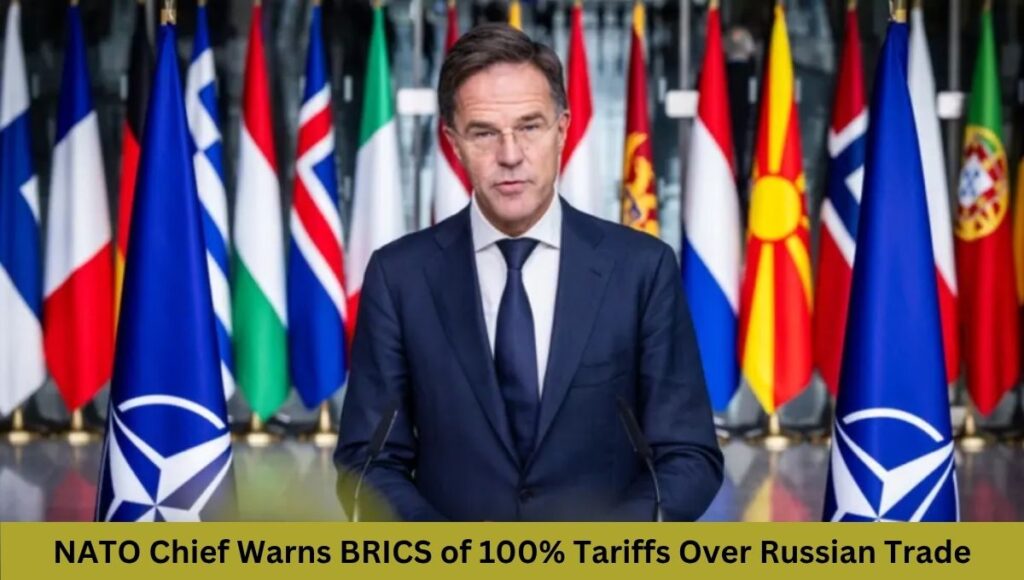
NATO Chief Warns BRICS of 100% Tariffs Over Russian Trade
Rutte’s Blunt Warning: “This Might Hit You Very Hard”
Speaking after his meeting with US senators, Rutte made a rare direct appeal to the leaders of three major BRICS nations.
“If you are the Prime Minister of India, the President of China, or the President of Brazil, and you continue to trade with Russia and buy their oil and gas, then you know: if the man in Moscow doesn’t take the peace negotiations seriously, I will impose secondary sanctions at 100%.”
He urged the countries to call on Russian President Vladimir Putin to get serious about peace negotiations. Rutte stressed that failure to act could result in massive economic backlash.
“Make the phone call to Vladimir Putin… because otherwise this will slam back on Brazil, on India, and on China in a massive way,” he warned.
Trump’s 50-Day Deadline for Peace Deal
Rutte’s remarks were aligned with President Donald Trump’s new Ukraine policy. On Monday, Trump gave Putin 50 days to negotiate a ceasefire with Ukraine. Failing that, the US would impose sweeping tariffs and secondary sanctions.
“If we don’t have a deal at the end of 50 days, it’s going to be too bad. The tariffs are going to go on and other sanctions go on,” Trump said.
Trump specified that these would include 100% tariffs on countries continuing to buy Russian exports. Notably, he said this action could be taken without Congressional approval.
Coordinated NATO-US Strategy on Ukraine
Rutte’s visit to Washington confirmed a united front between NATO and the US. Trump announced a new weapons package for Ukraine that includes Patriot missiles and other advanced arms.
“We will now massively supply Ukraine with weapons, not just air defense, also missiles and ammunition,” Rutte said. He noted that the package would be paid for primarily by European allies.
India, China, Brazil in the Crosshairs
India, China, and Brazil have maintained trade ties with Moscow throughout the war, particularly in energy and defense.
- India has significantly increased its imports of Russian crude oil, benefiting from discounted rates.
- China remains one of Russia’s top energy clients, deepening bilateral ties since 2022.
- Brazil continues to engage in trade with Russia in agricultural and defense sectors.
These nations now face the threat of being cut off from US markets and banking systems if secondary sanctions are applied.
India’s Delicate Balancing Act
India’s stance on the Russia-Ukraine conflict has been one of strategic neutrality. Prime Minister Narendra Modi has called for dialogue but has not condemned Russia directly.
India has abstained from several UN resolutions and declined to join Western-led sanctions.
Reasons behind India’s position:
- Over 60% of Indian defense hardware is Russian-made
- Discounted Russian oil supports India’s energy security
- New Delhi values strategic autonomy in global affairs
With this warning, however, India may be forced to reassess its foreign policy calculus.
U.S. Senate Pushes Sanctions Legislation
Back in Washington, a bipartisan bill spearheaded by Senators Lindsey Graham and Richard Blumenthal is gaining traction.
It would empower Trump to impose tariffs of up to 500% on countries aiding Russia’s war economy.
“We’ll continue to push for our Russia Sanctions bill with even tougher penalties to deter India, China, Brazil, and others from fueling Putin’s war machine,” Blumenthal wrote on X (formerly Twitter).
An overwhelming 85 out of 100 US senators support the bill, signaling likely passage.
Secondary Sanctions: How They Work
Secondary sanctions differ from direct ones. Rather than targeting Russia itself, they punish third-party countries and businesses trading with sanctioned entities. If imposed, these sanctions could:
- Block companies from accessing US financial markets
- Freeze international assets
- Sever participation in the SWIFT banking network
- Disrupt energy and trade flows
This could pose massive financial and diplomatic challenges for the BRICS nations.
Russia Rejects Ultimatums
Russian Deputy Foreign Minister Sergei Ryabkov has dismissed Trump’s threats.
“Russia is ready to negotiate with US President Donald Trump, but the ultimatums are unacceptable and will not bring any results,” Ryabkov said.
This signals that Moscow may dig in rather than give in, complicating Western diplomatic efforts.
Brazil and China Also Under Scrutiny
While India is at the center of attention, Brazil and China are also feeling the heat. Brazilian President Lula da Silva has consistently pushed for peace without taking sides.
China, meanwhile, continues strategic cooperation with Russia despite international criticism.
“If you live in Beijing or in Delhi or you’re the president of Brazil, you might want to take a look into this,” Rutte repeated. “Because this might hit you very hard.”
Trump Says No to Attacks on Moscow
In a separate development, Trump clarified that Ukraine should not use US-provided weapons to strike Moscow.
“No, he shouldn’t target Moscow,” Trump said, rejecting a report that he had encouraged deep strikes into Russian territory.
Instead, the US plans to support Ukraine’s defense and limited offensives without escalating the war into Russia’s heartland.
NATO and Pentagon Finalizing Ukraine Support
The Pentagon and NATO are currently working with Ukrainian forces to determine the exact nature of weapons and supplies to be sent. “It is both defensive and offensive,” Rutte confirmed.
“All kinds of weapons are on the table. The specifics are now with the Pentagon and the Supreme Allied Commander in Europe.”
Global Economic Consequences
If enacted, 100% secondary sanctions could:
- Spike global oil prices
- Trigger inflation in emerging markets
- Sever US ties with key BRICS economies
- Accelerate the formation of non-Western trade blocs
India, China, and Brazil would then be forced to decide between profitable energy deals with Russia and continued access to US-led financial systems.
Trump Targets BRICS Over ‘Anti-American Policies’
Trump’s threat of additional 10% tariffs on BRICS nations came after the bloc criticized US-Israeli military actions in the Middle East.
“This is part of a broader strategy to challenge emerging alliances that threaten US dominance,” said one administration official.
The BRICS alliance has increasingly pushed for alternative trade mechanisms that bypass the dollar and promote multipolarity in global governance.
Final Thoughts: Global Stakes Are High
As the 50-day deadline ticks down, the world watches to see how India, China, and Brazil will respond. Will they reduce Russian oil imports? Will they pressure Putin to negotiate?
What is clear is that NATO and the US are drawing new lines. Rutte’s message was blunt: “Pick up the phone to Putin or prepare to pay the price.”
The coming weeks could define the future of the global order, with consequences for energy, security, diplomacy, and economic alliances across continents.
Stay with The News for ongoing coverage.
Also Read: Trump’s 50-Day Ultimatum to Putin: Ceasefire or Face 100% Tariffs, Sanctions
Related Posts:
- Lula Slams Trump’s 50% Tariff as “Unacceptable…

- Trump Escalates Trade War: 50% Tariff on Brazil Over…

- “I Won’t Call Trump”: Lula Defiant After US Tariff…

- Modi and Lula Unite as Trump’s Tariffs Disrupt Global Trade

- Trump Targets Sri Lanka, BRICS with Sweeping Tariffs
- Trump’s 10-Day Ultimatum to Russia Over Ukraine…