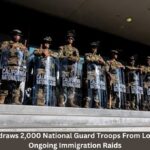
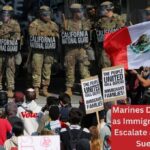
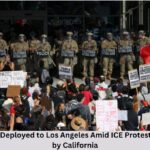
LOS ANGELES, CA — President Trumps Military Deployment in LA Sparks Outrage, Legal Battle Over Immigration Raids. What began as targeted immigration raids has escalated into a constitutional crisis as President Donald Trump’s aggressive enforcement tactics face legal and public backlash in California. The deployment of more than 4,000 National Guard troops and 700 U.S. Marines to Los Angeles authorized to detain civilians has ignited protests, lawsuits, and a fierce debate about the limits of presidential power in America.
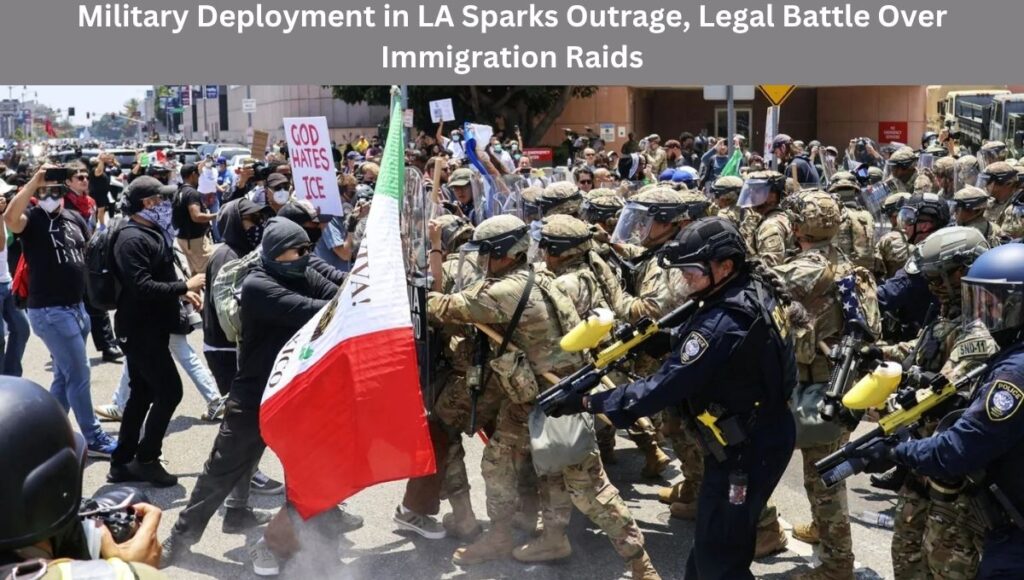
Military Deployment in LA Sparks Outrage, Legal Battle Over Immigration Raids
ICE Raids Spark Mass Protests Across Los Angeles
On June 6, Immigration and Customs Enforcement (ICE) launched a series of aggressive daylight raids in Los Angeles, targeting undocumented immigrants in public areas, workplaces, and homes. Over 120 individuals were detained. The raids triggered immediate protests that quickly grew from peaceful demonstrations into widespread unrest.
By June 10, over 400 protesters had been arrested, and clashes with law enforcement escalated. Tear gas, rubber bullets, and flash-bangs were used to disperse crowds, leaving scores injured. A curfew was imposed in downtown LA, and federal agents, including ICE and Homeland Security personnel, established a heavy presence alongside National Guard troops.
Trump Cites Title 10 to Justify Troop Deployment
President Trump defended his decision to deploy military forces by invoking Title 10, Section 12406 of the U.S. Code, which allows the president to federalize National Guard units in times of rebellion. He argued that the unrest in Los Angeles had crossed that threshold.
Speaking at Fort Bragg, Trump said, “If our troops didn’t go into Los Angeles, it would be burning to the ground right now.” He has also hinted at invoking the Insurrection Act, a rarely used law that allows domestic military deployment without state approval.
California Pushes Back: Newsom Files Lawsuit
California Governor Gavin Newsom and Attorney General Rob Bonta filed a federal lawsuit challenging Trump’s deployment, calling it an “unlawful abuse of power.”
The suit argues that Trump bypassed the state government by going directly to California’s Adjutant General and that none of the legal justifications for federalizing the National Guard have been met.
“Donald Trump is reckless. He’s immoral,” Newsom said. “They never coordinated with the governor of the state.”
A federal court in San Francisco is scheduled to hear California’s request for a temporary restraining order to block the deployment.
Legal Concerns Over Posse Comitatus and Civilian Detentions
The controversy centers around the Posse Comitatus Act of 1878, which prohibits the use of the U.S. military in domestic law enforcement. While National Guard units can assist federal agencies when under state command, their ability to arrest or detain civilians is highly restricted.
Major General Scott Sherman shocked many by confirming that Marines and Guard units were authorized to detain individuals until police arrive. Legal experts and local officials, including LA County Sheriff Robert Luna, questioned whether such actions are constitutional.
“My understanding is that they do not have powers to arrest or detain,” Luna stated during a press conference.
Mayor Bass and California Mayors Condemn Federal Overreach
Los Angeles Mayor Karen Bass, joined by more than 30 California mayors, publicly condemned the federal government’s handling of the situation. She declared a local emergency and curfew, arguing that the military presence is only inflaming tensions.
“The National Guard didn’t even arrive until Sunday. They’re not even doing crowd control,” Bass said. “What are the Marines going to do? That’s a good question.”
Arturo Flores, the Mayor of Huntington Park and a former Marine, issued a passionate statement: “These communities are not the enemy. Whether documented or not, they are Americans.”
Protests Spread Nationwide, with Global Echoes
What started in Los Angeles has now spread across the country. Protests erupted in New York, Atlanta, Chicago, San Francisco, Austin, and Philadelphia. Even Mexico City saw demonstrators gather outside the U.S. Embassy in solidarity.
In Austin, 13 protesters were arrested and four officers injured. San Francisco reported over 150 arrests. Washington, D.C. saw union leaders and lawmakers join demonstrators in a symbolic challenge to Trump’s immigration crackdown.
Military Parade and Massive Protests Scheduled
Coinciding with President Trump’s 79th birthday and a planned military parade in Washington D.C., more than 1,800 anti-Trump protests are scheduled nationwide this Saturday. Protesters aim to highlight concerns over civil rights, military overreach, and immigrant protections.
Trump’s Press Secretary Karoline Leavitt defended the administration, claiming state officials were “using a violent mob as a weapon” to interfere with law enforcement. “This is not America under mob rule,” Trump echoed on Truth Social.
$134 Million and Counting: The Cost of Military Deployment
According to the Pentagon, the military deployment in Los Angeles has already cost U.S. taxpayers over $134 million. Defense Secretary Pete Hegseth confirmed that at least 500 troops have been trained to assist ICE, a first in domestic operations, and one that blurs the line between civilian and military roles.
Critics argue that this establishes a dangerous precedent for military involvement in civil enforcement—a move that could reshape American democracy if left unchecked.
The Legal and Constitutional Stakes
This confrontation between state rights and federal authority is now being closely watched by legal scholars, lawmakers, and civil rights advocates. The core questions Can the president deploy troops without a governor’s consent? Can military personnel detain civilians? will likely be decided in the courts.
Military legal scholars warn that the Trump administration’s interpretation of the law could undermine the delicate federal-state balance enshrined in the U.S. Constitution.
Conclusion: A Flashpoint for Democracy
The crisis in Los Angeles has become a microcosm of broader national issues immigration, executive power, and civil liberties. Whether the courts side with California or uphold Trump’s interpretation of Title 10 and the Insurrection Act, the outcome will have lasting implications for the balance of power in the United States.
For now, LA remains under curfew, the military remains in place, and the eyes of the nation are fixed on the unfolding legal and political battle that could reshape the future of American democracy.
Also Read: Trump Vows to “Liberate” Los Angeles Amid Troop Deployment and Protests
Also Read: LA deployments to cost $134 million and last 60 days, Pentagon says