In a pivotal development US-China Trade Talks Yield Fragile Framework Agreement: Markets Watch Cautiously. The United States and China have reached a preliminary trade framework following two days of intense negotiations in London. While officials from both nations praised the outcome as a step forward, skepticism remains high regarding the framework’s durability and effectiveness. Final approval from Presidents Donald Trump and Xi Jinping remains pending, making this agreement more of a symbolic gesture than a policy breakthrough for now.
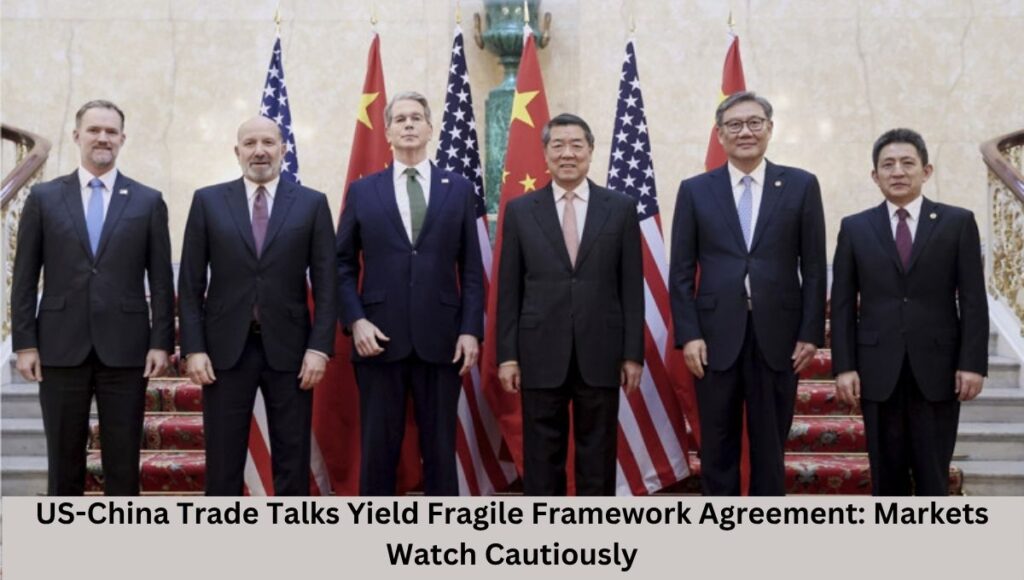
US-China Trade Talks Yield Fragile Framework Agreement: Markets Watch Cautiously
Markets React with Guarded Optimism
The news of a US-China trade framework brought a mixed response across global markets. US stock indexes such as the S&P 500 and Nasdaq futures dipped modestly by 0.2%, reflecting investors’ concerns over the lack of concrete details.
The dollar edged slightly higher to 145.05 yen, while the euro slipped to $1.1422.
Asian markets were more optimistic. MSCI’s broad Asia-Pacific index (excluding Japan) rose by 0.6%, Hong Kong’s Hang Seng climbed 1%, and China’s CSI 300 index increased by 0.8%. In Europe, the STOXX 600 gained a modest 0.14%.
While enthusiasm was muted, the market response shows that investors are hopeful—but not convinced—that the US-China trade war might be cooling.
What Was Agreed in London?
According to US Commerce Secretary Howard Lutnick, negotiators have agreed “in principle” to a framework that will implement previously discussed trade commitments from the Geneva summit and a recent Trump-Xi phone call.
The core of this framework revolves around mutual concessions on export controls and rare earth minerals resources crucial to modern technology and defense.
China will reportedly ease restrictions on rare earth exports, while the US is expected to roll back some sanctions, including limits on chip design software and possible visa bans on Chinese students.
Lutnick emphasized that “restrictions on rare earths and magnets will be resolved,” though no specific timelines or volumes were disclosed.
Rare Earth Minerals and Export Controls Take Center Stage
The talks in London revealed that rare earth minerals and export controls have become the focal point of the US-China economic rivalry.
China, the dominant global supplier of rare earths, imposed licensing restrictions in April that led to a 34.5% drop in exports to the US in May.
These restrictions disrupted key global supply chains, especially for sectors like electric vehicles, semiconductors, and defense systems.
In retaliation, the US expanded its export bans on semiconductors and AI technologies, further tightening the grip on China’s access to critical technologies.
This back-and-forth reflects how economic policy is increasingly tied to national security on both sides.
Huawei’s Comeback and Semiconductor Showdown
Adding to the complexity of the US-China tech rivalry is the surprising resurgence of Huawei. In 2023, the Chinese telecom giant launched its Mate 60 smartphone using high-performance chips, despite US restrictions aimed at crippling its semiconductor supply.
Huawei founder Ren Zhengfei acknowledged the company’s lag in chip tech but highlighted innovation through chip stacking and clustering.
“The US has exaggerated Huawei’s capabilities. We’re not that advanced yet,” Ren said, underlining the firm’s resilience and strategic importance in this global tech standoff.
Tariffs: The Flashpoint That Sparked It All
The broader US-China trade conflict began with President Trump’s global tariff imposition, to which China responded with equally steep levies.
Currently, US tariffs on Chinese goods stand at 145%, while China has implemented 125% tariffs on American imports. Although the Geneva truce on May 12 temporarily halted further escalation, critical issues remain unresolved.
These include disagreements over Taiwan, the illegal fentanyl trade, and China’s state-driven economic model none of which were addressed in the London framework.
Presidential Approval: The Next Critical Step
Despite the cautious optimism, the trade framework still requires the approval of Trump and Xi. “We’re going to go back and see if Trump approves it,” Lutnick stated.
Chinese Vice Commerce Minister Li Chenggang echoed a similar sentiment, noting that the results would be reported to Beijing for top-level review.
While no follow-up meetings are scheduled yet, officials confirmed that communications remain open, and the goal is to stabilize economic relations going forward.
Diplomatic Tone: Professional, Not Personal
Vice Minister Li described the talks as “professional, rational, in-depth, and candid,” emphasizing that the outcome could help rebuild trust between the two superpowers. Maintaining “face,” or mianzi, remains critical for China, particularly when the deal must also be presented as a domestic win for Xi Jinping.
For the US, the focus is on achieving a diplomatic balance that allows Trump to appear strong on China while also addressing economic pressures at home.
Inflation, Debt, and Investor Anxiety
The London deal comes at a time of heightened sensitivity in the US economy. Investors are eyeing May’s consumer price index (CPI) data, which is expected to show a 0.2% rise in headline inflation and 0.3% in core inflation.
Any upside surprise could force the Federal Reserve to delay interest rate cuts, putting further strain on the economy.
Meanwhile, gold prices rose 0.6% to $3,345 an ounce, and Brent crude edged up to $66.96 per barrelsigns of cautious optimism, but not outright confidence.
Managing a Rivalry, Not Solving It
Experts caution that this trade framework should not be seen as a permanent fix. According to the Brookings Institution, both nations are simply managing their economic rivalry rather than resolving it.
“There are no winners or losers here,” said Steve Okun, CEO of AC Advisors. “Washington has economic leverage; Beijing has political endurance.” This balance of power creates a fragile truce, not a final settlement.
Conclusion: A Fragile But Valuable Progress
The US-China trade framework born out of the London talks is a tentative but significant step forward. It doesn’t resolve the deep-rooted structural tensions or geopolitical rivalries, but it opens the door to continued dialogue.
With both sides emphasizing diplomacy and mutual interest in de-escalation, even a fragile truce is better than continued escalation. As Secretary Lutnick put it, “We had to get the negativity out.”
The world will now wait to see if Trump and Xi approve the framework, and if this moment of cautious optimism can lead to sustained cooperation or merely delay the next round of confrontation.
Also Read: US-China Trade Talks Resume in London: High Stakes, Fragile Optimism
Also Read: Deal getting US-China trade truce back on track is done, Trump says
Related Posts:
- 5 Major Takeaways from the US Supreme Court's…

- 11 Explosive Revelations From Ted Cruz’s Leaked…

- 7 Heartbreaking Facts About Venezuela's Earthquake Disaster

- 9 Explosive Claims as Trump Says US Winning Iran War
- In 8 Moves, EU Targets China-Linked Refineries and…

- 7 Powerful Facts About Ayatollah Ali Khamenei’s…