The global economy waits with bated breath as US-China Trade Talks Resume in London: High Stakes, Fragile Optimism. The global spotlight is back on US-China relations as both countries prepare for a pivotal round of trade negotiations in London on June 9, 2025. The announcement by President Donald Trump has stirred cautious optimism in global markets, coming just one day after a rare and lengthy phone call with Chinese President Xi Jinping.
Trump stated on his Truth Social platform that the meeting “should go very well,” hinting at a renewed push to stabilize the world’s two largest economies amid months of rising tariff threats, export controls, and growing geopolitical unease.
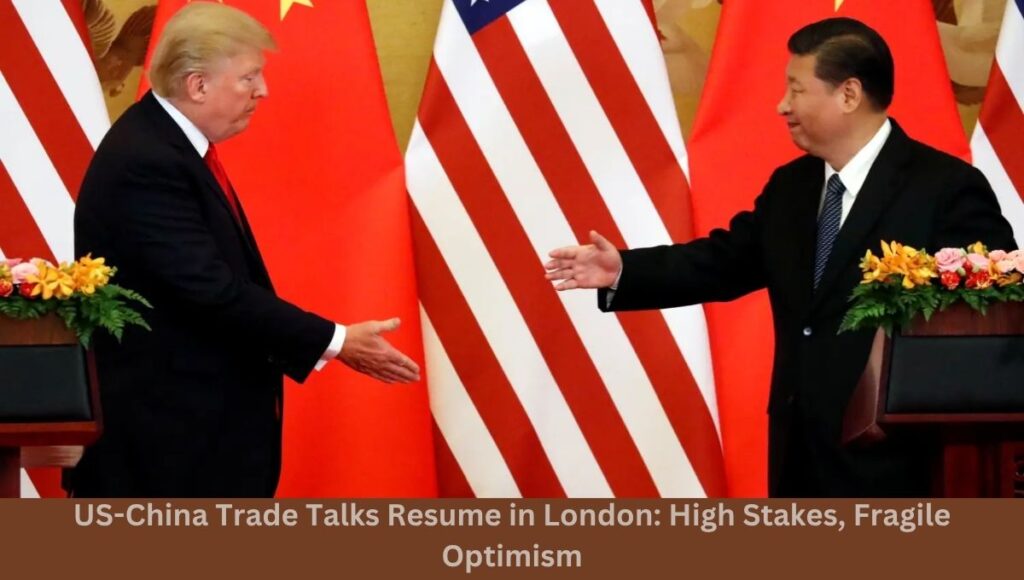
US-China Trade Talks Resume in London: High Stakes, Fragile Optimism
Top U.S. Officials to Lead Trade Delegation
According to the official announcement, the United States will be represented in London by Treasury Secretary Scott Bessent, Commerce Secretary Howard Lutnick, and U.S. Trade Representative Jamieson Greer. Their presence signals the White House’s commitment to finding common ground on thorny issues ranging from tariff disputes to technology transfer restrictions.
Observers noted that Commerce Secretary Lutnick’s inclusion likely means the talks will delve deeper into semiconductor export controls, an area where Washington maintains an advantage and has been ramping up restrictions.
Trump-Xi Phone Call Breaks Diplomatic Ice
The London trade talks follow a 90-minute phone call between Trump and Xi their first direct conversation since the May 12 Geneva truce. Trump described the exchange as “positive,” with both leaders agreeing to resume trade negotiations, encourage reciprocal visits, and instruct their teams to finalize details swiftly.
The Geneva deal saw both countries agreeing to roll back aggressive tariffs: the U.S. dropped its levies on Chinese goods from 145% to 30%, while China reduced its tariffs on U.S. products from 125% to 10%. However, unresolved issues, such as rare earth mineral exports, semiconductor controls, and Taiwan, still loom large.
Rare Earth Minerals: Strategic Leverage in Trade War
Among the most contentious issues heading into the June 9 talks is China’s tight control over rare earth minerals essential for electronics, defense systems, and green technologies. Despite its agreement in May to ease restrictions, Beijing has been slow-walking export approvals, prompting accusations from U.S. officials of non-compliance.
China, which dominates the global rare earth supply, views the resource as strategic leverage. “In principle, I can agree to export,” said Wu Xinbo of Fudan University, “but I can speed it up or slow it down depending on the political climate.”
Semiconductor and AI Chip Controls Deepen Divide
The U.S., in turn, has been tightening export controls on advanced semiconductors and chip-design software, sparking protests from Beijing. These moves have directly impacted China’s tech ambitions and were among the “discriminatory measures” criticized by China’s Commerce Ministry earlier this week.
The presence of Commerce Secretary Lutnick at the table is seen as an indicator that tech restrictions, particularly involving AI chips, chip-design tools, and national security concerns, will be front and center in London.
Taiwan and Visas: The Broader Geopolitical Context
While trade is the headline issue, the talks are unfolding against a backdrop of deeper geopolitical friction. During their recent phone call, Xi Jinping raised concerns over Taiwan, reiterating China’s firm position against any move toward Taiwanese independence.
Xi also confronted Trump over the revocation of thousands of student visas for Chinese nationals a policy Beijing views as discriminatory. In response, Trump struck a conciliatory tone, stating: “Chinese students are coming. No problem. It’s our honor to have them.”
Still, the divergence in priorities is clear. While Trump insists the discussion was “almost entirely about trade,” China’s official statement emphasized Taiwan and student visas as top concerns.
Markets React with Cautious Optimism
The news of renewed dialogue between the two economic giants triggered a modest relief rally across global markets. On Wall Street, the Dow Jones Industrial Average rose 0.15%, while the S&P 500 and Nasdaq experienced slight declines.
European and Asian indices followed suit, with the STOXX 600 up 0.16% and MSCI’s Asia-Pacific Index rising 0.82%. Commodity markets also responded.
Brent crude oil climbed 0.74% to $65.34 per barrel on hopes of economic stabilization, while gold dipped as risk sentiment improved marginally.
Supply Chain Disruptions Still Loom Large
Despite diplomatic momentum, supply chain vulnerabilities remain acute, particularly for sectors reliant on rare earths. Manufacturers in the U.S., Europe, and Asia continue to face bottlenecks, and there are fears that further delays or retaliatory measures could inflame the situation.
The U.S. arms sales to Taiwan, recently announced, could further complicate talks, given China’s sensitivities around the issue.
Strategic Stakes Beyond Tariffs
This week’s talks may focus on trade, but analysts say the stakes go far beyond tariffs. Technology dominance, military alignment, and strategic autonomy are all influencing the negotiations behind closed doors.
“This isn’t just about soybeans and iPhones,” said Yun Sun of the Stimson Center. “It’s about national power, control of future tech, and global influence.”
Looking Ahead: A Fragile Trade Truce
While the June 9 trade talks in London represent a significant diplomatic opening, the fragility of the US-China relationship remains unchanged. One wrong move on either side could unravel the tentative progress made so far.
As investors, manufacturers, and global leaders watch closely, the question remains: Can the world’s two largest economies find a path to cooperation amid deep strategic rivalry?
Conclusion: Hopes High, Expectations Measured
The return to the negotiating table marks a hopeful turning point in the ongoing US-China trade saga. But with fundamental disagreements still unresolved, optimism must be tempered with realism. The London trade talks offer a crucial test of whether diplomacy can succeed where confrontation has failed. For now, the global economy waits with bated breath.
Also Read: Markets Rise as Trump-Xi Phone Call Sparks Fresh Hopes for US-China Trade Deal
Also Read: US-China Trade Talks Go On For Second Day: Here’s What’s At Stake
Related Posts:
- 10 Big Takeaways from Trump’s 155% Tariff Warning to China

- Trump’s 2025 Gaza Peace Plan Signing and Historic…

- Trump to Host 2026 G20 Summit at His Florida Golf…

- 7 Crucial Insights Into Trump and Xi’s High-Stakes…
- What’s Next for Donald Trump After Court Rules His…
- 10 Powerful Revelations from the Trump–Putin Call on…