
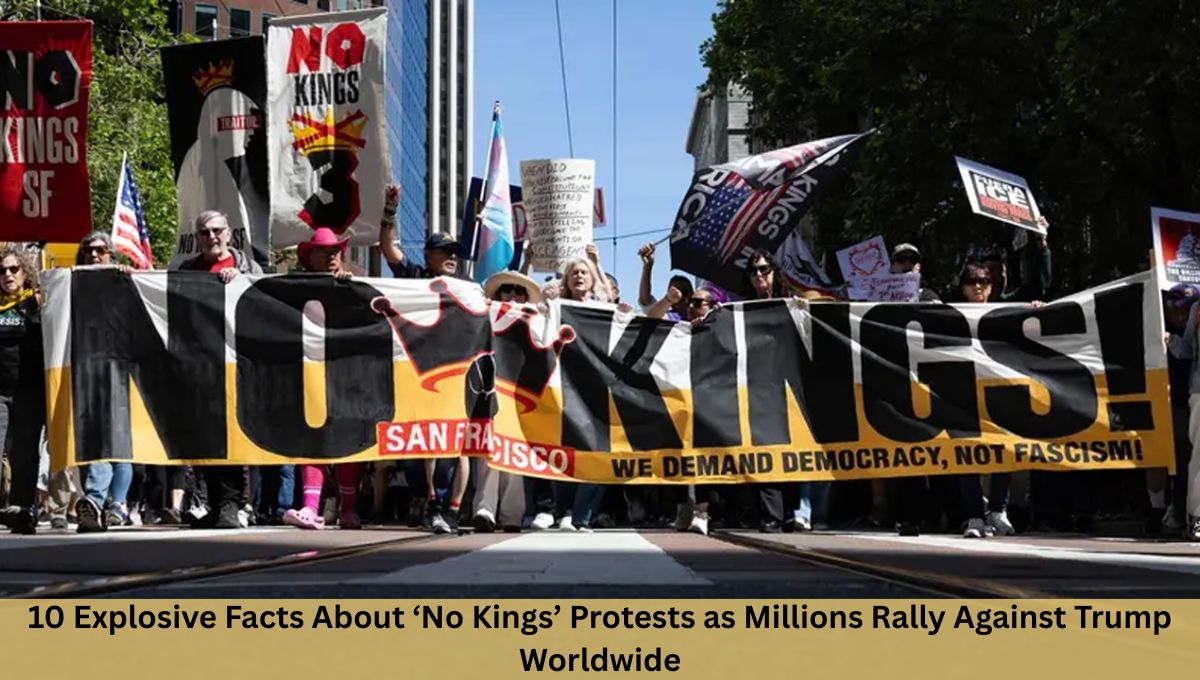
10 Explosive Facts About ‘No Kings’ Protests as Millions Rally Against Trump Worldwide — A global uprising. Millions of people flooded streets across the United States and multiple countries on March 28–29, 2026, in what is being described as one of the largest coordinated protest movements in recent history.
Branded as the “No Kings” rallies, the demonstrations were aimed at opposing President Donald Trump’s policies, particularly his administration’s aggressive immigration enforcement and the ongoing war in Iran.
From major metropolitan hubs to small rural towns, the protests reflected a wide and diverse coalition of dissent.
With events held in all 50 U.S. states and more than a dozen countries, the movement underscored a growing global reaction to American domestic and foreign policy decisions.
10 Explosive Facts About ‘No Kings’ Protests as Millions Rally Against Trump Worldwide
What Are the ‘No Kings’ Protests?
The “No Kings” movement is a decentralized protest initiative that began in 2025, shortly after Donald Trump’s return to the presidency.
The phrase itself symbolizes opposition to authoritarianism and the idea that no leader should wield unchecked power.
The protests are rooted in multiple concerns:
- The U.S. military involvement in Iran
- Immigration enforcement policies
- Civil liberties and democratic norms
- Economic inequality
- Transgender rights and social justice issues
Organizers describe the movement as a defense of democracy and a rejection of what they call “authoritarian tendencies.”
Minnesota: The Heart of the Movement
Flagship Rally Draws Massive Crowds
Minnesota emerged as the epicenter of the protests, hosting the flagship event at the State Capitol in St. Paul.
Thousands of demonstrators packed the Capitol lawn and surrounding streets, creating a powerful visual of unity and resistance.
Organizers estimated that up to 200,000 people attended the Minnesota rally alone, making it one of the largest single gatherings of the movement.
Symbolism and Emotion
The Minnesota protests carried deep emotional weight due to recent events in the state.
Demonstrators paid tribute to two individuals—Renee Good and Alex Pretti—who were killed by federal agents during immigration enforcement operations earlier in the year.
Their deaths became a rallying point, symbolizing broader concerns about the use of force and government overreach.
Protest signs, speeches, and performances consistently referenced these incidents, reinforcing the message that the movement is rooted in real human consequences.
Music, Celebrities, and Political Voices
A Cultural and Political Convergence
The Minnesota rally featured a powerful lineup of artists, actors, and political figures, blending entertainment with activism.
Musician Bruce Springsteen headlined the event, performing his song “Streets of Minneapolis,” which he wrote in response to the shootings.
The performance became one of the defining moments of the protests, drawing emotional reactions from the crowd.
Other notable figures included:
- Actor Robert De Niro
- Singer Joan Baez
- Actor Jane Fonda
- Senator Bernie Sanders
Their presence added visibility and credibility to the movement, amplifying its message to a global audience.
Nationwide Participation: From Cities to Small Towns
A Truly National Movement
One of the most striking aspects of the “No Kings” protests was their geographic reach.
Demonstrations were held:
- In major cities like New York, Los Angeles, and Washington, D.C.
- In smaller towns such as Driggs, Idaho, with fewer than 2,000 residents
Organizers reported over 3,100 events across all 50 states, with participation estimated to reach up to 9 million people—though final numbers remain unconfirmed.
Rural America Joins In
Interestingly, two-thirds of participants reportedly came from outside major urban centers.
This suggests that dissatisfaction with current policies is not confined to traditionally liberal cities but extends into suburban and rural areas.
Key Issues Driving the Protests
1. The War in Iran
The ongoing conflict involving the United States and Iran has been a major catalyst for the protests. Many demonstrators criticized the war as unnecessary, costly, and dangerous.
Signs and chants frequently called for:
- An immediate ceasefire
- Reduced military spending
- A shift toward diplomacy
2. Immigration Enforcement
The Trump administration’s intensified immigration crackdown, particularly in Minnesota, has drawn widespread criticism.
Protesters raised concerns about:
- Deportation raids
- Civil rights violations
- The role of federal agencies in local communities
3. Civil Liberties and Democracy
Many participants framed the protests as a defense of democratic values. Slogans such as “No kings” and “Regime change begins at home” reflected fears of authoritarian governance.
4. Social and Economic Issues
Other grievances included:
- Rising living costs
- Healthcare access
- LGBTQ+ rights
- Wealth inequality
Scenes from Across the United States
Washington, D.C.
Hundreds marched from the Lincoln Memorial to the National Mall, chanting slogans and carrying signs mocking political leadership.
The atmosphere combined protest with performance, including satirical elements aimed at criticizing authority.
New York City
Tens of thousands gathered across Manhattan and other boroughs.
Protesters carried diverse flags and banners, reflecting a wide coalition of causes—from anti-war activism to LGBTQ+ rights.
San Diego
Local authorities estimated around 40,000 participants. The protest remained largely peaceful, though tensions were reported in some areas.
Chicago and Dallas
Crowds gathered in major public spaces, with speeches focusing on labor rights, immigration, and social justice.
In some cities, minor clashes occurred between protesters and counter-protesters.
International Protests: A Global Response
The “No Kings” movement extended far beyond U.S. borders, with demonstrations taking place in Europe, Latin America, and Australia.
Europe Takes a Stand
- Rome: Thousands marched, criticizing both U.S. policies and domestic political issues.
- London: Protesters carried anti-war and anti-racism messages.
- Paris: Hundreds gathered at the Bastille, including expatriates and local activists.
These international rallies highlighted the global implications of U.S. political decisions, particularly regarding military actions.
Political Reactions: Sharp Divisions
White House Response
Officials dismissed the protests as politically motivated and lacking genuine public support.
Statements characterized the demonstrations as being driven by organized networks rather than grassroots sentiment.
Republican Criticism
Republican leaders and organizations strongly criticized the rallies, describing them as extreme and unrepresentative.
Protesters Push Back
Participants rejected these claims, arguing that the sheer scale and diversity of the protests demonstrate widespread concern across the population.
A Movement Growing in Scale
The March 2026 protests marked the third major “No Kings” mobilization.
Previous events:
- June 2025: Over 5 million participants
- October 2025: Around 7 million participants
The steady increase suggests growing momentum and sustained engagement.
Organizers believe the movement could become a defining force leading up to the upcoming U.S. midterm elections.
Peaceful Protest and Isolated Clashes
While the majority of demonstrations were peaceful, some incidents of unrest were reported:
- Tear gas deployed in parts of Los Angeles
- Arrests in Dallas and other cities
- Minor confrontations with counter-protesters
Organizers emphasized nonviolence, implementing de-escalation strategies and guidelines for participants.
The Role of Symbolism and Messaging
The protests were marked by creative and symbolic expressions:
- Upside-down U.S. flags representing distress
- Satirical costumes mocking political figures
- Signs with slogans like “Put down the crown, clown”
These elements helped communicate complex political messages in accessible and impactful ways.
Looking Ahead: What Comes Next?
Organizers stress that the “No Kings” protests are not a one-time event but part of a broader movement aimed at long-term change.
Key future goals include:
- Expanding grassroots organizing
- Influencing upcoming elections
- Continuing public demonstrations
- Building coalitions across political and social groups
Conclusion: A Defining Moment of Public Dissent
The “No Kings” protests represent a significant moment in contemporary political history.
With millions participating across continents, the movement reflects deep divisions, strong opinions, and a heightened level of civic engagement.
Whether viewed as a powerful democratic expression or a polarizing political statement, one thing is clear:
the scale and intensity of these protests have captured global attention.
As the political landscape continues to evolve, the impact of the “No Kings” movement will likely shape public discourse and policy debates in the months ahead.
Also Read: “No Kings” Protests Rock Nation as Trump Celebrates Military Parade and Birthday
Also Read: No Kings protests across the world: in pictures
Related Posts:
- 10 Million March: ‘No Kings’ Protests Sweep Across U.S.
- Thousands Join Anti-Immigration Rallies Across…

- “No Kings” Protests Rock Nation as Trump Celebrates…
- 5 Powerful Highlights as Trump Lands Second Nobel…

- 11 Explosive Revelations From Ted Cruz’s Leaked…

- Trump’s 2025 Gaza Peace Plan Signing and Historic…
