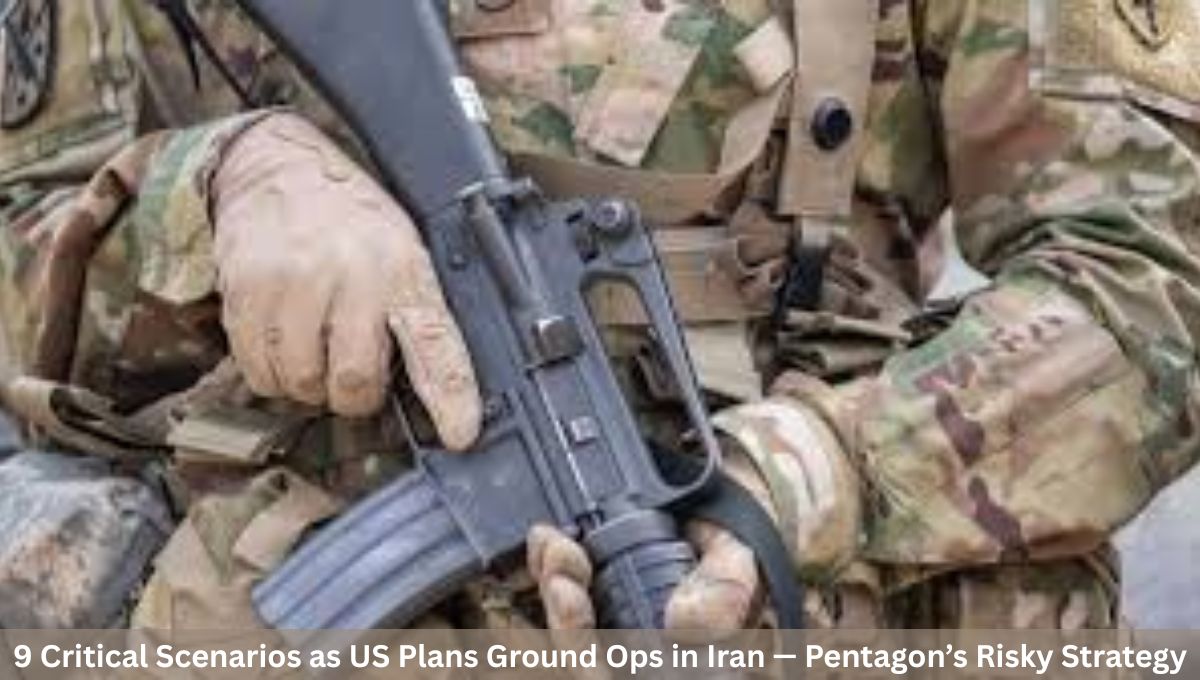
9 Critical Scenarios as US Plans Ground Ops in Iran — Pentagon’s Risky Strategy that could trigger major escalation. As the war involving Iran, the United States, and its allies intensifies, Washington appears to be approaching a critical inflection point. While airstrikes and naval operations have defined the conflict so far, new reports suggest that the Pentagon is actively preparing for the possibility of ground operations inside Iran.
These plans, however, do not resemble the large-scale invasions seen in Iraq or Afghanistan. Instead, they revolve around limited, high-impact missions—precision raids, targeted strikes, and short-term troop deployments designed to achieve strategic objectives without becoming entangled in a prolonged war.
The question now facing policymakers is both simple and profound:
can the United States achieve its goals without putting boots on the ground, or is escalation inevitable?
9 Critical Scenarios as US Plans Ground Ops in Iran — Pentagon’s Risky Strategy
Pentagon’s Evolving Strategy
From Air Campaign to Ground Contingencies
According to multiple reports, Pentagon officials have spent weeks developing operational scenarios that could be executed if the conflict escalates further.
These plans are not last-minute improvisations but carefully studied strategies that have been war-gamed and refined over time. The emphasis is on flexibility.
Military planners are crafting options that allow decision-makers—especially Donald Trump—to scale operations up or down depending on developments on the battlefield.
Not a Full-Scale Invasion
Officials have made it clear that the United States is not preparing for a full-scale invasion of Iran.
Instead, the focus is on:
- Short-duration operations
- Limited troop deployments
- Clearly defined objectives
- Rapid withdrawal after mission completion
This approach reflects lessons learned from past conflicts, where long-term occupations proved costly both militarily and politically.
What Ground Operations Could Look Like
Special Forces and Targeted Raids
One of the most likely scenarios involves the use of special operations forces supported by conventional infantry units.
These missions would focus on high-value targets, including:
- Iranian coastal military installations
- Missile and drone launch sites
- Infrastructure threatening global shipping routes
Such operations would prioritize speed, precision, and minimal exposure.
Timeline: Weeks, Not Years
Unlike traditional wars, these operations are expected to last:
- Weeks rather than months, according to some officials
- Possibly a couple of months in more complex scenarios
The objective is to deliver a decisive blow without becoming entangled in a prolonged conflict.
Kharg Island: The Strategic Prize
Why Kharg Island Matters
One of the most discussed targets is Kharg Island, a small but critically important island in the Persian Gulf.
This location is significant because:
- It handles around 85–90% of Iran’s oil exports
- It is central to Iran’s economic stability
- Disrupting it could create major leverage in negotiations
High Reward, High Risk
While capturing Kharg Island may seem strategically attractive, experts warn of serious risks:
- The island’s small size makes it vulnerable
- Iranian forces could launch sustained missile and drone attacks
- Holding the territory would be far more difficult than seizing it
Military analysts emphasize that such an operation could quickly turn into a dangerous and costly engagement.
Strait of Hormuz: The Bigger Battlefield
A Global Chokepoint Under Threat
Much of the Pentagon’s planning also revolves around the Strait of Hormuz, one of the most critical maritime routes in the world.
This narrow passage:
- Handles roughly 20% of global oil supply
- Is vital for global energy security
- Has already seen significant disruption
Coastal Raids and Maritime Security
Potential US operations may include:
- Strikes on Iranian coastal missile systems
- Destruction of naval assets threatening shipping
- Securing safe passage for commercial vessels
These actions aim to restore stability in global trade routes without escalating into full-scale war.
Military Build-Up Signals Intent
USS Tripoli and Marine Deployment
The arrival of the USS Tripoli (LHA-7) in the Middle East has intensified speculation about potential ground operations.
The deployment includes:
- Approximately 3,500 Marines and sailors
- Advanced aircraft such as F-35 jets
- Helicopters and Osprey transport aircraft
- Amphibious assault capabilities
This combination provides the US military with rapid-response options across land, sea, and air.
Largest Build-Up in Years
The current deployment represents one of the largest US military buildups in the region in over two decades.
Additional forces, including elements of the 82nd Airborne Division, are also reportedly on standby, further underscoring the seriousness of the situation.
Conflicting Signals from Washington
Public Messaging vs Military Reality
Despite the military preparations, official statements from Washington have been cautious and, at times, contradictory.
Marco Rubio has stated that US objectives can be achieved without ground troops, emphasizing a preference for limited engagement.
At the same time, White House officials have warned of severe consequences if Iran does not comply with US demands.
“Maximum Optionality” Strategy
The administration’s approach appears to be focused on maintaining “maximum optionality”—keeping all military options on the table while avoiding a firm commitment.
This allows flexibility but also creates uncertainty for allies, adversaries, and global markets.
Operational Risks and Challenges
Threat Environment for US Forces
Any ground operation in Iran would expose US troops to significant dangers, including:
- Drone attacks
- Ballistic missile strikes
- Ground combat engagements
- Improvised explosive devices (IEDs)
Iran has demonstrated its capability to strike US positions across the region, making any deployment inherently risky.
Rising Casualties Already
Even without a ground invasion, the conflict has already resulted in:
- Hundreds of US personnel wounded
- Multiple fatalities across the region
- Increased attacks on US bases
These incidents highlight the potential cost of further escalation.
Iran’s Defensive Advantage
Geography and Preparedness
Iran’s geography provides a natural defensive advantage:
- Mountainous terrain
- Strategic islands controlling sea routes
- Established missile and drone networks
In particular, Iran’s network of islands in the Persian Gulf acts as a defensive shield, complicating any US military operation.
Warnings from Tehran
Iran has issued stark warnings against any ground invasion, signaling that US troops entering its territory would face severe consequences.
Such rhetoric reflects both deterrence strategy and readiness for escalation.
Global Implications
Energy Markets on Edge
Any escalation involving ground operations could further disrupt global energy markets.
Potential consequences include:
- Sharp increases in oil prices
- Supply shortages
- Economic instability in energy-dependent countries
Risk of Broader Conflict
There is also concern that a US ground operation could trigger wider regional involvement, including:
- Iran-aligned militias
- Regional powers
- Global geopolitical actors
This could transform the conflict into a broader international crisis.
Possible Scenarios Ahead
1. Limited Special Operations
- Targeted raids achieve strategic objectives
- Minimal long-term troop presence
2. Escalation to Sustained Conflict
- Increased troop deployment
- Prolonged military engagement
3. Strategic Deterrence Success
- Military pressure forces negotiations
- Conflict de-escalates
4. Regional Spillover
- Multiple countries drawn into conflict
- Global economic consequences intensify
Conclusion: A Delicate Balance
The Pentagon’s planning for ground operations in Iran reflects a careful balancing act between military readiness and political caution.
While the United States is not preparing for a full-scale invasion, the possibility of limited ground engagement signals a significant escalation in the conflict.
With strategic targets like Kharg Island and the Strait of Hormuz at the center of planning, the stakes extend far beyond the battlefield.
The outcome of these deliberations will not only shape the future of the war but also have lasting implications for global security, energy markets, and international stability.
As decisions loom in Washington, the world watches closely—aware that even limited actions could have far-reaching consequences.
Also Read: 9 Explosive Risks as US Eyes Kharg Island and Iran Builds Deadly Defences
Also Read: Pentagon readies ‘for weeks of US ground operations’ in Iran
Related Posts:
- 3 Explosive Conditions Iran Sets to End War with US…

- 7 Powerful Facts About Ayatollah Ali Khamenei’s…

- Afghanistan–Pakistan War 2025: Inside the 48-Hour Ceasefire

- 9 Explosive Claims as Trump Says US Winning Iran War

- 5 Major Takeaways from the US Supreme Court's…

- 10 Explosive Warnings as Donald Trump Calls Iran…